WSRC-TR-2000-00158
Stripping of Tributylphosphate (TBP) with Steam during Evaporation
R. A. Pierce
Westinghouse Savannah River Company
Aiken, SC 29808
This report was prepared as an account of work sponsored by an agency of the United States Government. Neither the United States Government nor any agency thereof, nor any of their employees, makes any warranty, express or implied, or assumes any legal liability or responsibility for the accuracy, completeness, or usefulness of any information, apparatus, product or process disclosed, or represents that its use would not infringe privately owned rights. Reference herein to any specific commercial product, process or service by trade name, trademark, manufacturer, or otherwise does not necessarily constitute or imply its endorsement, recommendation, or favoring by the United States Government or any agency thereof. The views and opinions of authors expressed herein do not necessarily state or reflect those of the United States Government or any agency thereof.
This report has been reproduced directly from the best available copy.
Available for sale to the public, in paper, from: U.S. Department of Commerce, National Technical Information Service, 5285 Port Royal Road, Springfield, VA 22161, phone: (800) 553-6847, fax: (703) 605-6900, email: orders@ntis.fedworld.gov online ordering: http://www.ntis.gov/support/ordering.htm
Available electronically at http://www.osti.gov/bridge/
Available for a processing fee to U.S. Department of Energy and its contractors, in paper, from: U.S. Department of Energy, Office of Scientific and Technical Information, P.O. Box 62, Oak Ridge, TN 37831-0062, phone: (865 ) 576-8401, fax: (865) 576-5728, email: reports@adonis.osti.gov
Summary
The Savannah River Site H-Canyon generates aqueous solutions that must be disposed of in the tank farm. Due to a process outage, H-Canyon solutions must be re-routed from Tank 43 to a different waste tank, Tank 39. Unlike Tank 43, Tank 39 has more stringent controls on allowable organic concentrations due to flammability concerns. At issue is the need to show that the levels of organic materials sent to Tank 39 are low enough such that Tank 39 can be maintained as a non-organic tank. This presents a potential problem because, after being processed through solvent extraction and decanting, H-Canyon solutions are permitted to contain as much as 0.5% by volume of organic before going to the H-Canyon process evaporator.
It has always been understood that the tributylphosphate (TBP) and n-paraffin in the aqueous stream would be stripped to a large extent during evaporation. This has been demonstrated in the literature and verified in SRTC studies. However, current requirements for re-routing the H-Canyon waste solutions require a better characterization of the behavior of TBP during steam stripping in the evaporator.
Earlier SRTC tests demonstrated that steam stripping in the H-Canyon evaporator could effectively remove TBP and n-paraffin from solution prior to storage. For solutions with starting concentrations of 0-6 g/L uranium, as little as 25% by volume steam stripping could reduce TBP from 300 mg/L to 5 mg/L. Use of 100 volume % steam stripping could further reduce TBP levels to below 1 mg/L. Because the data contained significant uncertainty, it was necessary to conduct additional experiments to produce data with a higher level of technical confidence. The tests also evaluated evaporator performance between 10 and 25 volume percent steam stripping, a region of interest for determining operating requirements.
The follow-up testing produced TBP steam stripping data that were comparable to what was observed earlier. The differences between the data sets are not significant. A least squares analysis of all data produces a trendline that mirrors the initial steam stripping data obtained in February 1999. Therefore, SRTC recommends that the earlier data be used in establishing operating requirements for the H-Area evaporators. Use of that data set for predicting TBP behavior has the added benefits of 1) being most conservative within the range of interest (10-25 vol%), and 2) of being associated with experiments that contained uranium in contact with TBP.
Introduction
Prior to an outage of the 2H Evaporator, H-Canyon waste solutions were discharged to Tank 43. Tank 43 was allowed to receive organic components that might exist after being processed through the H-Canyon solvent extraction banks, decanters, and evaporators. The outage of the 2H Evaporator has forced H-Canyon to consider an alternate tank for disposing of its waste liquids. The tank being considered is Tank 39.
Unlike Tank 43, Tank 39 has more stringent controls on allowable organic concentrations due to flammability concerns. At issue is the need to show that the levels of organic materials sent to Tank 39 are low enough such that Tank 39 can still be maintained as a non-organic tank. If the waste stream exceeds the organic contribution to the CLFL (composite lower flammability limit) by more than 5%, then the full spectrum of organic controls must be applied. If this is required, the current Tank 39 liquid level is too high the permit any more additions.
Consequently, H-Canyon must demonstrate that the organic concentration in its waste streams is acceptably low. The primary concern is residual tributylphosphate (TBP) left over from solvent extraction. After leaving the solvent extraction banks, the solution is processed through the decanters to eliminate insoluble organic phases and then evaporated. Evaporation has been shown to be an effective means for removing TBP from the solution that is eventually discharged to the waste tanks.1-3
In 1999, SRTC performed a quick study to evaluate the amounts of TBP remaining in the evaporator bottoms following 10, 25, 50, 100, and 200 volume percent steam stripping.4 As the need arose to use the data to qualify the waste stream for disposal to Tank 39, so also arose the need to verify the data through extra experiments. Additionally, data points were added between 10 and 25 volume percent that would better support current NMS&S needs.
Experimental Description
Tests were conducted to observe the amount of TBP that is stripped as a function of volume of liquid stripped. The earlier set of tests, performed in 1999, involved placing 150 mL of a starting solution in the evaporator bottoms pot. The targeted concentrations for the starting solutions were 300 mg/L TBP, 40-50 mg/L DBP, 6 g/L uranium, and 0.5M HNO3. The condenser used on the evaporator was a typical laboratory condenser.
Next, the starting solution in the evaporator was heated to boiling. When condensate was observed collecting downstream of the condenser, water was continuously fed at 2.5 mL/min and evaporated at the same rate so that the volume of liquid in the evaporator bottom remained essentially constant. In the first test, 300 mL of water was fed and evaporated, or 200% of the starting volume. When feeding was complete, samples of the bottoms and overheads were taken and submitted for TBP analysis using gas chromatography. Subsequent tests added and evaporated water at 100%, 50%, 25%, and 10% of the initial volume.
The current set of experiments was performed using the H-Canyon evaporator model. The model employs three trays of bubble caps and an overheads condenser to provide process stages for more effective operation of the evaporator. The design of the evaporator simulates actual operations better than a simple laboratory condenser used in the 1999 experiments. Because uranium has been shown to have no measurable effect on TBP volatility,1 the test solution only contained 340 mg/L TBP and 0.5M HNO3.
The evaporator trays and overheads condenser were filled with water, and then air was pumped through the test unit to simulate bubbling due to evaporation. This caused some of the water on the trays to fall into the bottoms pot. The air was turned off and the bottoms were completely emptied. Next, 500 mL of 340 mg/L TBP in 0.5M HNO3 was placed in the bottoms pot. The heat was turned on along with the cooling water that feeds the overheads condenser. When condensate was observed in the overheads collection container, the feed pump that pumped water into the evaporator for steam stripping was turned on at approximately 5.5 mL/min. The feed rate was continuously regulated so that the volume of liquid fed would always approximate the volume collected as overheads.
Samples of the bottoms were pulled periodically to coincide with percent steam stripping levels of 10, 15, 20, 25, 50, and 100 percent. When a sample was pulled, a comparable volume of liquid was fed back into the evaporator to maintain a constant liquid volume. The liquid fed back into the pot was feed solution diluted with water such that its concentration was approximately 17 mg/L TBP in 0.025M HNO3. This prevents the data from having a low bias due to sampling. Samples of the liquids were submitted for TBP analysis by gas chromatography and phosphorus analysis by ICP-MS.
Test Results and Discussion
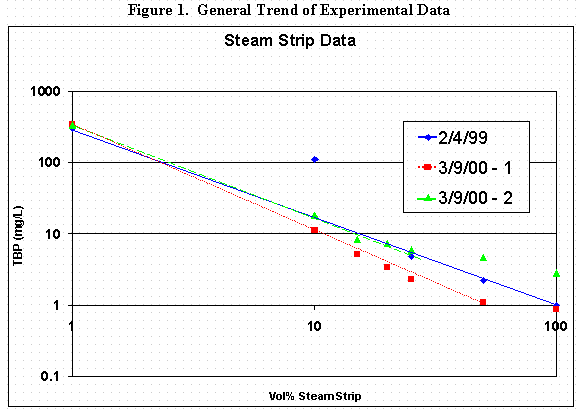
The current test results (3/9/00) confirm the data from earlier testing (2/4/99). All three tests demonstrate that TBP readily strips from solution in a similar manner (see Figure 1). As can be seen from Table 1, the bulk of the TBP is stripped with only 10-25% steam stripping, and nearly quantitative stripping can be obtained at 100%. Several data points do not appear to fit well with the general trends of Figure 1. The most notable deviation was on 2/4/99 at 10 volume percent (lightly shaded in Table 1). The rest of the data clearly depicts this point as inconsistent with the other results. It is presumed that this stems from either an analytical error or contamination of the sample. Two other points on 3/9/00 at 50% and 100% also show some deviation from what is predicted from the remainder of the data points. Fortunately, however, these two data points do not impact predictions within the range of interest (10-25 vol%).
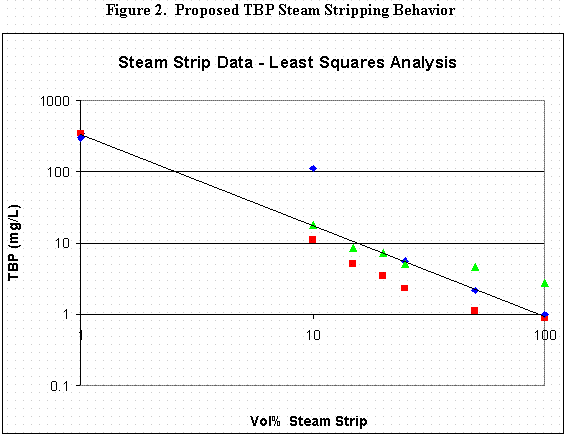
Because the data shows a high level of consistency, TBP behavior as a function of volume percent steam stripping can be confidently predicted. A least squares analysis of all data points was performed and plotted in Figure 2. The least squares analysis of the data produces a trendline that passes through all of the 2/4/99 data points, with the exception of the 10 vol% data point. Using the trendline, TBP behavior was predicted for the conditions studied. The proposed behavior is listed in the last column of Table 1.
The use of proposed data that mirrors the 2/4/99 experiment provides two additional benefits. First, of the three data sets, it is the most conservative within the range of interest (10-25 vol%). Second, the data set, excluding the point at 10 vol%, is associated with experiments containing TBP in solution with uranium in the evaporator bottoms.
Table 1. Steam Stripping of TBP
|
TBP – Evaporator Bottoms (mg/L) |
||||
|
Volume % Steam Strip |
2/4/99 |
3/9/00 |
3/9/00 |
Proposed
|
|
200 |
< 1.0 |
-- |
-- |
-- |
|
100 |
< 1.0 |
0.87 |
2.8 |
1.0 |
|
50 |
2.2 |
1.1 |
4.6 |
2.2 |
|
25 |
5.1 |
2.3 |
5.5 |
5.5 |
|
20 |
-- |
3.4 |
7.2 |
7.0 |
|
15 |
-- |
5.1 |
8.5 |
10 |
|
10 |
110 |
11 |
18 |
17 |
|
0 |
300 |
340 |
340 |
340 |
Conclusions
Steam stripping in the H-Canyon evaporators can be effectively used to remove TBP from enriched uranium solutions. Two sets of experiments were conducted without uranium, and the data confirm earlier results that were obtained with uranium present. As little as 10% by volume steam stripping can reduce TBP from 340 mg/L to below 20 mg/L, and 25% by volume can reduce TBP levels to 5 mg/L.
A least squares analysis of all data produces a trendline that mirrors the initial steam stripping data. Use of that data set for predicting TBP behavior has the added benefits of 1) being most conservative within the range of interest (10-25 vol%), and of being associated with experiments that contained uranium in contact with TBP. The general agreement between all three data sets indicates a high level of certainty associated with the data.
References