WSRC-MS-99-00944
Deflagration Transient Study of the CIF Incinerator
Thong Hang
Westinghouse Savannah River Company
Savannah River Technology Center
Aiken, SC 29808
This report was prepared as an account of work sponsored by an agency of the United States Government. Neither the United States Government nor any agency thereof, nor any of their employees, makes any warranty, express or implied, or assumes any legal liability or responsibility for the accuracy, completeness, or usefulness of any information, apparatus, product or process disclosed, or represents that its use would not infringe privately owned rights. Reference herein to any specific commercial product, process or service by trade name, trademark, manufacturer, or otherwise does not necessarily constitute or imply its endorsement, recommendation, or favoring by the United States Government or any agency thereof. The views and opinions of authors expressed herein do not necessarily state or reflect those of the United States Government or any agency thereof.
This report has been reproduced directly from the best available copy.
Available for sale to the public, in paper, from: U.S. Department of Commerce, National Technical Information Service, 5285 Port Royal Road, Springfield, VA 22161, phone: (800) 553-6847, fax: (703) 605-6900, email: orders@ntis.fedworld.gov online ordering: http://www.ntis.gov/support/ordering.htm
Available electronically at http://www.osti.gov/bridge/
Available for a processing fee to U.S. Department of Energy and its contractors, in paper, from: U.S. Department of Energy, Office of Scientific and Technical Information, P.O. Box 62, Oak Ridge, TN 37831-0062, phone: (865 ) 576-8401, fax: (865) 576-5728, email: reports@adonis.osti.gov
Key Words: Environmental Science, Process-Oriented, Risk Analysis.Abstract
The Consolidated Incineration Facility (CIF) treats solid and liquid RCRA hazardous and mixed wastes generated at the Savannah River Site (SRS). The transient responses of the CIF system to a deflagration, caused by an accidental charge of a modest quantity of solvent (e.g. toluene) into the rotary kiln, were a major safety concern. Using a dynamic computer model, a study was conducted to analyze the transient system responses to the rapid temperature and pressure surge in the kiln. The objective of the study was to determined the maximum pressure, temperature, and gas flow rate in each CIF component (rotary kiln, secondary combustion chamber, quencher, scrubber/cyclone, mist eliminator, reheaters, HEPAs, and ID fans). The resulting data provided a basis for the subsequent structural analysis. This paper will describe the CIF deflagration study in some detail, and present the results of the simulation scenarios.
Process Description
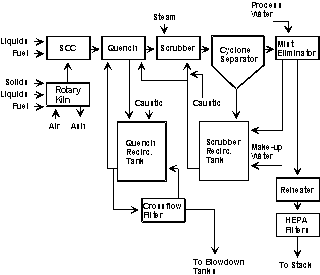
The CIF was designed for treatment of liquid and solid low-level radioactive, mixed and RCRA hazardous wastes. Figure 1 shows a schematic CIF process flow diagram. The incineration system consists of a 13-million Btu rotary kiln (RK) and a 5-million Btu secondary combustion chamber (SCC) to treat both solid and liquid combustible wastes. Normal operating temperatures are 1832° F in the rotary kiln, and 2012° F in the SCC. Maximum solids retention time in the RK is 90 minutes. A 2-second offgas residence time is required in the SCC. No. 2 fuel oil burners are used in the RK/SCC for startup, shutdown, idling and temperature control.
Figure 1. CIF Flow Diagram
A wet offgas system was selected for air emission control. SCC offgas is cooled to saturation in a liquid-recirculating quench. Particulates and acid gases in the quench offgas are removed by a steam-atomized scrubber. The liquid/gas separation of the scrubbing mixture takes place in a cyclone separator. A mist eliminator removes entrained water droplets. Saturated scrubber offgas is reheated, and filtered through HEPAs prior to atmospheric discharge.
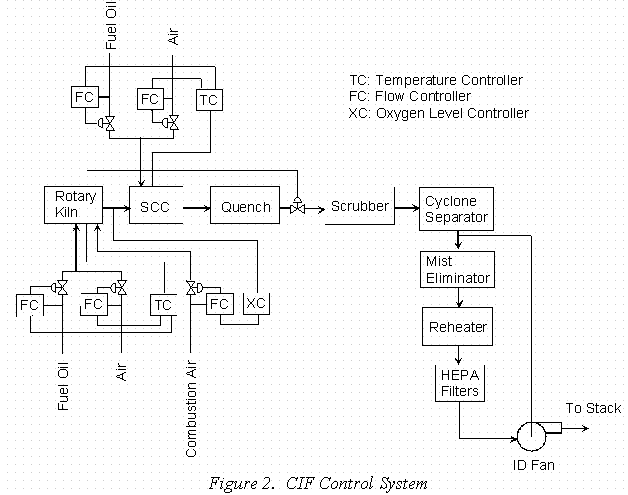
The two principal variables to be controlled in the CIF system are temperature and pressure. Temperatures are monitored at the exit of the rotary kiln, the SCC, and the reheater. Pressures are measured at the kiln exit and the mist eliminator inlet. Additionally, the oxygen level in the rotary kiln flue gas is also subject to control in order to maintain the design excess air required for combustion. Figure 2 shows a schematic diagram of the CIF control system.
The CIF began operation in 1995. To support CIF startup and operation, the Savannah River Technology Center (SRTC) designed an extensive test program which included metals partioning (Burns et al., 1994), offgas testing, and RK seal testing.
In complement of the test program, mathematical modeling was utilized to simulate various aspects of the incineration process: flow pattern, heat transfer, dynamic responses to fluctuations in the feed or upsets in the system equipment. This paper focuses on the modeling study of deflagration.
Deflagration Study
During normal CIF operation, a small quantity of flammable solvents (e.g. toluene) may pass X-ray inspection undetected and be accidentally charged to the rotary kiln through the solids ram feeder system. The worst case results from the solvent being contained in a metal container. The kiln high heat release superheats the liquid solvent causing pressurization of the container until it ruptures to rapidly release the content. The dispersed flammable vapors could cause rapid deflagration of all the oxygen present, which would increase the kiln temperature and pressure to a value approaching the adiabatic isochoric complete combustion (AICC) temperature and pressure for a stoichiometric mixture.
Deflagration is a major concern to CIF. An assessment of the system transient responses to deflagration would be essential to address the problem. The objective of this study is to determine the maximum pressure, temperature, and gas flowrate in each component (kiln, SCC, quencher, scrubber/cyclone, mist eliminator, reheaters, HEPAs, and ID fans). The data provide a basis for the structural analysis.
Methodology
The transient responses of the CIF system to deflagration were analyzed using an existing CIF dynamic computer model. Model development and simulation results of the CIF process dynamics were presented elsewhere (Hang 1992). In this study, the model was modified to add the following features:

rate: Energy rate (Btu/hr)
TK: Kiln operating temperature (°
R)
flow = 3600 Cd Avent Gvent
Gvent = 7.7 (D P)0.5flow: Vent outlet flow rate (lbs/hr)
Cd: Vent discharge coefficient (= 0.5)
Avent: Vent area (ft2)
Gvent: Mass discharge rate (lbs/ft2-sec)
D P: Pressure difference [Kiln pressure–atmospheric pressure] (psi)
Results
Five scenarios were selected for the deflagration simulation to cover a wide range of the CIF operations:
Scenarios 1 and 2 cover the entire range of the kiln operating temperatures. Scenarios 3 and 4 provide the worst scenarios for upstream components, in which the deflagration causes the 30" damper completely closed. That would significantly reduce the gas flow to the offgas components downstream of the quench and therefore would require a longer time to get the rotary kiln back to the normal operating condition. Scenario 5 conservatively estimates the effect of deflagration on the offgas components downstream of the scrubber/cyclone, when the ID fans failed to control the offgas properly. The quench recirculation rate was assumed at its low flow alarm value of 150,000 lbs/hr.
In each scenario the simulation was carried out in two stages:
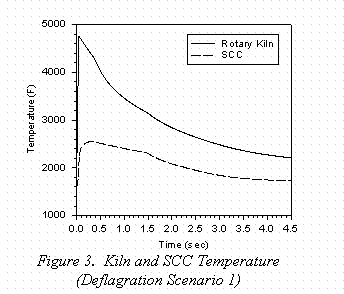
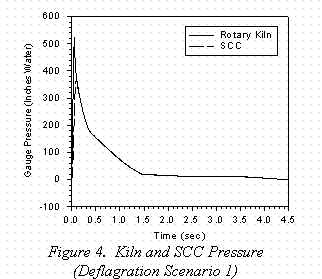
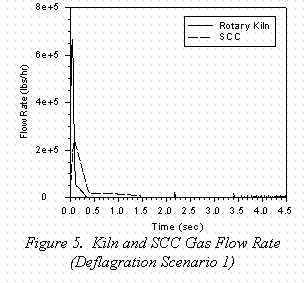
The results of the five scenarios are summarized in Table 1, in which the maximum temperature, pressure, and gas flow rate are listed for each process component. For illustration, Figures 3, 4, and 5 below show the transient responses (temperature, pressure, flow rate) of the rotary kiln, and the SCC to deflagration in Scenario 1.
The results showed that the 30" control damper had no significant impact on the rotary kiln and the SCC regarding the peak values of process variables. However, with the 30" control damper completely closed, a longer time was required to reestablish the normal operating condition in the kiln. Scenario 5 also indicated that a failure of the offgas pressure control (e.g. simulated by maintaining a fixed vane angle of the ID fans) would result in a large pressure increase in the HEPAs and the ID fans.

Conclusions
This study shows that deflagration in the rotary kiln causes a tremendous overpressure in the CIF system. The kiln pressure may increase to 525" water and 403" water if deflagration occurs at the kiln operating temperatures of 1400° F and 1832° F, respectively. The simulations indicate that within 5 seconds the kiln pressure returns to negative. If the 30" control damper to control the kiln pressure was completely closed due to deflagration, a longer time (> 10 seconds) would be required to reestablish the normal kiln operating pressure. A failure to properly control the offgas pressure would result in a significant pressure in the HEPA filters and ID fans.
References
Burns, D.B.; H. Holmes Burns; M.G. Looper; and G.R. Hassel. 1994. "Metals Partitioning in a Rotary Kiln Incinerator with a Wet Off-Gas System." In Proceedings of the 1994 International Incineration Conference (Houston, TX, May 9-13). The Regents of the University of California, Irvine, CA, 527-531.
Hang, T. 1992. "Dynamic Simulation Study of the CIF Incinerator." In Proceedings of the 1992 Incineration Conference (Albuquerque, NM, May 11-15). The Regents of the University of California, Irvine, CA, 679-682.
Acknowledgement
The information contained in this paper was developed during the course of work done under Contract No. DE-AC09-96SR18500 with the U.S. Department of Energy.