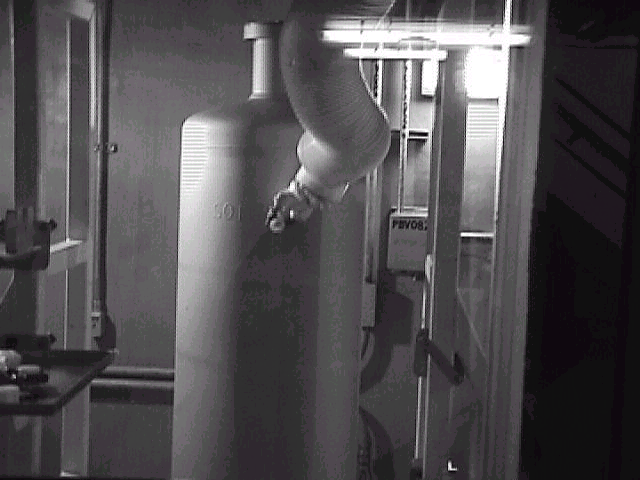
Figure 1: A Manipulator Arm Holds a Smear on a Stainless Steel Canister Filled with
High Level Waste in the Smear Test Station at the Defense Waste Processing Facility.
WSRC-MS-99-00669
Field Comparison of the Sampling Efficacy of
Two Smear Media: Cotton Fiber and Kraft Paper
M. G. Hogue
Westinghouse Savannah River Company
Aiken, SC 29808
This report was prepared as an account of work sponsored by an agency of the United States Government. Neither the United States Government nor any agency thereof, nor any of their employees, makes any warranty, express or implied, or assumes any legal liability or responsibility for the accuracy, completeness, or usefulness of any information, apparatus, product or process disclosed, or represents that its use would not infringe privately owned rights. Reference herein to any specific commercial product, process or service by trade name, trademark, manufacturer, or otherwise does not necessarily constitute or imply its endorsement, recommendation, or favoring by the United States Government or any agency thereof. The views and opinions of authors expressed herein do not necessarily state or reflect those of the United States Government or any agency thereof.
This report has been reproduced directly from the best available copy.
Available for sale to the public, in paper, from: U.S. Department of Commerce, National Technical Information Service, 5285 Port Royal Road, Springfield, VA 22161, phone: (800) 553-6847, fax: (703) 605-6900, email: orders@ntis.fedworld.gov online ordering: http://www.ntis.gov/support/index.html
Available electronically at http://www.osti.gov/bridge
Available for a processing fee to U.S. Department of Energy and its contractors, in paper, from: U.S. Department of Energy, Office of Scientific and Technical Information, P.O. Box 62, Oak Ridge, TN 37831-0062, phone: (865 ) 576-8401, fax: (865) 576-5728, email: reports@adonis.osti.gov
Abstract
Two materials were compared in field tests at the Defense Waste Processing Facility: kraft paper (a strong, brown paper made from wood pulp prepared with a sodium sulfate solution) and cotton fiber. Based on a sampling of forty-six pairs of smears, the cotton fiber smears provide a greater sensitivity. The cotton fiber smears collected an average of forty-four percent more beta activity than the kraft paper smears and twenty-nine percent more alpha activity. Results show a greater sensitivity with cotton fiber over kraft paper at the 95% confidence level.
Regulatory requirements for smear materials are vague. The data demonstrate that the difference in sensitivity of smear materials could lead to a large difference in reported results that are subsequently used for meeting shipping regulations or evaluating workplace contamination levels.
Introduction
At the Defense Waste Processing Center (DWPF) at the Savannah River Site, Aiken, SC, high level waste sludge material is chemically treated and melted into a glass matrix. This molten glass is poured into stainless steel canisters. The canisters are sealed with a temporary plug and decontaminated with a spray of water and glass frit. The canisters are then surveyed in the smear test station (Figure 1). This subject of this article is the choice of materials used to survey the canisters.
Figure 1: A Manipulator Arm Holds a Smear on a Stainless Steel Canister Filled
with
High Level Waste in the Smear Test Station at the Defense Waste Processing
Facility.
The material originally used for smear-testing canisters was kraft paper (a strong, brown paper made from wood pulp prepared with a sodium sulfate solution). An alternative was proposed to use cotton fiber, which has become the site standard for contamination surveys. This suggestion had to be studied carefully for the following reasons: 1) High level waste treatment documentation receives a high level of scrutiny, so the canister quality assurance records must be kept meticulously accurate; 2) The canisters must be surveyed remotely using smaller than standard-sized (11/4 inch diameter) smears loaded in special holders. The holders are specially designed to be handled by remote manipulators and passed through pneumatic tubes for smear counting and reloading.
The alternative, cotton fiber, is postulated to provide a more sensitive test of surface contamination. The cotton fiber that was used in this comparison was obtained from Frham Safety Products, Inc. part number 812-500 made of #290 Nuclear Sateen 100% Cotton.
Materials and Methods
The Data: How Smears were Taken and Counted
The test surface selected was the Contact Decontamination and Maintenance Cell (CDMC). The reasons for this selection were that the CDMC has stainless steel surfaces and it has contamination arising from the sludge waste stream. These characteristics are in common with the canisters.
Alternatively, the samples could have been taken directly from the canisters in the Smear Test Station. However, this would have been prohibitively time-consuming for operators. The canisters are usually very lightly contaminated, if at all. Therefore, a large number of canisters would have been required to collect meaningful data. Also, long counting times would have been required to detect the low levels of contamination.
For each of forty-six pairs of smears, a location was pre-selected. Two smears were taken in that location (one with kraft paper and one with cotton fiber). To avoid bias, care was taken to not overlap a smeared area. Also, the order of materials used was reversed from location to location, such that if location x would have a kraft paper smear taken first, location x + 1 would have a cotton fiber smear taken first.
The cotton fiber smears were trimmed down versions of the standard cotton fiber described above. These cotton fiber smears are manufactured with a 3" x 41/2" rectangular paper backing. Kraft paper smears were the standard items used for canister smearing. However, the kraft paper smears were attached to the same style of paper backing to make the smearing technique match that of the cotton fiber. (Matching the smearing technique proved to be very important. The present calculation is based on a second run of smears. The first run of smears was suspect because the kraft paper had to be held between the technician's gloved thumb and finger(s) whereas the present data is based on the technician holding the backing paper, not the smear material. This will be discussed in a separate article.) Smears were then taken per Radiological Control Manual standard practice, covering approximately 100 cm2.
The smears were counted on a low level counting system for alpha and beta radiation. The alpha results included nine with less than minimum detectable activity (<MDA) readings for the kraft paper and five <MDA for cotton fiber. The beta results included no values <MDA.
Basic Results
The cotton fiber smears on average collected 29% more alpha activity and 44% more beta activity than the kraft paper smears.
|
Media |
Mean alpha dpm |
Standard Deviation |
Mean beta dpm |
Standard Deviation |
|
Cotton fiber |
252.6 |
213.6 |
4868.4 |
4582.4 |
|
Kraft paper |
195.7 |
192.2 |
3387.2 |
2903.6 |
Statistical Test on Mean Activity
The method for verifying a statistically significant increase is based on the "Hypotheses Concerning Two Means" method (Miller and Freund 1985).
H0 (Null Hypothesis): The samples are of the same activity.
H1 (Alternate Hypothesis): The cotton fiber samples have a higher activity.
Level of significance: a
= 0.05
Criteria: Reject the null hypothesis if z > 1.645
Calculation: A test statistic is derived per the following equation:
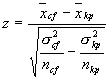
where…
z = the test statistic for the difference between two means
 =mean of cotton fiber
beta dpm
=mean of cotton fiber
beta dpm
 = mean of kraft paper
beta dpm
= mean of kraft paper
beta dpm
 = variance of cotton
fiber beta dpm
= variance of cotton
fiber beta dpm
 = variance of kraft
paper beta dpm
= variance of kraft
paper beta dpm
ncf = nkp = number of smears = 46
|
Data set |
z |
Result @ 95% Confidence Limit |
|
Alpha |
2.44 |
Mean of cotton fiber > mean of kraft paper |
|
Beta |
1.87 |
Mean of cotton fiber > mean of kraft paper |
Possible Sources of Error
The most important consideration seems to be whether the smears are sampling the same contamination. Is there any bias in the handling of the types of smears? To answer this question, the method of sampling is considered. The sampling was designed so that no bias would result from the order of smearing, as described above. To verify that the data is related, a check is performed to determine whether there is a correlation of activity with location between the two smear types.
Correlation Analysis
The correlation coefficient may be used to test the hypothesis that the data is related. This analysis is also described in (Miller and Freund 1985). To simplify the computation, a Microsoft® Excel (Microsoft 1997) formula is used. This is described as:
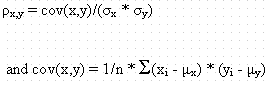
The correlation coefficient may be used to test the hypothesis that the data is related:
H0 (Null Hypothesis): The samples do not correlate by smear location. r = 0 (Where r is the "true" correlation coefficient for the entire population whereas the correlation coefficient calculated is for our sample of forty-six smears.)
H1 (Alternate Hypothesis): r ¹ 0
Level of significance: a = 0.025
Criteria: Reject the null hypothesis if z < -2.576 or z > 2.576
(The z-value is for a /2 since this is a two-tailed test.)
Calculation: A test statistic is derived from our correlation coefficient:
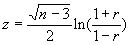
where n = number of samples = 46 and r = calculated sample correlation coefficient.
The results are provided below:
|
Media |
Correlation Coefficient (r) |
z |
Result |
|
Alpha |
0.930 |
11 |
Reject H0 |
|
Beta |
0.694 |
5.6 |
Reject H0 |
This test for correlation shows that the smears taken in a specific location will provide contamination levels that correlate based on the location.
Discussion
The data clearly show that the cotton fiber smears are more sensitive to the contamination presented. This is not a surprising result, since the cotton fiber is visibly softer, more textured, and more absorbent. The correlation results show that the test was valid; the attempt to take smears in the same areas resulted in comparable samples.
Regulatory requirements for smear materials call for "dry filter or soft absorbent paper." (USDOE2001, USNRC1974), or "absorbent material" (USDOT2000). Standards call for "small pieces of paper, such as discs of filter paper" (for example, NCRP1978). Available data on the sensitivity of smear material are scarce.
References