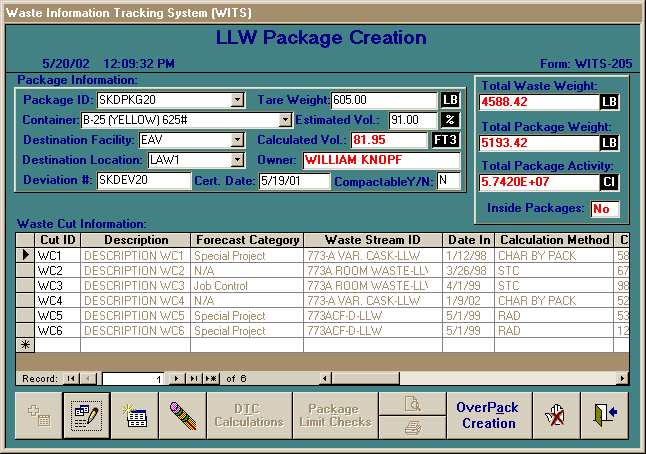
Figure 1. LLW Package Creation Screen
Waste Package Data Processing by Direct
Upload to the SRS Waste Information System
Vito R. Casella, P. Neal Smith, Larry J. Harpring and John E.
Black
Westinghouse Savannah River Company
Aiken, SC 29808
This report was prepared as an account of work sponsored by an agency of the United States Government. Neither the United States Government nor any agency thereof, nor any of their employees, makes any warranty, express or implied, or assumes any legal liability or responsibility for the accuracy, completeness, or usefulness of any information, apparatus, product or process disclosed, or represents that its use would not infringe privately owned rights. Reference herein to any specific commercial product, process or service by trade name, trademark, manufacturer, or otherwise does not necessarily constitute or imply its endorsement, recommendation, or favoring by the United States Government or any agency thereof. The views and opinions of authors expressed herein do not necessarily state or reflect those of the United States Government or any agency thereof.
This report has been reproduced directly from the best available copy.
Available for sale to the public, in paper, from:
U.S. Department of Commerce, National Technical Information Service, 5285
Port Royal Road, Springfield, VA 22161, phone: (800) 553-6847, fax:
(703) 605-6900
email: orders@ntis.fedworld.gov
online ordering: http://www.ntis.gov/help/index.asp
Available electronically at http://www.osti.gov/bridge
Available for a processing fee to U.S. Department
of Energy and its contractors, in paper, from: U.S. Department of Energy, Office
of Scientific and Technical Information, P.O. Box 62, Oak Ridge, TN 37831-0062,
phone: (865 ) 576-8401, fax: (865) 576-5728, email: reports@adonis.osti.gov
Abstract
Hundreds of waste packages are generated each month at the Westinghouse Savannah River Site (SRS), Aiken, SC. Most of these waste packages are compactable, low level waste (LLW) either in 55-gallon drums or B-25 boxes, and TRU waste is put in DOT Type A 55-gallon drums.
Several methods are used for assay of the waste package contents, including direct assay, dose-to-curie measurements, and smear-to-curie measurements. These assays generate many thousands of data that must be entered manually into the SRS Waste Information Tracking System (WITS) by a Generation Certification Official, even though much of this data is already available electronically. Since spreadsheets are routinely used to collect data for manual entry into WITS, direct data upload would greatly improve data entry.
WITS was originally written as an interactive program, requiring each data item to be entered individually with subsequent tests being performed on each data entry to ensure that acceptance criteria were met. An error message was displayed if the acceptance criteria were not met, and either corrected data had to be re-entered or a deviation had to be approved by WITS personnel. This system did not allow batch data entry, where essentially all the data could be entered, and then all of this data were evaluated against the acceptance criteria.
A WITS user interface has been written for batch data entry for over twenty waste generators. This interface accepts all the data for a waste package, and an error report is generated listing non-conforming data. This interface allows direct uploads of electronic data for waste packages by dumping this data into Microsoft Excel spreadsheets that are formatted for direct data entry into WITS. Therefore, programs can be written to transfer any electronic data to the WITS interface spreadsheet for direct uploads of waste data. The whole process is now much less labor intensive, more cost effective, and more accurate.
Introduction
WITS tracks the Savannah River Site’s solid Low Level Waste from the waste generator, through any processing, to storage and disposal. It performs nuclide limit checks, both package- and inventory-based, to verify compliance with the Waste Acceptance Criteria and safeguard the authorization basis for the E Area Vaults (LLW Burial Grounds) and other facilities. It provides waste generators with the option of tracking waste within their facilities and checking nuclide inventory limits for them as well. It prints shipping manifests and provides full support of barcoding. WITS provides data on approved waste containers, and site organizations and facilities to the site's Hazardous/Mixed Waste Tracking System.
Recently, waste package databases have been developed to track sample information using bar codes, and spreadsheets are routinely used to collect and verify data for manual entry into WITS. A computer program for the Savannah River Technology Center (SRTC) Solid Waste Assay Facility (SWAF) and another application, currently under development, the Central Laboratory (CLAB) Facility Waste Tracking System, will generate information that will be available for direct upload to WITS.
WITS Manual Data Entry
The main way a waste generator creates a waste package is by inputting the Package Data on the LLW Package Creation screen shown in Figure 1.
Figure 1. LLW Package Creation Screen
This screen is divide into three parts:
| Package Information | The Package Information consist of the data pertaining to the type of container used |
| Waste Cut Information | The Waste Cut Information consist of the contents inside the container |
| Radionuclide Information | The Radionuclide Data consist of the activity amounts for each individual isotope. |
All information entered on this screen is either validated at the time
of entry or when the waste package is saved to the WITS Database. No invalid
data can be saved to the WITS Database. The amount of activity is calculated
by using one of four calculation methods selected at the time of Waste
Cut entry:
| DTC | Dose To Curie |
| CHAR BY PACK | Characterization By Package |
| STC | Smear To Curie |
| RAD | Curies or RAD Weight |
The DTC calculation method can not be mixed with the other calculation methods. The total waste, package and activity weights are calculated from Waste Cut summations and the empty container weight.
If the CHAR BY PACK calculation method is selected, then the Generator will enter activity amounts for each individual isotope on the Characterization By Package Entry screen shown in Figure 2. The Radionuclide Package Limit check calculation is run against the destination facility and location.
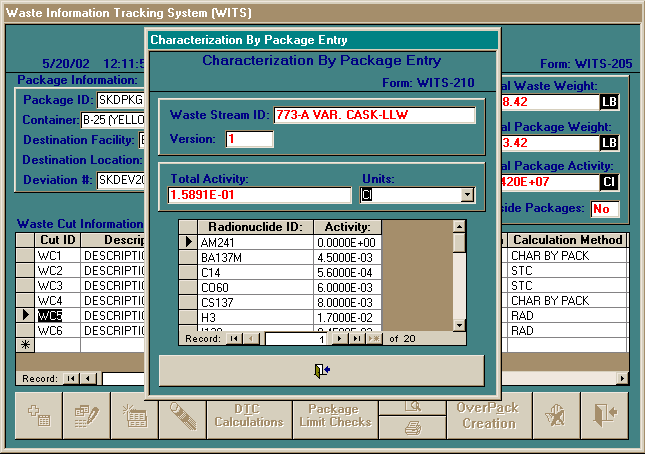
Figure 2. Characterization By Package Entry Screen
All information must be hand entered into the LLW Package Creation Screen and the Characterization by Package Entry Screen which is very tedious, labor-intensive and prone to input transcription errors.
WITS Electronically Upload Package Data (EUPD)
A second method for creating Package Data in WITS is being implemented. It is by Electronically Uploading the Package Data (EUPD) from a Microsoft Excel Workbook Spreadsheet (MEWS) into WITS. The EUPD process will validate the data, run Package calculations and save the data using the same methods as performed on the LLW Package Creation screen.
The user will create the spreadsheet in a standard predefined format and place the file in a repository server location out on a server. Figure 3 shows a partial MEWS Package Data file. The file can contain multiple Packages and Waste Cuts using all four calculation methods. The file is selected on the LLW Electronically Upload Package Data screen shown in Figure 4.
Any Package created using the EUPD process can be modified or deleted on the LLW Package Creation screen.
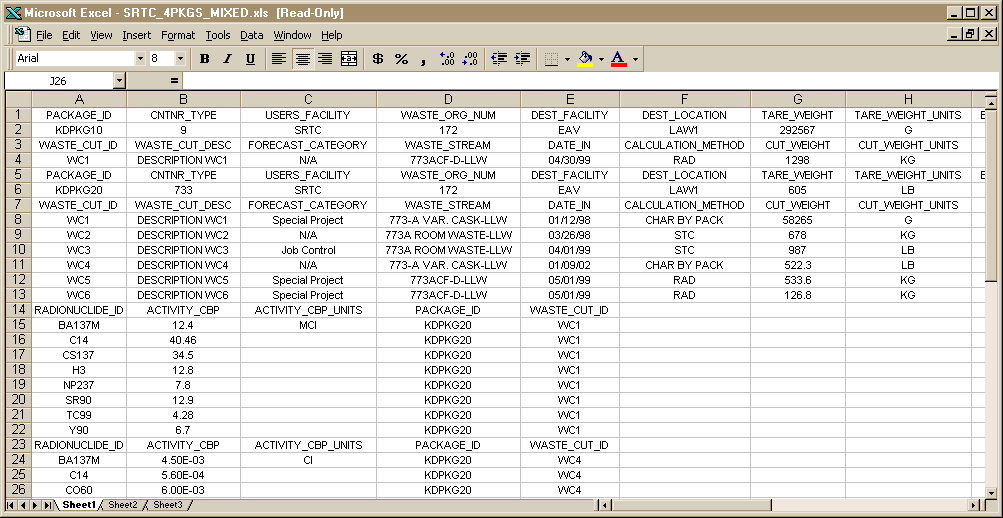
Figure 3. Partial MEWS Package Data File
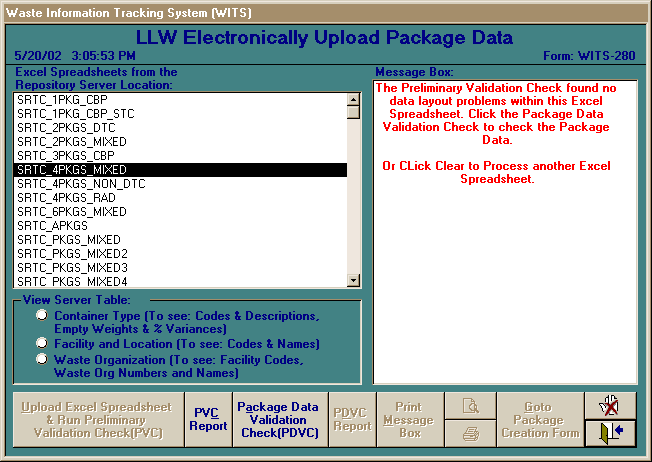
Figure 4. LLW Electronically Upload Package Data Screen
Conclusions
WITS was originally written as an interactive program, requiring each data item to be entered individually with subsequent tests being performed on each data entry to ensure that acceptance criteria were met. This system did not allow batch data entry, where essentially all the data could be entered, and then all of this data were evaluated against the acceptance criteria. Since spreadsheets are routinely used to collect and verify data for manual entry into WITS, direct upload of this data would represent a major improvement in data processing.
A WITS user interface has been written for batch data entry for over twenty waste generators. This interface accepts all the data for a waste package, and an error report is generated listing non-conforming data. This interface allows direct uploads of electronic data for waste packages by dumping this data into Microsoft Excel spreadsheets that are formatted for direct data entry into WITS. Therefore, programs can be written to transfer any electronic data to the WITS interface spreadsheet for direct uploads of waste data. The whole process is now much less labor intensive, more cost effective, and more accurate.
References