WSRC-MS-2000-00903
Advanced Technology for Repackaging TRU-Waste
D. Marzolf, R. Fogle, M. Prather, R. Milling, and L. Harpring
Westinghouse Savannah River Company
Aiken, SC 29808
This report was prepared as an account of work sponsored by an agency of the United States Government. Neither the United States Government nor any agency thereof, nor any of their employees, makes any warranty, express or implied, or assumes any legal liability or responsibility for the accuracy, completeness, or usefulness of any information, apparatus, product or process disclosed, or represents that its use would not infringe privately owned rights. Reference herein to any specific commercial product, process or service by trade name, trademark, manufacturer, or otherwise does not necessarily constitute or imply its endorsement, recommendation, or favoring by the United States Government or any agency thereof. The views and opinions of authors expressed herein do not necessarily state or reflect those of the United States Government or any agency thereof.
This report has been reproduced directly from the best available copy.
Available for sale to the public, in paper, from: U.S. Department of Commerce, National Technical Information Service, 5285 Port Royal Road, Springfield, VA 22161, phone: (800) 553-6847, fax: (703) 605-6900, email: orders@ntis.fedworld.gov online ordering: http://www.ntis.gov/support/ordering.htm
Available electronically at http://www.osti.gov/bridge/
Available for a processing fee to U.S. Department of Energy and its contractors, in paper, from: U.S. Department of Energy, Office of Scientific and Technical Information, P.O. Box 62, Oak Ridge, TN 37831-0062, phone: (865 ) 576-8401, fax: (865) 576-5728, email: reports@adonis.osti.gov
Abstract
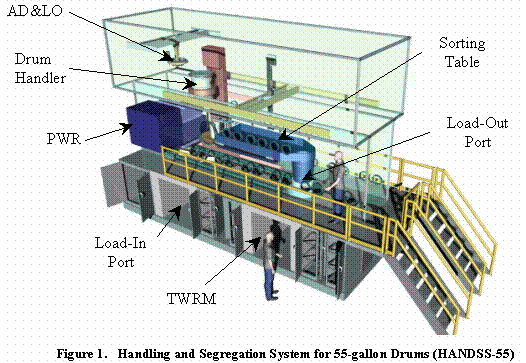
The Savannah River Technology Center (SRTC), the Idaho National Engineering and Environmental Laboratory (INEEL), the Pacific Northwest National Laboratory (PNNL), the Office of Science and Technology’s Transuranic and Mixed Waste Focus Area (TMFA), and the Savannah River Site’s Solid Waste Management Division (SWD) are working to develop a system to repackage drummed, mixed, transuranic (TRU) waste. The system is known as the Handling and Segregation System for 55-gallon drums (HANDSS-55). HANDSS-55 is designed to be a semi-remotely operated, modular, waste conditioning system that would open 55-gallon drums containing mixed TRU-waste, sort and segregate the contents of the drum, and separately repackage the acceptable waste and the non-compliant waste. The HANDSS-55 operation, which is contained in a glovebox, is composed of a number of modules that perform discrete functions as shown in Figure 1.
The modules for HANDSS-55 include (1) a drum and liner opener (AD&LO), (2) a visual inspection and sorting table, (3) a TRU-waste repackaging module (TWRM), (4) a process waste reduction module (PWR), and (5) components for integrating the modules. The function of the AD&LO module is to open a 55-gallon drum and its internal liner to allow access to the drum’s contents. The visual inspection and sorting table module will allow segregation of the drum’s contents so that all non-compliant items are removed from the waste stream. The TWRM repackages the acceptable waste and removes it from the glovebox. The process waste reduction module will provide size-reduction of the original waste container so that it will fit into the repackaging container. Finally, the components for module integration perform a variety of functions including manipulation of the incoming 55-gallon waste drum, extricating waste stuck in the drum, and moving waste between modules. This paper addresses the work that SRTC is performing in the design, fabrication, assembly, and testing of the TWRM.
Work Description
The Solid Waste Management Division at the Savannah River Site (SRS) has responsibility for thousands of 55-gallon drums of mixed TRU-waste. The majority of the TRU waste is the result of routine maintenance activities performed in plutonium processing operations. Typical waste includes wipes, tape, cardboard, paper towels, gloves, bags, plastic suits, and tools. This waste is being stored at SRS while awaiting certification and transfer to the Waste Isolation Pilot Plant (WIPP) located near Carlsbad, NM. The drums must meet the WIPP waste acceptance criteria (WAC) before they can be transferred to WIPP. Unfortunately, some of this waste is commingled with unacceptable items such as resins and aerosol cans.
The function of the TWRM is to enable the removal of acceptable, radioactive waste from the HANDSS-55 glovebox. The waste will be loaded directly into a high-density polyethylene,
welded, leak-tight container free of external contamination. The process utilizes a welding and cutting operation to fuse and then separate the waste container from the glovebox while maintaining both glovebox and waste container integrity.
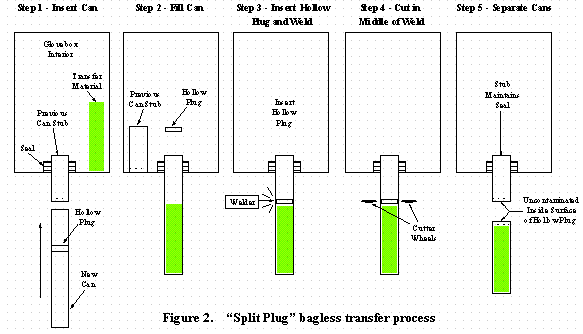
Engineers investigated the feasibility of adapting "split plug" bagless transfer technology in the development of the TWRM. The split plug bagless transfer system has been used at SRTC with metal cans and modified commercial welding and cutting tools for the processing of special nuclear materials. In the split plug bagless transfer process shown in Figure 2, a waste-receiving container made of metal or a polymer is inserted through a sphincter seal into the glovebox. A hollow plug is carried into the glovebox inside the container, removed from the container prior to placement of the compliant waste into the waste-receiving container and then reinserted into the waste-filled container. Welding/bonding and cutting operations are then performed outside the glovebox. The outer wall of the plug is welded (if metal) or bonded (if polymer) to the inner wall of the container. It should be noted that this bond must be hermetic to fully encapsulate any contamination that may have gotten on the inner wall of the container or outer wall of the plug.
The container/plug seal is then cut horizontally around the periphery of the container at the center of the plug. The top half of the cut maintains the glovebox seal while the bottom half of the cut becomes the lid for the waste-receiving container. Since the seal between the container and plug walls is hermetic, any contamination in the cut plane is encapsulated and non-transferable. Finally, a new receiving container and hollow plug are inserted through the sphincter seal, pushing the upper portion of the previous container, which now becomes waste, into the glovebox, and the process is repeated.
Discussion
The three main challenges in adapting the split plug bagless transfer system to the TWRM
were: (1) waste container material composition, size, and shape, (2) sealing of the joint between the container wall and the hollow plug and verifying that no defects exist in the sealed area of the plug and container prior to separation and (3) preventing migration of radionuclides outside the glovebox confinement. Since high-density polyethylene (HDPE) drum liners have been used in the solid waste disposal process for years at SRS, HDPE was the obvious candidate of choice for container and plug relative to repackaging the acceptable waste.
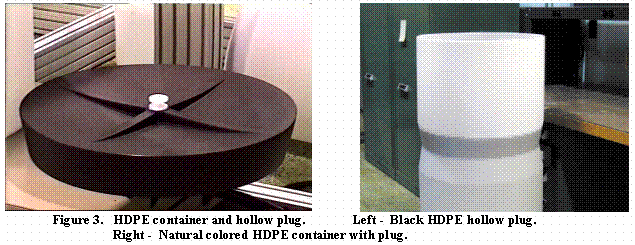
The size of the container was dictated by the criteria to fit into a standard 55-gallon steel drum for transportation purposes. The mating walls of the container and plug were tapered at 10 degrees to ensure good wall contact when a downward force on the plug is applied remotely. Wall contact between the plug and the container wall is necessary to achieve a good bond. The container color is natural or translucent and the plug is black as shown in Figure 3. The color selection was based on the bonding process for the container and plug. The plug and container were produced in a rotational molding process from HDPE of the same resin. A rotational grade HDPE resin with a melt index of approximately 4.5 was used to enhance the bonding process. The HDPE used for the plug has 0.2 % carbon black added to the resin. A knob is welded to the plug to permit remote handling when the plug is in the glovebox. It also provides a means of handling the upper section of the waste-receiving container after the bonding and cutting process is complete.
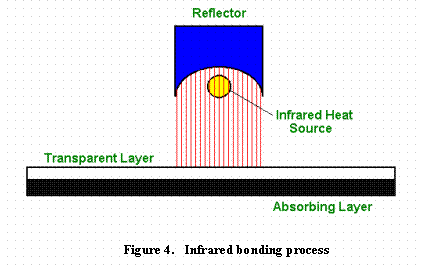
The second important element in split plug bagless transfer is the bond between the container and plug. This bond must be a continuous hermetic seal over a wide enough band so that a cut on the periphery of the container will separate the container/plug combination in the bonded region. In addition, the bond must be made from the exterior of the container. A number of polymer bonding techniques including adhesives, RF or dielectric welding, ultrasonic welding, induction welding, and spin welding were investigated. Most of these were found to be either ineffective or inapplicable to the process. Research led to a bonding technique known as infrared or IR welding as illustrated in Figure 4.
IR welding utilizes focused infrared radiation to bond translucent polymers to colored (preferably black) polymers. This bonding method requires the waste-container material to be natural or translucent in color and the hollow plug to be black. The IR energy is passed through the translucent material of the container, which behaves as a transparent layer, and collected by the absorbing layer of the plug-colored material. The energy is then passed back to the translucent material by conduction, causing both materials to melt and upon cooling, form a very strong bond. IR welding of polymers has proven to be fast, relatively inexpensive, and readily adaptable to containers of various sizes and shapes.
For experimental purposes, a test welder was fabricated using four parabolic reflector infrared heat lamps as shown in Figure 5. The lamps were configured on an adjustable radius slightly larger than that of the container so the distance from the lamps to the container could be varied. Criteria for an acceptable weld were as follows:
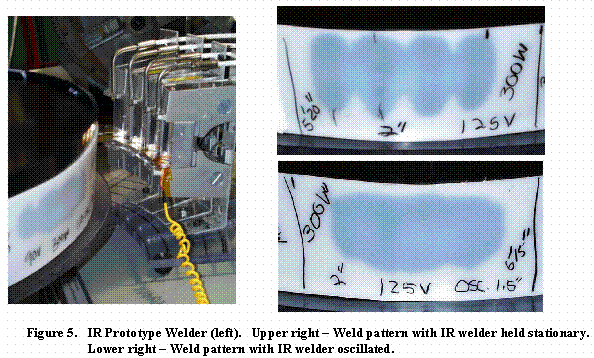
Past experience indicated that initial verification of criteria 1 and 2 above could be done visually. When a weld is made, the translucent material darkens as the black material begins to bond to it. Voids in the weld area will remain translucent and are readily visible. Numerous test welds were made, with variations in distance between the welder and container wall, voltage, lamp power (wattage), and weld time. The best results were obtained using 120 volt, 300-watt lamps at a distance of 5 centimeters. Examples of a test weld using the prototype welder are shown in Figure 5. In the final design, the infrared welder was oscillated to achieve a uniform welded area. Since natural colored HDPE is not a perfect transmitter for IR energy, air cooling of the outer surface of the container was required to prevent exterior melting of the material.
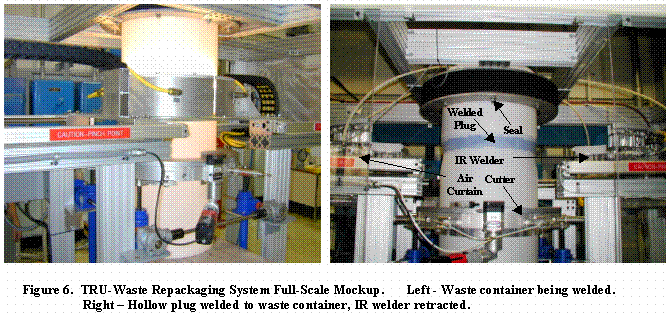
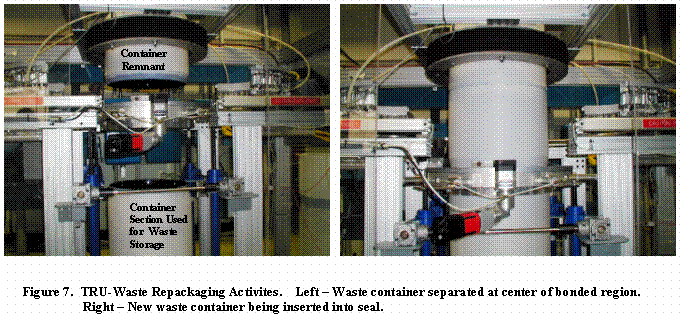
Based on the testing results of the prototype IR welder, a 48-lamp welder array was designed, fabricated and installed in the TWRM mockup as shown in Figure 6. The welder consists of 2 semi-circular halves mounted on air slides that come together around the HDPE waste container as it is positioned by the lift table. Once the weld is made, it is visually inspected. The container is then cut through at the center of the weld by a circular cutting device that separates the waste storage section of the container from the remnant that is maintaining the glovebox seal as shown in Figure 7. The container section filled with compliant waste items is then removed and placed in a 55-gallon drum. Another waste container and hollow plug are loaded on the lift table, aligned with the container remnant as shown in Figure 7 and inserted into the sphincter seal, therefore repeating the waste-repackaging process.
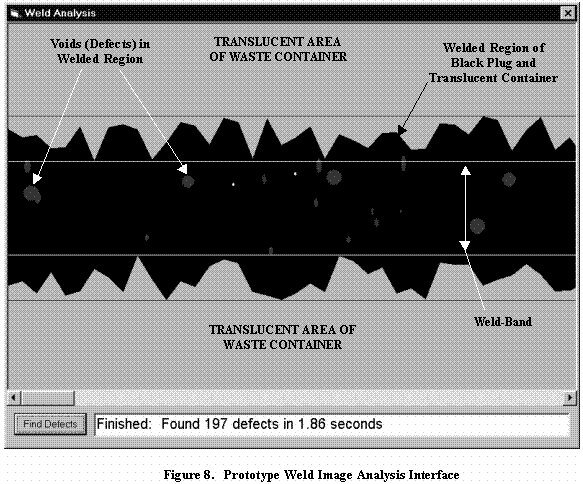
Prior to separation of the container and plug at the bonded region, the bond must be visually inspected to verify the absence of any voids. Two conditions that can create a void in the bonded region are (1) one or more of the IR lamps stop functioning during a weld cycle and (2) the outer surface of the hollow plug is not in full contact with the inner surface of the container. Since there is a significant change in the amount of reflected light from the bonded area of translucent container and the black plug, a digital imaging system can be used to detect voids in the bonded area. The imaging system is based on the use of a line scan camera mounted on the rotational ring of the cutter. The line scan camera captures one line of video per exposure and as the camera is moved along the bonded periphery of the container, the lines can be joined to form an image of the bond (weld) as shown in Figure 8. Approximately 18,000 line scans are required for the complete image. A resolution of 1024 pixels on a 4 inch width should permit the detection of voids with a diameter of 0.012 inches or greater.
The algorithm used to analyze the created image of the weld area will convert the image to binary black and white, which makes the welded areas black and the non-welded areas white. A weld-band is then determined, as illustrated in Figure 8. This area in the weld-band is then analyzed for defects and a cut line, which is a horizontal line centered in the weld-band, is generated for separation of the container. The analyzed weld image will be provided to personnel for inspection on a video screen. These areas of suspected defects within the weld-band will be highlighted and require operator interaction prior to providing permission to deploy the cutter for container separation.
The third important element of this repackaging system is the seal. A sphincter seal is needed to prevent the release of radionuclides outside of the glovebox containing the HANDSS-55 system. Sphincter seals have been used for many years in operating facilities at the Savannah River Site for certain applications. Using a prototype seal, SRTC engineers demonstrated the viability of using a large-diameter, multi-lip seal as the interface between the TWRM and the 55-gallon HDPE containers into which waste is to be transferred. The newest version of the seal has three EPDM rubber seal lips with an inside diameter of 19-1/8". It effectively seals around a polyethylene container with an outside diameter of 22-1/8". The final design will incorporate four EPDM rubber seal lips for improved sealing.
The Sphincter Seal Assembly is compiled of two parts, the Seal Ring Assembly and the Seal Sleeve Assembly shown in Figures 9 and 10, respectively. The Seal Ring Assembly consists of four EPDM seal lips separated by 1" neoprene rubber spacer rings, and pressed together between top and bottom aluminum cap rings. The cap rings are pulled together with cap screws and set-length standoffs during initial assembly. The assembly requires periodic replacement as needed, due to seal wear and contamination migration. Incidentally, because of the size of the Seal Ring
Assembly, the cap rings and spacer rings are designed to be disassembled and disposed of through the TWRM load-out port, allowing 100% of the Seal Ring Assembly to be discarded without special tooling or equipment.
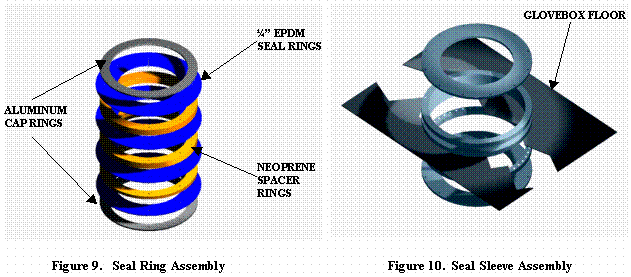
The Seal Sleeve Assembly is the housing assembly for the Seal Ring Assembly. The Seal Sleeve Assembly is a series of flanges and gaskets that bolt together through the glovebox floor for securing a stainless steel section of pipe. The pipe provides the sleeve, wall-sealing surface for the seal rings on the Seal Ring Assembly. Additional top and bottom cap flanges position, capture and squeeze the Seal Ring Assembly during final installation of the change-out process.
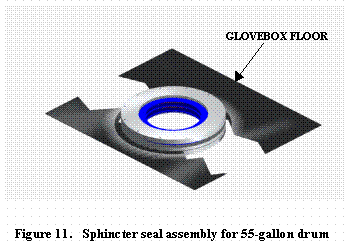
During the change-out process, a lift table located beneath the load-out port will be used for locating and lifting the new seal as the old seal is pushed out of the Seal Sleeve and into the glovebox. This process ensures that seal containment is not compromised. The Sphincter Seal Assembly will support the "split plug" bagless transfer method of handling radiological waste while preventing migration of radionuclides outside the glovebox confinement. Figure 11 shows a model of the final Sphincter Seal Assembly.
Conclusion
"Split plug" bagless transfer technology has been adapted to the repackaging of TRU-waste into 55-gallon HDPE waste containers. The infrared welding of the HDPE plug and container provides a hermetic seal that encapsulates any contamination that may exist at that interface as a result of the waste loading process. This welding technology can be adapted to various shapes and sizes of HDPE containers. Automation of the TRU-Waste Repackaging System will include the capability for remote inspection of the weld for defects, using a line scan digital imaging system and weld image analysis software, prior to the separation of the waste container. Maintaining a good seal in the glovebox and the waste container is also critical for HANDSS-55 operation. Designing a seal for such a large diameter and pliable container was a challenge. Currently, several other uses for this waste encapsulating technology are being discussed.