WSRC-TR-99-00181
A Thermal Conduction Analysis of Proposed Lateral and
Downstream Row 1
Module Plate Designs
M. A. Shadday and L. L. Hamm
Westinghouse Savannah River Company
Aiken, SC 29808
This document was prepared in conjunction with work accomplished under Contract No. DE-AC09-96SR18500 with the U.S. Department of Energy.
DISCLAIMER
This report was prepared as an account of work sponsored by an agency
of the United States Government. Neither the United States Government nor any
agency thereof, nor any of their employees, makes any warranty, express or
implied, or assumes any legal liability or responsibility for the accuracy,
completeness, or usefulness of any information, apparatus, product or process
disclosed, or represents that its use would not infringe privately owned
rights. Reference herein to any specific commercial product, process or
service by trade name, trademark, manufacturer, or otherwise does not
necessarily constitute or imply its endorsement, recommendation, or favoring by
the United States Government or any agency thereof. The views and opinions of
authors expressed herein do not necessarily state or reflect those of the
United States Government or any agency thereof.
This report has been reproduced directly from the best available copy.
Available to DOE and DOE Contractors from the Office of Scientific and
Technical Information, P. O. Box 62, Oak Ridge, TN 37831; prices available from
(423) 576-8401.
Available to the public from the National Technical Information
Service, U.S. Department of Commerce, 5285 Port Royal Road, Springfield, VA
22161.
Summary
In the event of a LOCA in the Accelerator Production of Tritium (APT) blanket heat
removal system that results in dryout of one or more modules, the decay heat
must be dissipated by the cavity flood system. Thermal conduction modeling of
the highest power plate in a lateral or downstream row 1 module shows that the
cavity flood system can adequately dissipate the heat of an internally dry row
1 module with plates up to 7.5 inches long. The current blanket design has 4.0
inch plates in the high power inner modules close to the target and longer
plates in the lower power modules further removed from the target. This study
shows that the short plates in the inner modules can be safely replaced, with
respect to the thermal criteria for safety analyses, by the longer plate
design, resulting in a single plate design for all lateral modules. Uniform
size plates simplify fabrication and assembly demands/costs.
Introduction
The cavity flood system is designed to be the primary safeguard for the integrity
of the blanket modules during loss of coolant accidents (LOCAs). In the
unlikely event that the internal flow passages in a module dryout, decay heat
in the metal structures will be dissipated to the cavity flood system through
the module walls. There is a design proposal under consideration to utilize a
single 7.5 inch plate design in the APT blanket lateral modules. Currently,
the lateral and downstream row 1 modules are designed with 4.0 inch plates, and
longer plates are utilized in the lower power outer row modules. There are
many benefits (e.g., fabrication costs, assemblage error reductions) to having
a single plate design. The purpose of this study is to determine if the longer
plate design meets the safety criterion that, when a module is internally dry,
it can be adequately cooled by the cavity flood system.
Problem Description
A LOCA in the blanket heat removal systems (HRS) could result in one or several
of the modules becoming hydraulically isolated and ultimately drying out. The
decay heat in those modules would then need to be dissipated by the cavity
flood system. The highest powers occur in the row 1 modules, so a
demonstration of adequate cooling of these modules is bounding. The
temperature limit for the modules is 150°C. This limit is based on a
10,000 hour exposure time interval. There is a decoupler on the target side of
each row 1 module with a very narrow gap between this decoupler and row 1
module (conservatively assumed not to exist in these analyses), and a one inch
gap separates the row 1 and row 2 modules. When the cavity flood system is
activated, the one inch gap is flooded, and this side of the module is cooled.
To determine the adequacy of cavity flood cooling, post-beam shutdown transient
heat transfer in the highest power row 1 module plate was modeled with a
three-dimensional thermal conduction code (HEATEL). Only the one inch gap end
of the plate was cooled. The peak temperature in the plate, both spatially and
temporally, was determined. The cavity flood system was assumed to be
operative and capable of handling the heat loads.
Description of the Thermal Conduction Model
The highest power plate (referred to as the "hot" plate) in the lateral or
downstream row 1 modules was modeled with HEATEL, a transient three-dimensional
thermal conduction code. Considering a single plate substantially reduces the
size and complexity of the numerical model, and the thermal behavior of the hot
plate is bounding, because thermal conduction to adjacent plates with lower
power generation is not accounted for. Three plate designs were modeled: (1) a
nominal 4.0" plate, which represents the present design; (2) a nominal 7.5"
plate, which represents the proposed design; and (3) a plate with intermediate
dimensions. The nominal 4.0" plate represents the current row 1 design which
is a thicker plate than the original design. The intermediate size plate was
analyzed to check for possible nonlinear effects in peak temperature versus
plate size. This provides increased confidence to designers for future size
optimization studies. Figure 1 shows horizontal cross-sections of the three
plate designs, as well as a horizontal cross-section of the original plate
design that was the basis for safety analysis in the initial draft of the
Preliminary Safety Analysis Report (PSAR) [1]. The cross-sections also show
the HEATEL finite element grids for the plates. To expedite development of
finite element grids for each of the three plate designs being modeled, the
existing original grid was stretched to the lengths and widths of the three new
plate designs. The stretching process resulted in some shape distortion. Due
to the low heat loads associated with shutdown conditions it is expected that
precise geometrical grids are not required. The exact plate dimensions for the
three designs are shown in Figure 1. Figure 2 shows the three-dimensional mesh
of plate C with 20 vertical cells. The schematic is compressed by a scale of
10:1 in the vertical direction. The original plate design has an aluminum
cladding thickness of 55 mils, and the presence of a uniform one mil air-filled
gap between the lead and the aluminum is assumed. These dimensions were
distorted in the stretching process. By design the plates are narrower at the
high power decoupler ends. They are stacked together in the "y" direction of
Figure 1 to form a module. With the cross-sections of adjacent plates being
mirror images, the scalloped sides of the plates form the module internal flow
channels. A consistent scale factor is used for each mesh in Figure 1 to show
the relative plate sizes. As shown in Figure 1, a significant increase in
plate volume occurs when going from the original design to the proposed C
design.
Vertical and horizontal lengthwise power distributions in a plate are included
in the model. The power distribution in the horizontal direction normal to the
stacked plates is accounted for by modeling the highest power or hot plate in
the module. Three row 1 modules were considered, and the hot plate of the
downstream row 1 module was determined to have the highest power. Spatial
power density distribution data [3], for a blanket with nominal 4" row 1 module
plates was utilized, and the power density distributions along the lengths of
the nominal 5.5" and 7.5" plates were extrapolated from this data. The
extrapolated horizontal power density distributions were integrated and
normalized with the integrated power density distribution for the nominal 4"
plate to determine extrapolated plate powers for the two longer plate designs.
Table 1 shows the pre-incident plate powers for the hot plate in the three
modules considered. To simplify input in the model, all of the power is
deposited in the lead. Figure 3 shows the axial power density profile, and
Fig. 4 shows the horizontal lengthwise power density profile for the hot plate
of the downstream row 1 module. The points in Figure 4 with lateral distances
of four inches or greater are extrapolated values. For the short and
intermediate length plate designs, appropriate portions of the horizontal power
density profile, shown in Figure 4 were used. Figure 5 shows the power density
distribution that is in the horizontal plane and perpendicular to the beam, for
the downstream row 1 module. The hot plate is the one that is approximately
-29.3 cm from the beam center.
The decoupler end of the plate and the two sides formed by the internal flow
channels are assumed to be adiabatic boundaries, as are the top and bottom
faces. The cavity flood gap end of the plate is cooled by single-phase mixed
convection, or boiling heat transfer if the wall superheat exceeds 15°C.
The single-phase convective heat transfer (htc) coefficient is 72.4
W/m2-K, which corresponds to laminar flow through a one inch gap.
With the onset of boiling, the heat transfer coefficient is conservatively
assumed to be 2000 W/m2-K, the pool boiling value associated with a
wall superheat of 10°C [2]. The conservatism is a result of delaying the
wall superheat for the onset of nucleate boiling (ONB), by 5° to
15°C, where the boiling htc would be in excess of 5000 W/m2-K.
The cavity flood free stream temperature is the local saturation temperature
based on a free surface at atmospheric pressure and with an elevation of
approximately 6.4 m above the top of the module. The initial plate temperature
is assumed to be 100°C, and the transient calculation commences 100
seconds after beam shutdown. A dryout time of 100 seconds is an extremely
conservative estimate in view of the available decay power and the inventory of
water in the modules. With no flow through the row 1 modules, three hours are
required to heat the liquid inventory to saturation, and an additional
twenty-five hours are required to boil-off the liquid [4]. The average plate
power is a function of the elapsed time from beam shutdown. The initial 100
hours after beam shutdown is simulated
Table 1. Pre-incident powers for the hot plate in the three modules.
Front Lateral
Module |
Geometry A |
60.67 kW |
Geometry B |
82.60 kW |
Geometry C |
104.50 kW |
Back Lateral
Module |
Geometry A |
76.60 kW
|
Geometry B |
103.70 kW |
Geometry C |
130.10 kW |
Downstream Module |
Geometry A |
88.80 kW
|
Geometry B |
137.30 kW |
Geometry C |
189.60 kW |

Figure 1. Horizontal cross-sections of the original and the three modeled plate designs
with HEATEL finite element grids (all grids shown in scale).

Figure 2. Three-dimensional mesh of the row 1 plate C design.
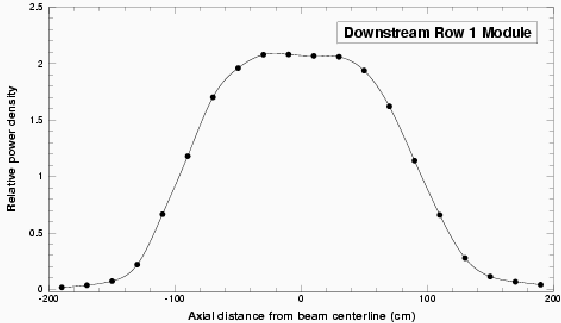
Figure 3. Axial power density profile in the downstream row 1 module.

Figure 4. Horizontal lengthwise power density profile in the hot plate of
the downstream row 1 module, plate C design.
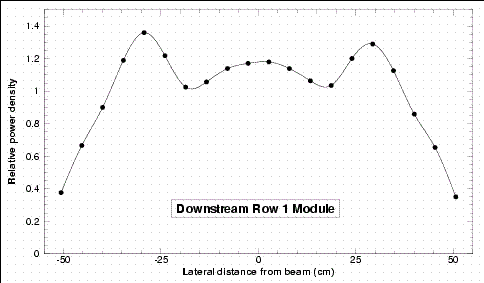
Figure 5. Horizontal power density profile, perpendicular to the beam,
in the downstream row 1 module.
Results and Discussion
Figure 6 shows the temperature distribution in a horizontal slice of hot plate C at
the elevation where, and at the elapsed time that, the peak temperature occurs.
This elevation is near the mid-plane of the plate. For the three hot plate
geometries considered, Figures 7a through 7c show the transient maximum (in
space) plate temperatures and the gap wall and cavity fluid temperatures at the
same elevation. The peak (in time and space) metal temperature occurs early in
the transient at the decoupler end of the plate. The maximum metal temperature
exceeds 150°C for a brief period of time with hot plate C, the long plate
design. The oscillations in the wall temperature occur due to the assumed step
function nature of boiling in this model. During the early phase of the
transient, the time step was shortened to minimize the effect of wall
temperature oscillations on the maximum metal temperature. For hot plate C,
the surface heat flux at the axial elevation where the peak metal temperature
occurs is shown in Figure 8. Figure 9 shows the transient maximum metal
temperatures for the three hot plate geometries on a single plot. Figure 10
shows the peak metal temperature, both spatially and temporally, as a function
of plate length. The relationship is slightly non-linear. The peak
temperature for hot plate C, the proposed long plate design, is 153.6°C.
Figure 11 shows the axial profile at the time that the peak temperature occurs
for hot plate C where maximum metal temperatures at each horizontal plane were
chosen. Also shown are axial profiles of the wall, ONB, and cavity flood fluid
temperatures (i.e., maximum values at each horizontal plane). The central
portion of the gap, from approximately one to three meters axially, is at the
ONB threshold. The decay power is insufficient to sustain boiling with the
heat transfer coefficient utilized in the model, so the wall temperature
oscillates, rising when the single-phase heat transfer coefficient is applied
and dropping when the boiling heat transfer coefficient is applied. This
situation persists for approximately 45 hours after beam shutdown, as indicated
by the oscillations in surface temperature in Fig. 7c. Thereafter, the decay
power drops below the level required for a single-phase wall/free stream
temperature difference of 15°C.
Table 2 presents the results of a model sensitivity study. Five parameters in
the hot plate C model were perturbed separately, and the resultant peak metal
temperatures are presented. Also shown is the unperturbed (nominal) case.
Raising the pre-incident plate power by 20% increases the peak metal
temperature by 5.8°C. Decreasing the ONB wall superheat to 10°C
drops the peak temperature by 3.7°C. Increasing the boiling heat transfer
coefficient from 2000 W/m2-K to 5000 W/m2-K drops the
peak temperature by 1.0°C. Increasing the cavity flood free surface
elevation above the top of the module from 6.4 to 8.2 m increases the peak
temperature by 2.8°C. Eliminating the air gap between the lead and the
aluminum decreases the peak temperature by 1.3°C. Figure 12 shows the
peak temperatures for hot plate C as a function of the elapsed time from beam
shutdown to the onset of dryout. The precise time of dryout is a function of
the specific LOCA being considered. A post beam shutdown dryout delay time of
100 seconds is clearly bounding. Figure 12 shows the effect of relaxing this
assumption and allowing a longer period for dryout to occur. The threshold
dryout time for a peak temperature below 150°C is 80.0 minutes. Based on
these preliminary sensitivity studies, an overall uncertainty in predicting the
peak metal temperature should fall within 3-4°C.
Figure 14 shows the peak metal temperatures for case C design plates in the
downstream and front/back lateral row 1 modules, as a function of the
pre-incident deposited power. These results are for dryout times of 100
seconds. For a given plate power, the peak temperatures for plates in the two
lateral modules are considerably higher than the peak temperature in a plate in
the downstream module. This is due to the differences in the spatial power
distributions in the plates. The axial deposited power distributions for the
three modules are very similar and therefore do not substantially contribute to
this peak temperature versus deposited power difference. Figure 14 shows the
horizontal lengthwise relative deposited power profiles for plates in the three
modules under consideration. These profiles are normalized with respect to the
average power densities in the plates. The deposited power profiles are
considerable more peaked towards the adiabatic decoupler ends of the plates in
the lateral modules than in the downstream module. The normalized deposited
power densities at the decoupler ends of the plates in the lateral modules are
approximately 3.2 whereas it is approximately 1.4 for the downstream module.
The difference in pre-incident deposited power between the case C design hot
plate of the downstream module, 189.6 kW, and the hot plates in the lateral
modules, 104.5 kW in the front lateral module and 130.1 kW in the back lateral
module, more than compensates for this power distribution difference. The peak
temperatures for the hot plates of the two lateral modules are 146.0°C and
150.2°C for the front and back modules, respectively; whereas, the peak
temperature for the downstream module hot plate is 153.6°C.
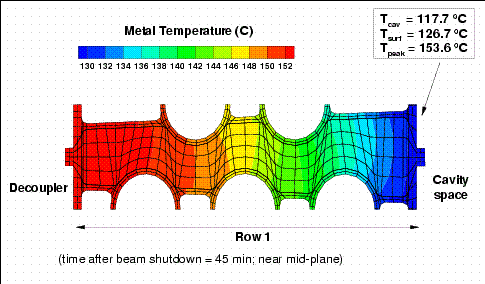
Figure 6. Temperature distribution in a horizontal slice of a plate (near the
mid-plane)
at the elevation where, and at the elapsed time that, the peak
temperature occurs (hot plate C: 7.3760" by 2.25").
Table 2. HEATEL sensitivity study results for hot plate C.
Perturbed Parameter |
Peak Metal
Temperature (°C)
|
Nominal Case |
153.6 |
20% increase in power |
159.4 |
10°C ONB wall superheat |
149.9 |
Boiling htc set at 5000 W/m2-K |
152.6 |
Cavity flood free surface 8.2 m above module |
156.4 |
No gap between lead and aluminum |
152.3 |

Figure 7a. Maximum metal temperatures, with wall and cavity fluid temperatures
at the same elevation, for the downstream row 1 module
(hot plate A: 3.8746" by 1.75").
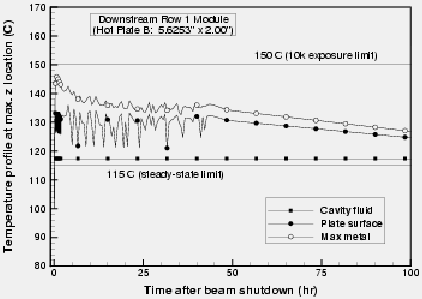
Figure 7b. Maximum metal temperatures, with wall and cavity fluid temperatures
at the same elevation, for the downstream row 1 module (hot plate B: 5.6253" by 2.0").
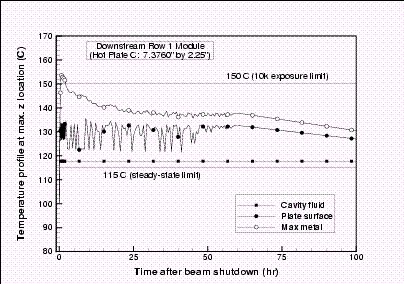
Figure 7c. Maximum metal temperatures, with wall and cavity fluid temperatures at the same
elevation, for the downstream row 1 module (hot plate C: 7.3760" by 2.25").

Figure 8. Surface heat flux at the axial elevation where the peak metal
temperature
occurs for the downstream row 1 module (hot plate C: 7.3760" by
2.25").
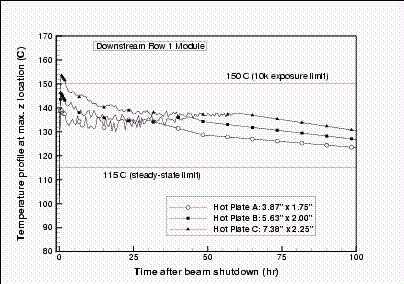
Figure 9. Maximum metal temperatures for the downstream row 1
module for the three plate geometries considered.
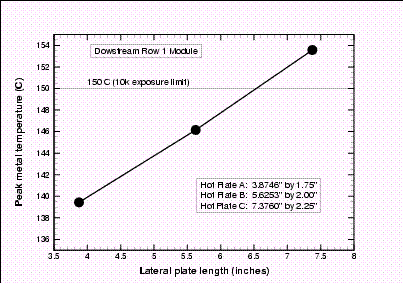
Figure 10. Peak metal temperatures for the downstream row 1
module as a function of plate length.

Figure 11. Axial temperature profiles at the time of the peak temperature
(hot plate C: 7.3760" by 2.25").

Figure 12. Peak metal temperatures as a function of elapsed time from beam
shutdown to the onset of module dryout (Case C: 7.3760" by 2.25").
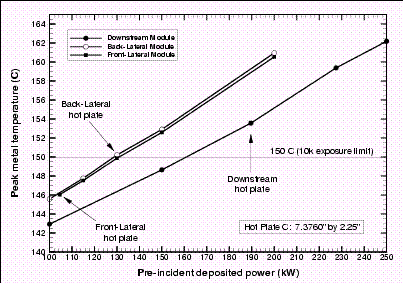
Figure 13. Peak metal temperatures as a function of pre-incident deposited power
in plates in downstream and lateral row 1 modules (Case C: 7.3760" by 2.25").
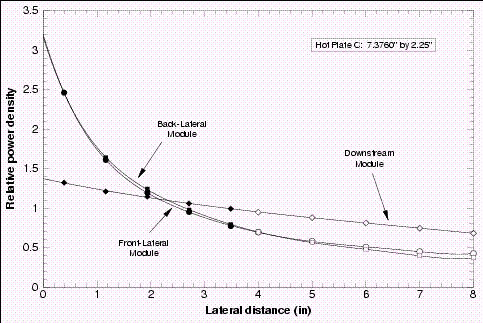
Figure 14. Horizontal lengthwise relative deposited power profiles for
plates in the three row 1 modules considered
(Solid symbols data, [3], open symbols
extrapolated).
Conclusions
The peak temperature of hot plate C, the 7.5" plate design, is 153.6°C with an
overall uncertainty of less than 3-4°C. This exceeds the 150°C
long-term exposure metal temperature limit for blanket components, but only for
a brief period (i.e., less than five hours of exposure). The highest power
plate in all of the row 1 modules was conservatively modeled. The peak
temperatures of most of the lateral and downstream row 1 plates will be below
the temperature limit. The beamwise power distribution multiplier for the back
plate in a front lateral row 1 module is 1.59. This is the ratio of the
average power for the back plate to the module average plate power. The
beamwise power distribution multiplier for the front plate in a back lateral
row 1 module is 1.38, and the transverse power distribution multiplier for the
hot plate in the downstream module is 1.36.
The assumption that a row 1 module is drained at 100 seconds after beam
shutdown is not realistic, and this is probably the most significant
conservative assumption in these analyses. If the elapsed time from beam
shutdown to the onset of dryout exceeds 80 minutes, the peak temperature in hot
plate C will be below the 150°C temperature limit.
Therefore, it is concluded that the cavity flood system can adequately cool
lateral and downstream row 1 modules with 7.5" plates, even when the modules
are internally dry. This conclusion is supported by: (1) the bounding nature
of these analyses and (2) the brief period of exposure time and limited spatial
extent of the region predicted to exceed this temperature limit.
References
- L. L. Hamm, S. Y. Lee, M. A. Shadday, and F. G. Smith, III, "APT PSAR Blanket
Safety Analysis Based on Initial Conceptual Design," Westinghouse Savannah
River Company, WSRC-TR-98-0087 (July 1998).
- L. L. Hamm, S. Y. Lee, M. A. Shadday, and F. G. Smith, III, "APT Blanket
System Internally Dry Flooded Cavity Accident (IDFCA) Based on Initial
Plate-Type Design - Demonstration of Bin Heat Conduction Capability,"
Westinghouse Savannah River Company, WSRC-TR-98-0064 (July 1998).
- R. Kapernick, EXCELL Spread Sheet: Lat R1, 1.5kg, received from Los Alamos
National Laboratory, March 1999.
- L. L. Hamm, S. Y. Lee, M. A. Shadday, and F. G. Smith, III, "Blanket Module
Boil-Off During a Loss-Of-Coolant Accident (LOCA) - Case 0: with Beam Shutdown
only," Westinghouse Savannah River Company, WSRC-TR-98-00213 (July 1998).