WSRC-TR-2001-00296
HEU Holdup Measurements on 321-M A-Lathe
R. A. Dewberry and S. R. Salaymeh
Westinghouse Savannah River Company
Aiken, SC 29808
This report was prepared as an account of work sponsored by an agency of the United States Government. Neither the United States Government nor any agency thereof, nor any of their employees, makes any warranty, express or implied, or assumes any legal liability or responsibility for the accuracy, completeness, or usefulness of any information, apparatus, product or process disclosed, or represents that its use would not infringe privately owned rights. Reference herein to any specific commercial product, process or service by trade name, trademark, manufacturer, or otherwise does not necessarily constitute or imply its endorsement, recommendation, or favoring by the United States Government or any agency thereof. The views and opinions of authors expressed herein do not necessarily state or reflect those of the United States Government or any agency thereof.
This report has been reproduced directly from the best available copy.
Available for sale to the public, in paper, from: U.S. Department of Commerce, National Technical Information Service, 5285 Port Royal Road, Springfield, VA 22161, phone: (800) 553-6847, fax: (703) 605-6900, email: orders@ntis.fedworld.gov online ordering: http://www.ntis.gov/support/ordering.htm
Available electronically at http://www.osti.gov/bridge/
Available for a processing fee to U.S. Department of Energy and its contractors, in paper, from: U.S. Department of Energy, Office of Scientific and Technical Information, P.O. Box 62, Oak Ridge, TN 37831-0062, phone: (865 ) 576-8401, fax: (865) 576-5728, email: reports@adonis.osti.gov
Abstract
The Analytical Development Section of SRTC was requested by the Facilities Disposition Division (FDD) to determine the holdup of enriched uranium in the 321-M facility as part of an overall deactivation project of the facility. The 321-M facility was used to fabricate enriched uranium fuel assemblies, lithium-aluminum target tubes, neptunium assemblies, and miscellaneous components for the production reactors. The facility also includes the 324-M storage building and the passageway connecting it to 321-M. The results of the holdup assays are essential for determining compliance with the solid waste Waste Acceptance Criteria, Material Control & Accountability, and to meet criticality safety controls. Three measurement systems were used to determine highly enriched uranium (HEU) holdup. One is a portable HPGe detector and EG&G Dart system that contains high voltage power supply and signal processing electronics. A personal computer with Gamma-Vision software was used to provide space to store and manipulate multiple 4096-channel g-ray spectra. The second is a 2" x 2" NaI crystal with an MCA that uses a portable computer with a Canberra NaI+ card installed. This card converts the PC to a full function MCA and contains the ancillary electronics, high voltage power supply, and amplifier required for data acquisition. The third is a Canberra Q2 waste assay system. This report covers holdup measurements on the A-Lathe that was used to machine uranium-aluminum-alloy (U-Al). Our results indicated that the lathe contained more than the limits stated in the Waste Acceptance Criteria (WAC) for the E-Area Vaults. Thus the lathe was decontaminated three times and assayed four times in order to bring the amounts of uranium to an acceptable content. This report will discuss the methodology, Non-Destructive Assay (NDA) measurements, assumptions, and results of the U-235 holdup on the lathe. The reported holdup value on the lathe is 43± 13 g, and the reported values of contamination removed from the lathe and packaged as solid waste is 90± 40 g.
The 321-M facility was used to fabricate enriched uranium fuel assemblies, lithium-aluminum target tubes, neptunium assemblies, and miscellaneous components for the production reactors. The facility also includes the 324-M storage building and the passageway connecting it to 321-M. The facility operated for 25 years. During this time thousands of uranium-aluminum-alloy (U-Al) fuel tubes were produced. After the facility ceased operations in 1995 all of the easily accessible U-Al was removed from the building, and only residual amounts remained. The bulk of this residue is located in the equipment that generated and handled small U-Al particles and the exhaust systems for this equipment (e.g., Chip compactor, casting furnaces, log saw, lathes A & B, cyclone separator, Freon™ cart, riser crusher, ...etc).1
U-235 holdup measurements were performed in 1995 and documented in technical report WSRC-TR-95-0492.2 The holdup values reported in WSRC-TR-95-0492 were only best estimates, due to lack of time for conducting the measurements and analysis. Therefore Facilities Disposition Division (FDD) has requested technical assistance from the Analytical Development Section (ADS) of the Savannah River Technology Center (SRTC) to determine the holdup of enriched uranium in the 321-M facility, as part of an overall deactivation project of the facility.3 This project includes the dismantling and removal of all held-up HEU to the extent practical. ADS conducted holdup assays to quantify the amount of HEU on all components removed from the facility prior to placement in B-25 containers. The U-235 holdup in any single component of process equipment must not exceed a 50 g in order to meet the B-25 limit.4 This limit was imposed to meet criticality requirements of the E-Area Low Level Vaults. Thus the holdup measurements are used as guidance to determine if further decontamination of equipment is needed to ensure that the quantity of 235U does not exceed the 50 g limit. The results of the holdup assays are essential for determining compliance with the solid waste Waste Acceptance Criteria, Material Control & Accountability, and to ensure that criticality safety controls are not exceeded.
This report covers holdup-measurements on A-Lathe that was used for the machining of uranium aluminum alloy (U-Al) castings. Our results indicate a total amount of (43+13) g enriched uranium residue holdup on A-lathe. This determination (including uncertainty that exceeds the 50-g criticality limit) was accepted5 after multiple decontamination attempts and after four different assays. This report discusses the assays, which were made in several acquisition configurations, assumptions, calculations, and results to determine the total holdup of HEU residue on the A-lathe.
A 2" x 2" NaI detector system was used to conduct NDA measurements of HEU holdup on the A-Lathe. The detector system uses a 2" x 2" NaI crystal with an MCA that uses a portable computer with a Canberra NaI+ card installed. This card converts the PC to a full function MCA and contains the ancillary electronics, high voltage power supply and amplifier required for data acquisition.6
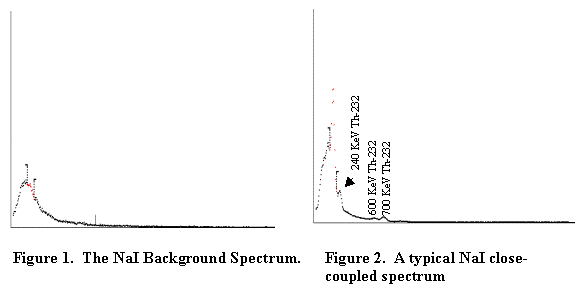
The 32 spectra acquired on December 4, 2000 were obtained in three distinct configurations. One configuration was a far field at a range of 24 inches or 79 inches. The second configuration was a close field at a distance of eight inches, and the third configuration was at contact. We calculated the measured 235U masses for each acquisition and compared results to arrive at applicable conclusions. The acquisitions are listed in Table 1. The second column in Table 1 includes a very short description of the detector location and the acquisition configuration. A background spectrum is shown in Figure 1. Figure 2 is a typical NaI close-coupled spectrum.
The region of interest of the 186 keV peak from 235U decay is shown in red in both spectra. The two peaks near 600 and 700 kev in Figure 2 represent g-rays from the daughter products from decay of naturally-occurring 232Th. We confirm this designation later in this report with a spectrum acquired with the portable high purity germanium detection system.
The first four spectra in Table 1 were taken in the far-field configuration at a distance of 24 inches. Using a point source assumption, the observed masses for each of these four were calculated by
[235U] = (Kp)(d)2(measured cps) = (0.000126)(24)2(cps), (1)
where the first factor is the point source calibration constant in units of g-sec/in2 for the 2" x 2" NaI detector with one inch recess in the steel-clad Pb shield.6 The point source values tabulated for the first four acquisitions are a measure of the 235U content of the two ends of the lathe and of the back side of the lathe divided into two segments. Each of these four acquisitions indicate only 1 to 2 grams of residue on the ends and back panel. The front of the lathe, which we expected to contain the bulk of the HEU residue, was taken at a range of 79 inches in acquisition 22 of Table 1. Our point source assay of the front indicates 75 grams of residue, as shown in Table 1.
We performed an alternate calculation assuming an area source configuration from each of the acquisitions 1 – 4 and 22. For these calculations we used equation (2)
[235U] = (Ka)A(measured cps) = (0.000137)(501)(cps), (2)
where Ka is the area source calibration constant, and the effective area of the NaI detector at a range of 24 inches is 501 in2 (reference 7). The area source calculations for the first four spectra are tabulated in the last column of Table 1, and are in excellent agreement with the point source calculations. At a range of 79 inches we determined that the detector is viewing an effective area of 5420 square inches.7 The area source calculation of HEU on the front face is listed in the last column for acquisition 22. The area source value of 71 grams is in excellent agreement with the point source calculation for the front face.
Each of the calculations above yielded values that were not transmission-corrected. Therefore we assumed in reporting our preliminary results that the value of 71 grams on the front face of the lathe represented a lower limit of content. To achieve the 50 gram limit, we recommended further decontamination.8
To determine the optimum places for further decontamination, we performed close-coupled and contact measurements on the front vertical surface of the lathe (Figure 3), on the chuck, ingot holder, and catch pan (Figure 4), and on the opposing force component (Figure 5). The close-coupled measurements on the vertical sides of the front of the lathe are tabulated in rows 5 through 12 of Table 1. Each of the acquisitions 5 through 12 was taken at a range of eight inches. The HEU contents were calculated assuming an area source using equation (3) with an effective field of view of 56 in2 (reference 7).
[235U] = (Ka)A(measured cps) = (0.000137)(56)(cps). (3)
Table 1. Measured 185-keV g-ray
peak area and U-235 mass obtained with the
2x2 NaI detector in each configuration at 8 inches (First day).
|
Acquisition Number |
Description |
Count Time (sec) |
Area of 185 KeV |
cps |
s cps |
Point Source Grams |
Area Source Grams |
|
1 |
first end two feet |
60 |
1036 |
17.26667 |
1.113802 |
1.25 |
1.09 |
|
2 |
opposite end two feet |
60 |
2004 |
33.4 |
1.204275 |
2.42 |
2.10 |
|
3 |
electrical side first half |
60 |
730 |
12.16667 |
0.913631 |
0.88 |
0.77 |
|
4 |
electrical side second half |
60 |
487 |
8.116667 |
0.890693 |
0.59 |
0.51 |
|
5 |
near tray 8 inches |
60 |
12698 |
211.6333 |
3.065398 |
|
1.63 |
|
6 |
moving left one foot |
60 |
22038 |
367.3 |
3.753813 |
|
2.83 |
|
7 |
moving left one foot |
60 |
27560 |
459.3333 |
4.258553 |
|
3.54 |
|
8 |
moving left one foot |
60 |
16896 |
281.6 |
3.245809 |
|
2.17 |
|
9 |
moving up one foot |
60 |
58884 |
981.4 |
5.892462 |
|
7.56 |
|
10 |
moving left to box |
60 |
11334 |
188.9 |
2.69583 |
|
1.45 |
|
11 |
left end front corner |
60 |
2363 |
39.38333 |
1.416274 |
|
0.30 |
|
12 |
ingot holder in front of chuck |
60 |
44995 |
749.9167 |
5.372331 |
|
5.77 |
|
13 |
long background A:BG1109 |
14200 |
|
0 |
0 |
|
|
|
|
|
|
|
|
|
Deming contact Grams |
|
|
14 |
contact right tray |
40 |
10694 |
267.35 |
4.175973 |
0.16 |
|
|
15 |
moving left 8 inches (still contact) |
40 |
11446 |
286.15 |
4.263948 |
0.17 |
|
|
16 |
moving left 8 inches (contact) |
40 |
11633 |
290.825 |
4.452948 |
0.17 |
|
|
17 |
moving left 8 inches (contact) |
40 |
16911 |
422.775 |
5.365864 |
0.26 |
|
|
18 |
right under ingot holder (contact) |
40 |
33637 |
840.925 |
7.23075 |
0.53 |
|
|
19 |
under ingot holder left (contact) |
40 |
74020 |
1850.5 |
10.45332 |
1.30 |
|
|
20 |
under chuck left (contact) |
40 |
38184 |
954.6 |
7.801242 |
0.60 |
|
|
21 |
middle of chuck (contact) |
40 |
19712 |
492.8 |
6.280078 |
0.30 |
|
|
22 |
front far field spectrum (d = 79") |
40 |
3827 |
95.675 |
2.357302 |
75* |
71 |
|
23 |
contact above tray |
40 |
16589 |
414.725 |
5.743801 |
0.25 |
|
|
24 |
contact above tray moved right |
40 |
10905 |
272.625 |
4.476676 |
0.16 |
|
|
25 |
contact on box at left end |
40 |
652 |
16.3 |
1.601171 |
0.01 |
|
|
26 |
contact moving left to screen |
40 |
708 |
17.7 |
1.369991 |
0.01 |
|
|
27 |
contact, center left end |
40 |
1112 |
27.8 |
1.421047 |
0.02 |
|
|
28 |
contact electrical side first half |
40 |
465 |
11.625 |
1.223979 |
0.01 |
|
|
29 |
contact electrical side second half |
40 |
191 |
4.775 |
1.090585 |
0.00 |
|
|
30 |
contact right end |
40 |
573 |
14.325 |
1.197915 |
0.01 |
|
|
31 |
holder opposite chuck |
40 |
8620 |
215.5 |
3.759654 |
0.13 |
|
|
32 |
contact above space to rt of chuck |
40 |
9209 |
230.225 |
4.18061 |
0.14 |
|
|
33 |
BG |
40 |
0 |
0 |
0.890926 |
|
|
* Point Source Value
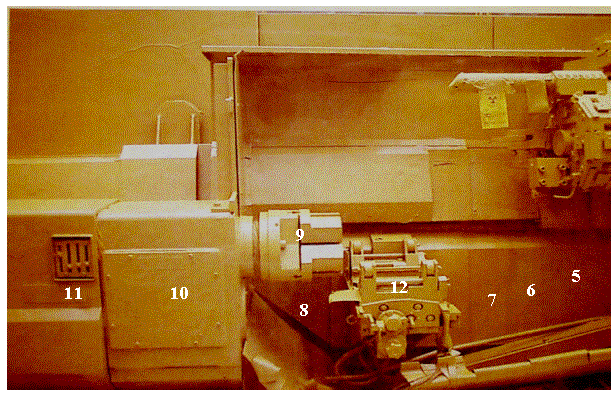
Figure 3. Photograph of the A-Lathe showing measurement points 5-12.

Figure 4. Photograph of the A-Lathe showing measurement points 14-21 and 23-27 of the first generation assay.
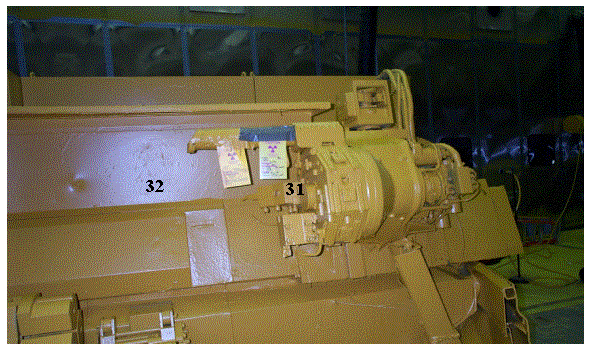
Figure 5. Photograph of the A-Lathe showing measurement points 31 and 32 of the first generation assay.
Acquisition 5 was obtained from a distance of eight inches from the right end of the vertical front of the lathe. Acquisitions 6 through 11 were also taken from a range of eight inches by moving the detector incrementally eight inches to the left for each successive spectrum. Acquisition 9 was taken of the chuck, and acquisition 12 was taken by viewing the holder in front of the chuck vertically from a height of eight inches. (See Figure 3.) The measured value from each of these acquisitions is listed in the last column of Table 1 in rows 5 through 12. The sum of these acquisitions indicates 25 grams holdup on these components taken together as a group.
We then obtained eighteen contact measurements in acquisitions 14 through 21 and 23 through 32. The measured values obtained from each of these contact measurements was obtained from an interactive fit of equation (4)
cpm = 1.03x10⁵m/(1 + 0.147m), (4)
which was derived empirically in reference 6. In (4), m is mass in grams of U-235 HEU residue. The close-contact measurement results are listed in the appropriate row for each acquisition in the seventh column of Table 1.
The NaI detector crystal is a cylinder of radius 1 inch and height 2 inches. In a close-contact configuration the detector shield is touching the surface of the item measured, and the circular base of the detector views exactly p in2 of surface area of the component. Looking, for example, at the four contact spectra taken of the catch pan (Figure 4), acquisitions 14 through 17, the detector viewed a total of 4p in2 and observed a sum of 0.76 g HEU residue. From the exact dimensions of the catch pan we obtain a total surface area of 2280 square inches. Assuming a uniform distribution of residue, this yields a total surface contamination of
[235U] = (0.76/4p)(2280) = 138 g.
Using very similar reasoning and calculations, the content of HEU residue on the holder under the chuck (Figure 4) can be estimated from acquisitions 18 and 19 to be
[235U] = [(0.6+1.3)/2p](22x35) = 233 g.
The content of HEU residue on the chuck (Figure 4) can be estimated from acquisition 21 to be
[235U] = (0.6/p)(35/2)(35/2)(p) = 184 g.
The contact estimates very likely have uncertainty near 100%. But we believe they strongly support the overall conclusion that the lathe contained gross amounts of HEU residue and demonstrated that the chuck, holder, and catch pan should be decontaminated. These assay results and conclusions were reported in reference 8.
After an initial decontamination by FDD personnel, we performed a second assay of the lathe on February 6, 2001. The spectra acquired in this set of assays are listed in Table 2. The first acquisition in Table 2 is a background count. Acquisitions F1 through F4 are far-field point source counts obtained from the front of the lathe (F1) and from the two ends and back of the lathe from a distance of 48 inches. The next twelve acquisitions (C5 through C16) are close-field acquisitions obtained at a distance of 8 inches. These were taken as shown in Figures 6 and 7. In the initial decontamination, the chuck was removed from the lathe, so that acquisition C16 was actually obtained from the space formerly occupied by the chuck. The acquisitions labeled PanC1 through PanC4 were obtained vertically from above the catch pan at a distance of 8 inches. The acquisition labeled Chuck was taken of the bagged out, removed chuck. That acquisition was obtained from a distance of 24 inches. The acquisition labeled Bag(SC) is a count of the bag of recovered residue obtained from the decontamination. It too was taken from 24 inches.
Table 2. Measured 185-keV g-ray
peak area and U-235 mass obtained with the 2x2 NaI detector
in each configuration
at 8 inches (second day).
|
Acquisition Number |
Count Time (sec) |
Area of 185 KeV |
% s |
cps |
Point Source Grams |
Area Source Grams |
|
105CBG |
335.03 |
379 |
30.39 |
0.88 |
|
|
|
F1 |
120 |
7559 |
2.36 |
62.11 |
18.03 |
|
|
F2 |
120 |
1690 |
6.07 |
13.20 |
3.83 |
|
|
F3 |
120 |
1862 |
5.47 |
14.63 |
4.25 |
|
|
F4 |
120 |
3552 |
3.53 |
28.72 |
8.34 |
|
|
C5 |
60 |
10725 |
2.01 |
177.87 |
|
1.37 |
|
C6 |
60 |
16695 |
1.55 |
277.37 |
|
2.14 |
|
C7 |
60 |
11924 |
1.68 |
197.85 |
|
1.52 |
|
C8 |
60 |
3960 |
3.29 |
65.12 |
|
0.50 |
|
C9 |
60 |
1805 |
5.57 |
29.20 |
|
0.22 |
|
C10 |
60 |
16208 |
1.47 |
269.25 |
|
2.07 |
|
C11 |
60 |
16762 |
1.49 |
278.48 |
|
2.14 |
|
C12 |
60 |
29963 |
1.11 |
498.50 |
|
3.84 |
|
C13 |
60 |
22415 |
1.21 |
372.70 |
|
2.87 |
|
C14 |
60 |
64529 |
0.72 |
1074.60 |
|
8.27 |
|
C15 |
60 |
45103 |
0.91 |
750.83 |
|
5.78 |
|
C16 |
60 |
26660 |
1.27 |
443.45 |
|
3.41 |
|
PanC1 |
60 |
65186 |
0.74 |
1085.55 |
|
8.36 |
|
PanC2 |
60 |
20663 |
1.36 |
343.50 |
|
2.64 |
|
PanC3 |
60 |
13639 |
1.74 |
226.43 |
|
1.74 |
|
PanC4 |
60 |
15775 |
1.48 |
262.03 |
|
2.02 |
|
|
|
|
|
|
|
|
|
Bag(SC) |
60 |
10273 |
1.66 |
170.33 |
12.36 |
|
|
Chuck |
60 |
1365 |
5.8 |
21.87 |
1.59 |
|
The point source masses determined for acquisitions F1 – F4 were calculated using equation (5).
[235U] = (Kp)(d)2(measured cps) = (0.000126)(48)2(cps). (5)
The results for acquisitions F1 – F4 are tabulated in the column labeled point source grams in Table 2. These calculations indicate 18 grams remaining on the front face of the lathe after the initial decontamination. The HEU residue contents from acquisitions C5 – PanC4 were calculated in the area source configuration using equation (3). The area source results from each acquisition is tabulated in the last column of Table 2 and represents our best determination of the content of HEU in each individual field of view of the acquisition. Acquisitions C5 – C16 were intended to provide a complete view of the front face of the lathe, and acquisitions PanC1 – PanC4 were intended to provide a complete view of the catch pan. The summed content from the close-coupled measurements of the lathe front is 34.13 g, and the summed content from the close-coupled measurements of the catch pan is 14.76 grams. These two sums taken together yield 48.89 g, which is in good agreement with the sum of the four far field measurements of the obtained in acquisitions F1 – F4 (34.45 g).
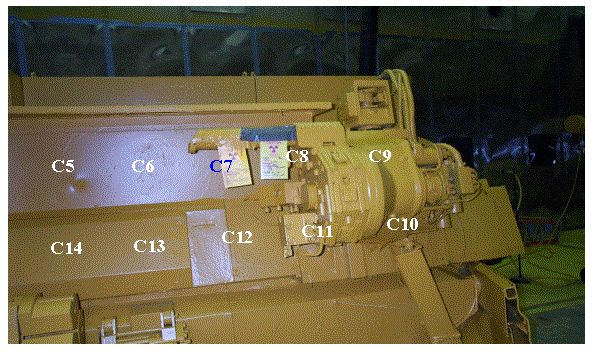
Figure 6. Photograph of the A-Lathe showing measurement points C5-C14 of the second generation assay.
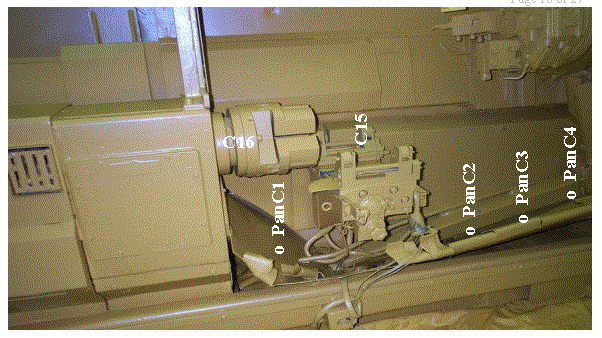
Figure 7. Photograph of the front of the A-Lathe showing measurement points PanC1-PanC4
and C15 & C16 of the second generation assay.
The last acquisition labeled Chuck is a point source acquisition obtained 24 inches from the chuck. The measured HEU content on the chuck was calculated using equation (1) and yields a point source content of 1.59 g. The acquisition labeled Bag(SC) is a point source acquisition obtained from 24 inches of a bag of job control material and residue sweepings. The contents of this bag were calculated using equation (1) and assuming no sample self-absorption. Thus the transmission-uncorrected content of this waste bag is greater than 12 grams.
From the data of the second-generation acquisitions we estimated a content of 49 g (with an uncertainty of 100%) still remaining on the lathe. For this estimate we used the sum of the close field data only. No formal reporting was done from these acquisitions. Rather, FDD management was informed that the lathe still contained sufficient residue to exceed the upper limit of 50 grams within the uncertainty of our determination.
After the second generation assay, upon our recommendation, FDD conducted an additional decontamination to further reduce the HEU content to below 50 grams. The horizontal run of the catch pan was completely removed, and the ingot holder was partly disassembled and decontaminated. We then performed a third assay of the lathe on February 20, 2001. The spectra acquired in this set of assays are listed in Table 3. We again conducted four far field acquisitions from a distance of 48 inches that we labeled as F1 through F4. The next ten acquisitions (C1 through S10) were close field acquisitions obtained at a distance of 8 inches. Acquisitions C1 – C8 were obtained to represent approximately the same total surface area as those of acquisitions C5 – C14 in Table 2. Acquisitions S9 and S10 were obtained from in front of the chuck and from in front of the vertical portion of the catch pan on the right side of the lathe.
Acquisitions F1 – F4 were treated as point source configurations, and HEU holdup was calculated using equation (5).
[235U] = (Kp)(d)2(measured cps) = (0.000126)(48)2(cps). (5)
The results for acquisitions F1 – F4 are tabulated in the column labeled point source in Table 3. These calculations indicate 25 grams remaining on the front face of the lathe and a total of 45 grams in all four far-field acquisitions. The HEU residue content from acquisitions C1 – C8 were calculated in the area source configuration using equation (3). The area source results from each acquisition is tabulated in the last column of Table 3 and represent our best determination of the content of HEU in each individual field of view of the acquisition. Acquisitions C1– C8 and S9 and S10 were intended to provide a complete close-coupled view of the front face of the lathe. The summed content from the close-coupled measurements of the lathe front is 19 g. This is in good agreement with the far-field calculation of 25 grams on the front face.
Table 3. Measured 185-keV g-ray
peak area and U-235 mass obtained with the 2x2 NaI detector
in each configuration
at 8 inches (Third day).
|
Acquisition Name |
Count Time (sec) |
Area of 185 KeV |
% s |
cps |
Point Source Grams |
Area Source Grams |
|
F1 |
60 |
5145 |
2.97 |
85.75 |
24.89 |
|
|
F2 |
60 |
1108 |
7.56 |
18.47 |
5.36 |
|
|
F3 |
60 |
1605 |
6.76 |
26.75 |
7.77 |
|
|
F4 |
60 |
1490 |
5.95 |
24.83 |
7.21 |
|
|
C1 |
60 |
3693 |
3.54 |
61.55 |
|
0.47 |
|
C2 |
60 |
3877 |
3.46 |
64.62 |
|
0.50 |
|
C3 |
60 |
6371 |
2.86 |
106.18 |
|
0.82 |
|
C4 |
60 |
11796 |
1.93 |
196.60 |
|
1.51 |
|
C5 |
60 |
43108 |
0.95 |
718.47 |
|
5.53 |
|
C6 |
60 |
13175 |
1.16 |
219.58 |
|
1.68 |
|
C7 |
60 |
9514 |
2.17 |
158.57 |
|
1.22 |
|
C8 |
60 |
6893 |
2.37 |
114.88 |
|
0.88 |
|
S9 |
60 |
4622 |
3.29 |
77.03 |
|
0.59 |
|
S10 |
60 |
30772 |
1.29 |
512.87 |
|
3.95 |
|
|
|
|
|
|
|
|
|
Ragbag |
60 |
17358 |
1.48 |
289.30 |
2.33 |
|
|
Chips |
60 |
68089 |
0.65 |
1134.82 |
9.15 |
|
The last two acquisitions obtained in the third generation assay were of a bag of job control material used in the second decontamination (Ragbag) and of a bag of residue sweepings obtained in the second decontamination. These two acquisitions were obtained from a distance of 8 inches in the close-field configuration, and were treated as point sources in the determination of HEU content of them. The two HEU content values were calculated using equation (5) with the distance equal to 8 inches instead of 24 inches. The results are listed in the point source column in Table 3.
From the data of the generation three acquisitions we estimated a content of 40 g (with an uncertainty of 100%) still remaining on the lathe. For this estimate we used the sum of the close field data for the front face and added the sum of the far-field measurements for the remaining three sides. As with the second-generation acquisitions, no formal reporting was done from these acquisitions. FDD management was informed that the follow up decontamination had removed further residual HEU, but the lathe still contained sufficient residue to exceed the upper limit of 50 grams within the uncertainty of our determination.
After the third generation assay, upon our recommendation, FDD conducted an additional decontamination to further reduce the HEU content to below 50 grams. Much of the remaining paneling on the front face of the lathe was removed, and the interior portion of the lathe that became visible was decontaminated of residue. The ingot holder was removed. We then performed a fourth assay of the lathe on March 21, 2001. The spectra acquired in this set of assays are listed in Table 4. For these assays electronic signals from the detection system were interrupted after eleven acquisitions. Three far-field acquisitions from a distance of 48 inches were conducted and were labeled as F5 through F7. The next eight acquisitions (C11 through C18) were close-field acquisitions obtained at a distance of 8 inches. Acquisitions C11 – C18 were obtained to represent approximately the same total surface area as those of acquisitions C1 – C8 Table 3. Because of the detection system failure we were not able to obtain the far-field acquisition F8 that would have been analogous to F4 in Tables 2 and 3, and we were not able to obtain the side-looking close-coupled acquisitions that would have been analogous to S9 and S10 of Table 3.
Table 4. Measured 185-keV g-ray
peak area and U-235 mass obtained with the 2x2 NaI detector
in each configuration
at 8 inches (fourth day).
|
Sample Name |
Count Time (sec) |
Area of 185 KeV |
% s |
cps |
Point Source Grams |
Area Source Grams |
|
F5 |
60 |
3475 |
4 |
57.92 |
16.81 |
|
|
F6 |
60 |
1234 |
8 |
20.57 |
5.97 |
|
|
F7 |
60 |
1490 |
6 |
24.83 |
7.21 |
|
|
C11 |
60 |
3023 |
4 |
50.38 |
|
0.39 |
|
C12 |
60 |
6010 |
3 |
100.17 |
|
0.77 |
|
C13 |
60 |
6451 |
3 |
107.52 |
|
0.83 |
|
C14 |
60 |
9155 |
2 |
152.58 |
|
1.17 |
|
C15 |
60 |
26973 |
1 |
449.55 |
|
3.46 |
|
C16 |
60 |
13919 |
1.16 |
231.98 |
|
1.79 |
|
C17 |
60 |
7056 |
2 |
117.60 |
|
0.91 |
|
C18 |
60 |
1714 |
6 |
28.57 |
|
0.22 |
Acquisitions F5 – F7 were treated as point source configurations, and HEU holdup was calculated using equation (5).
[235U] = (Kp)(d)2(measured cps) = (0.000126)(48)2(cps). (5)
The results for acquisitions F5 – F7 are tabulated in the column labeled point source in Table 4. These calculations indicate 17 grams remaining on the front face of the lathe and a total of 37 grams in all four far-field acquisitions. To gain an estimate for acquisition F8 that we were not able to obtain, we used the value of F4 from Table 3. The HEU residue content from acquisitions C11 – C18 were calculated in the area source configuration using equation (3). The area source results from each acquisition is tabulated in the last column of Table 4 and represent our best determination of the content of HEU in each individual field of view of the acquisition. Acquisitions C11– C18 along with intended acquisitions S19 and S20 were intended to provide a complete close-coupled view of the front face of the lathe. The summed content from the close-coupled measurements of the lathe front is 14 g. To attain this estimate we summed the results for acquisitions C11 – C18 and added the results for acquisitions S9 and S10 from Table 3.
The sum of the close-field measurements yielded a content of 14 grams, which is in excellent agreement with the far-field measurement of the front face. The sum of the close-field measurements indicate that the third decontamination performed by FDD decreased the front face HEU content by only five grams. The sum of the far-field measurements yielded a content of 37 grams, which is only very slightly less than those of Table 3. Further decontamination did not seem to be cost effective.
The interpretation of all of the holdup data acquired in each of the four assay generations is described in reference 9. The interpretations of that reference allowed us to report a holdup content with an uncertainty of less than 100%. In the first generation assay we observed > 75 grams of HEU residue on the lathe from the far-field measurements, and the near-field measurements indicated about 500 grams of residue on the chuck, catch pan, and ingot holder. After an effective FDD decontamination effort, the second generation assay indicated 49 grams of residue, with most or all of it concentrated on the front face of the lathe.
Subsequent decontamination was less effective. Our estimates of the total HEU holdup dropped from 49 to 40 to 35 grams. The close-field estimates on the front face dropped from 49 to 19 to 14 grams, and the summed close-field estimates of the front face were consistently in good agreement with the far-field measurements of the front face. Decontamination efforts were never concentrated on the back and two ends of the lathe, and the other three far-field measurements of the back and two ends never changed significantly.
As the measured values were decreasing very slowly, we concluded that each of the last six measurements of the last three assay generations provided a reasonably good determination of HEU holdup on the front face. Likewise the last three far-field assays on the back face and two ends of the lathe provided a reasonable determination of HEU holdup there. We used that technique to estimate holdup in our final analysis in reference 9.
The reported value for the front face was determined by
{(summed close field + far field)assay 2 + (summed close field + far field)assay 3 +
(summed close field + far field)assay 4}/6 =
{(18 + 49)assay 2 + (25 + 19)assay 3 + (17 + 14)assay 4}/6 = (24± 13),
where the uncertainty was determined by the standard deviation of the six values.
The reported value for all other faces was determined by
{(3.8 + 4.2 + 8.3)assay 2 + (5.4 + 7.8 + 7.2)assay 3 + (6.0 + 7.2 + 7.2)assay 4}/3 = (19+2).
We reported a content of (24± 13) + (19± 2) = (43± 13),9 and this value was used in the request for deviation to manifest the HEU holdup content on the lathe.
To confirm our designation of the peaks near 600 keV and 700 keV in the spectrum of Figure 2, we obtained several final spectra of the lathe using the portable high purity germanium detection system. This system is described in reference 10 and has been used extensively in HEU holdup measurements for FDD.11-13 The HpGe spectra were acquired on May 1, 2001 in building 105-C. A background spectrum is shown in Figure 8, and the sample spectrum taken from the middle of the front face in the area source configuration from a range of 48 inches is shown in Figure 9.
The primary objective for the HpGe acquisitions was to confirm the diagnosis of the two peaks in the NaI spectra at about 600 KeV and 700 KeV. Note in Figure 9 that we observe peaks at 511-, 584-, 609-, 728-, 911-, 969-, and 1112-keV. Each of these is from the daughter products of decay of naturally-occurring 2325Th. Except for the large peaks at 143-, 163-, 186- and 203-KeV, which are g-rays from the 235U HEU residue on the lathe, no other strong peaks occur in the spectrum. The high resolution spectrum of the last seven peaks confirms our diagnosis from the NaI spectra and removes any doubt that other process activity might be present as holdup on the lathe.
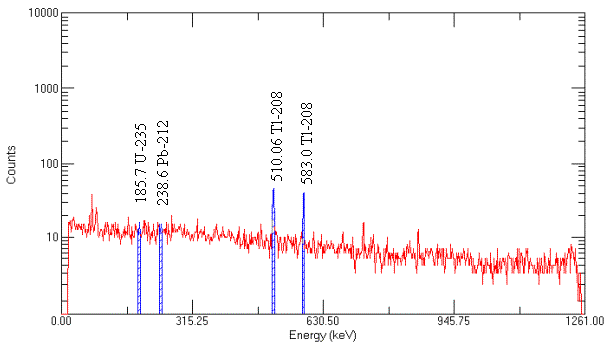
Figure 8. HPGe Background Spectrum in 105-C.
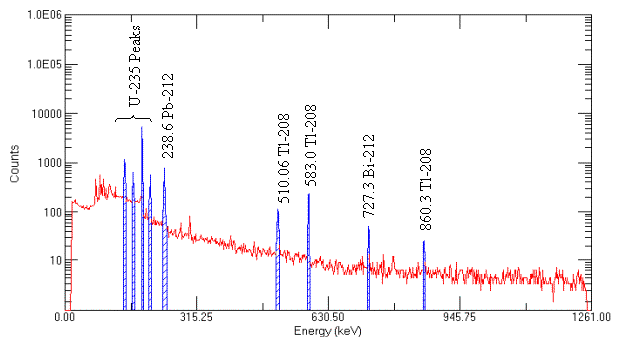
Figure 9. HPGe Spectrum of the Front Face of the Lathe.
From the HpGe spectra we can gain another measure of HEU holdup on the lathe. From a range of 48 inches we estimate that the detector system is approximately able to view the entire front face of the lathe, so that we can rationalize use of either a point source or area source configuration in the calculations. The point-source calculation of HEU holdup is
[235U] = (Kp)(d)2(measured cps) = (2.36x10⁻⁵)(2.54x48)2(46.17), (6)
where Kp is in units of g-sec/cm2 and is taken from the HpGe detector efficiency calibration.10 The measured detection rate in the 186 keV peak was 46.17 cps and yields a measure of 16.2 grams of HEU residue. This value is in excellent agreement with the value reported above.
The area source calculation of holdup is
[235U] = (Ka)(A)(measured cps) = (1.29x10⁻⁵)(26900)(46.17), (7)
where Ka is in units of g-sec/cm2 and is taken from the HpGe detector efficiency calibration. In reference 10 we determined that at a range of 48 inches the detection system views an effective area of 26900 cm2 or 4200 in2. The measured detection rate in the 186 keV peak was 46.17 and yields a measure of 16.0 grams of HEU residue. This value is also in excellent agreement with the value reported above and with that of equation (6).
In order to gain a mass balance on the measured values, we assayed the residue and sweepings from the lathe that were placed in the scrap cans referenced in experimental sections 2.2 and 2.3. The chuck and the floor sweepings from the first and second decontamination were packaged into 55-gallon drum FD2191, and the can of HEU chips was packaged into 55-gallon drum FD2189. Both drums were shipped from C-Area to M-Area for assay on the Q2 solid waste assay instrument. The drums were assayed by the direct Q2 technique and by the adapted three-segment segmented scanner technique. The latter technique is described in references 14 and 15.
The direct Q2 assay method yielded 24 g of 235U in FD2189, while the adapted technique yielded 35 g. The direct assay method yielded 45 g in FD2191. Both of these drums were very massive. FD2189 was 81 kg, and FD2191 was 187 kg. The transmission correction on each was very large and for reasons given in reference 14 should not be considered reliable. The transmission through the bottom section of FD2191 could not even be measured by using the adapted technique, therefore no measured 235U content could be reported by that technique. The Q2 measurements should therefore be considered lower limits of content for these two drums.
The drums were then unpacked so that some of the items could be assayed individually. We were particularly interested in the results for the individual assay of the scrap can that contained the floor sweepings and chips from the lathe decontaminations. We were also interested in the results from holdup measurements of the chuck. The individual scrap can assays are discussed in the next section.
After removal of the scrap can from the drum FD2189 it was re-assayed as drum FD2189-1 using the direct Q2 technique only. Though it was not repacked, drum FD2191 was also re-assayed as drum FD2191-1. In addition, we used the direct Q2 technique to assay the job control material and instacoat material from the decontaminations of the lathe. These were packaged into drum FD1992, which was assayed by the direct Q2 technique. The results of the direct Q2 assays are listed in Table 5. Table 5 also contains results from the direct assay of three additional drums that we discuss later in this report. Uncertainties are estimated to be about 60%.
The results of Table 5 demonstrate that drum FD2191, which contains the chuck from the lathe, could be assayed with good precision to have 40 – 50 grams of 235U holdup. Drum FD2189 contained approximately 20 – 30 grams of HEU residue, which was contained entirely in the scrap can. Drum FD1992 contains approximately 10 – 20 grams of 235U contamination from the decontamination activities performed in the 105-C Decon Facility.
For drum manifest purposes, we note that drum FD2189 now contains 0.3± 0.2 g HEU, the content of drum FD2191 should be reported as 48± 29 g, and the content of drum FD1992 has already been reported as 14± 8 g.
Table 5. Direct Q2 assay results for several drums that contained
lathe
decontamination job control material and residue.
|
Drum Number |
Grams of HEU |
|
FD2189 |
24± 14 |
|
FD2191 |
45± 27 |
|
FD1992 |
14± 8 |
|
FD2189-1 |
0.3± 0.2 |
|
FD2191-1 |
48± 29 |
|
FDcan6213 |
7± 4 |
|
FDcan6205 |
3± 2 |
|
FDcan6212 |
10± 6 |
The scrap can that contained the lathe residue was assayed using the 321-M transmission corrected billet assay station. The assay station was efficiency calibrated for the Deming16 technique and for the traditional far-field transmission-corrected configuration. Both of these techniques are described in reference 10. The calibration for our Deming technique used six standards that ranged in content from 0.69 g to 102.38 g of 235U. The calibration data are shown in Table 6 and were fit with the quadratic curve
cps = 0.541 + 1.670m - 0.00707m2, (8)
where m is the mass of 235U in grams.
Table 6. Deming Calibration Data.
|
Standard Number |
Mass of U-235 (g) |
Counts per second |
s cps |
|
wt2014a |
1.01 |
2.31 |
0.08 |
|
wt2016a |
38.84 |
52.59 |
0.55 |
|
wt2019a |
15.66 |
26.47 |
0.32 |
|
wt2021a |
4.85 |
8.34 |
0.16 |
|
wt2023a |
0.69 |
1.63 |
0.06 |
|
wt2026a |
102.39 |
98.25 |
1.06 |
The Deming technique is an empirical fit to the data that already contain the sample self-absorption transmission correction. The billet assay station far-field transmission-correction technique uses equation (6) with distance equals 45.5 inches, and the transmission correction uses the traditional source shine through.
[235U] = (Kp)(d)2(measured cps)(Cf) = (2.36x10⁻⁵)(2.54x45.5)2(cps)(Cf). (6)
The transmission source was a mass of 4.85 g acquired at a distance of 74 inches. The transmission-corrected data are listed in Table 7, which is an Excel spreadsheet that performs the transmission-corrected assay calculations. The unabsorbed transmission source spectrum T0 had a count rate of 5.81 cps in the 235U peak. Using equation (6) at a distance of 74 inches we obtain an excellent QC check of the system.
[235U] = (Kp)(d)2(measured cps)(Cf) = (2.36x10⁻⁵)(2.54x74)2(5.81)(1), (6)
= 4.84 g.
We also performed quality control checks of the system by counting each of the sources 0.69-g, 1.01-g, 15.66-g , and 102.38-g in the far field transmission corrected configuration. Results and uncertainties are listed in columns 10 and 11 and in columns 12 and 13 of Table 7. We obtained excellent transmission-corrected agreement for the first three sources, and we note that the method fails when the source self-absorption becomes large. We had previously set our upper limit for this technique with scrap cans at 30 g,13 so the inability of the system to correctly assay the 102 g source is not a system failure. The Deming results are in excellent agreement with the known values for the five smallest mass sources. As with the transmission-corrected calculation, the Deming interactive fit routine was not able to project a measured content for the largest source.
The spectrum acquired of scrap can W0412, which contained the HEU residue from the decontaminaton of the lathe, had a detection rate of 46.40 cps in the sample-only spectrum (W0412) and a rate of 48.54 cps in the transmission spectrum (W0412T). These data are listed in Table 7 also. From equation (6), we obtained a measured content of 24.1± 1.6 g with a transmission-correction factor of 1.65. The Deming interactive fit of spectrum W0412 yielded a content of 31.7± 3.3 g. To improve accuracy in these measurements, we requested that scrap can W0412 be repackaged into three separate cans that would have lower mass and lower transmission correction.
The results from the repackaged cans (6205, 6212, and 6213) are listed in Table 7. The Deming results and uncertainties are shown in columns 12 and 13. We note that the values of column 10 and column 12 are in fairly good agreement. Where they differ we generally prefer the Deming values. That preference is the choice we have made in the scrap can values we have previously reported in reference 7.
In summary, we originally measured > 75 g HEU on the lathe. After three decontaminations we measured approximately 40 g left on the lathe and approximately 90 g in the decontamination material recovered. This total of 130 g is well within the original estimate and closes the material balance. Due to the uncertainties in the measurements, the 40-g reported remaining might be as high as 53 g, so a deviation request for disposal over the 50 g limit was requested to be sure that the conservative bases of the WAC are maintained.
Table 7. Results of the transmission corrected far field
g-PHA assay of scrap cans.
|
Date |
Can |
tT = CT (sec) |
CT = counts |
sT = count error |
tC = CT (sec) |
CC = counts |
sC = count error |
Trans |
MU = 235U (g) |
2sU = MU Error |
Deming |
Deming |
||||||||||||||||||||||||||||||||||||||||||||||||||||||||||||
|
|
Number |
4.85g U + Can |
4.85g U+Can |
4.85g U + Can |
Can |
Can |
Can |
Corr |
Can |
Can |
235U (g) |
2sU |
||||||||||||||||||||||||||||||||||||||||||||||||||||||||||||
|
6/4/01 |
321BKG604 |
6000 |
1066 |
69 |
|
|
|
|
|
|
|
|
||||||||||||||||||||||||||||||||||||||||||||||||||||||||||||
|
6/4/01 |
ic2023a |
300.48 |
1077 |
37 |
600 |
870 |
37 |
1.65 |
0.75 |
0.088 |
0.55 |
0.34 |
||||||||||||||||||||||||||||||||||||||||||||||||||||||||||||
|
6/4/01 |
ic2021 |
|
|
|
400 |
3335 |
62 |
|
|
|
4.76 |
0.50 |
||||||||||||||||||||||||||||||||||||||||||||||||||||||||||||
|
6/4/01 |
ic2014a |
300 |
1483 |
42 |
500 |
1155 |
39 |
1.49 |
1.08 |
0.104 |
1.06 |
0.33 |
||||||||||||||||||||||||||||||||||||||||||||||||||||||||||||
|
6/4/01 |
ic2016a |
|
|
|
200 |
10518 |
110 |
|
|
|
36.93 |
1.75 |
||||||||||||||||||||||||||||||||||||||||||||||||||||||||||||
|
6/4/01 |
ic2019a |
300 |
8451 |
100 |
300 |
7943 |
96 |
1.85 |
15.46 |
1.049 |
16.71 |
|
||||||||||||||||||||||||||||||||||||||||||||||||||||||||||||
|
6/4/01 |
ic2026a |
100 |
10069 |
107 |
100 |
9825 |
106 |
1.54 |
47.79 |
3.201 |
|
|
||||||||||||||||||||||||||||||||||||||||||||||||||||||||||||
|
6/5/01 |
Tcan |
300 |
822 |
32 |
|
|
|
|
|
|
|
|
||||||||||||||||||||||||||||||||||||||||||||||||||||||||||||
|
|
|
|
|
|
|
|
|
|
|
|
|
|
||||||||||||||||||||||||||||||||||||||||||||||||||||||||||||
|
|
|
|
|
|
|
|
|
|
|
|
|
|
||||||||||||||||||||||||||||||||||||||||||||||||||||||||||||
|
|
|
|
|
|
|
|
|
|
|
|
|
|
||||||||||||||||||||||||||||||||||||||||||||||||||||||||||||
|
6/4/01 |
W0412 |
300 |
14563 |
131 |
300 |
13920 |
129 |
1.65 |
24.08 |
1.591 |
31.7 |
3.3 |
||||||||||||||||||||||||||||||||||||||||||||||||||||||||||||
|
|
|
|
|
|
|
|
|
|
|
|
|
|
||||||||||||||||||||||||||||||||||||||||||||||||||||||||||||
|
6/5/01 |
6205 |
300 |
3213 |
62 |
300 |
2499 |
55 |
1.56 |
4.10 |
0.317 |
4.76 |
0.50 |
||||||||||||||||||||||||||||||||||||||||||||||||||||||||||||
|
6/5/01 |
6212 |
300 |
9762 |
107 |
300 |
8898 |
103 |
1.42 |
13.28 |
0.896 |
18.95 |
1.98 |
||||||||||||||||||||||||||||||||||||||||||||||||||||||||||||
|
6/5/01 |
6213 |
300 |
6534 |
87 |
300 |
5786 |
86 |
1.53 |
9.28 |
0.650 |
11.81 |
1.22 |
||||||||||||||||||||||||||||||||||||||||||||||||||||||||||||
|
|
|
|
|
|
|
|
|
|
|
|
|
|
||||||||||||||||||||||||||||||||||||||||||||||||||||||||||||
|
|
|
|
|
|
|
|
|
|
|
|
|
|
||||||||||||||||||||||||||||||||||||||||||||||||||||||||||||
|
|
|
|
|
|
|
|
|
|
|
|
|
|
||||||||||||||||||||||||||||||||||||||||||||||||||||||||||||
|
|
|
|
|
|
|
|
|
|
|
|
|
|
||||||||||||||||||||||||||||||||||||||||||||||||||||||||||||
|
|
|
|
|
|
|
|
|
|
|
|
|
|
||||||||||||||||||||||||||||||||||||||||||||||||||||||||||||
|
|
|
|
|
|
|
|
|
|
|
|
|
|
||||||||||||||||||||||||||||||||||||||||||||||||||||||||||||
|
|
|
|
|
|
|
|
|
|
|
|
|
|
||||||||||||||||||||||||||||||||||||||||||||||||||||||||||||
|
ST (4.85g Uranium Standard transmission @189 cm) = 5.81 cps |
||||||||||||||||||||||||||||||||||||||||||||||||||||||||||||||||||||||||
|
Transmission Correction = SQRT(ST/CanT) where:CanT = ((CT/tT) - (CC/tC)) |
||||||||||||||||||||||||||||||||||||||||||||||||||||||||||||||||||||||||
|
MU (grams 235U) = (CC/tC)(2.36E-05)(47x2.54)2(SQRT (ST/CanT)) |
where:CanT = ((CT/tT) - (CC/tC)) |
|||||||||||||||||||||||||||||||||||||||||||||||||||||||||||||||||||||||
|
2sU = (MU)(2.0)SQRT((SQRT((sT/CT))2+(sC/CC))2))/(CC/tC))2+SQRT(7/236)2+SQRT(0.112)2) |
||||||||||||||||||||||||||||||||||||||||||||||||||||||||||||||||||||||||
We have used four techniques to conduct the holdup assay of 235U in the 321-M A process lathe. The holdup assays were conducted over a period of five months in which we performed four distinct measurements after three successive decontaminations of the process lathe. In order to gain closure and to lend support to our measurements, we also conducted assay measurements of the residual HEU scrap that was removed from the lathe in the decontaminations. For the same purposes, we conducted assays of the HEU contamination that remained on the job control waste material and that remained on the individual working components as they were removed from the lathe.
Our initial far field holdup assay performed with a NaI detection system demonstrated that at least 75 g of HEU residue and contamination were on the lathe. Close-field and contact measurements indicated the value could be as high as several hundred grams. After three successive decontamination efforts by FDD operators we finally reported a total content of 43± 13 grams remaining on the lathe. This value with uncertainty was accepted with a request for a deviation to allow removal of the lathe for on-site burial. The deviation was required because the reported value plus uncertainty exceeds the criticality limit of 50 g HEU for an individual B-25 container. Follow up assay of the front face of the decontaminated lathe using a high purity germanium detection system yielded results in very good agreement with the final NaI measurements.
Our assays of the decontamination job control material, of the chuck component of the lathe, and of the HEU residue removed from the lathe were conducted using the 321-M assay station and using the 313-M Q2 assay instrument. Together these items were packaged in three 55-gallon drums that we assayed using either the direct Q2 technique or using the adapted three-segment technique. In these three drums we observed a summed content of 80 g HEU, for which we estimated an uncertainty of 60%.
The scrap can of HEU residue that was inside one drum was removed and assayed on the 321-M far-field transmission-corrected assay station. In our measurements we observed a content of 32± 3 g, in very good agreement with the adapted Q2 measurement of 35± 13 g. Because of the fairly large content, the can was repackaged into three separate cans that were again separately measured on the assay station. In these three cans we observed a sum of 36± 2 g. These individual cans were subsequently packaged into separate 55-gallon drums that were assayed by the direct Q2 technique. We observed a total of 20± 12 g in these three measurements.
For closure we have reported a total of 43± 13 g remaining on the lathe and a total of about 90± 40 g removed from the lathe in one form or another. Thus we have accounted for a total of approximately 130± 40 g of HEU. This is in very good support of our initial report of >75 g of HEU holdup on the lathe. No follow-up assay was performed on some of the lathe components that were placed in a separate B-25. Thus some HEU still remains unaccounted for.