
WSRC-TR-2000-00467
SAES ST909 Bench Scale Methane Cracking Tests
J. E. Klein
Westinghouse Savannah River Company
Aiken, SC 29808
This report was prepared as an account of work sponsored by an agency of the United States Government. Neither the United States Government nor any agency thereof, nor any of their employees, makes any warranty, express or implied, or assumes any legal liability or responsibility for the accuracy, completeness, or usefulness of any information, apparatus, product or process disclosed, or represents that its use would not infringe privately owned rights. Reference herein to any specific commercial product, process or service by trade name, trademark, manufacturer, or otherwise does not necessarily constitute or imply its endorsement, recommendation, or favoring by the United States Government or any agency thereof. The views and opinions of authors expressed herein do not necessarily state or reflect those of the United States Government or any agency thereof.
This report has been reproduced directly from the best available copy.
Available for sale to the public, in paper, from: U.S. Department of Commerce, National Technical Information Service, 5285 Port Royal Road, Springfield, VA 22161, phone: (800) 553-6847, fax: (703) 605-6900, email: orders@ntis.fedworld.gov online ordering: http://www.ntis.gov/support/ordering.htm
Available electronically at http://www.osti.gov/bridge/
Available for a processing fee to U.S. Department
of Energy and its contractors, in paper, from: U.S. Department of Energy, Office
of Scientific and Technical Information, P.O. Box 62, Oak Ridge, TN 37831-0062,
phone: (865 ) 576-8401, fax: (865) 576-5728, email: reports@adonis.osti.gov
Summary
Bench scale tests using a stack of ten whole SAES St909 pellets, 6 grams, to crack methane have been completed with methane feed compositions ranging from 5 vol% to 100 vol% methane, zero to 95 vol% helium carrier gas, 20 to 95 vol% hydrogen carrier gas, and one test with 1.9 vol% ammonia in the feed gas as an impurity. Test conditions ranged from 600 to 800°C, 380 to 1520 torr, and feed gas flows from 10 sccm to 20 sccm. Methane reformation tests, test where hydrogen was passed through a St909 bed after cracking methane, were performed to determine if and how much methane can be generated under these conditions.
Phase structure determinations of St909, composed of a ZrMnFe alloy with aluminum used as a pellet binder, after methane cracking were complicated by the number of materials that can be formed by the elements in the St909 and the carbon from methane cracking. It was determined that the aluminum not only alloys with the Zr, Mn, and Fe in the St909 alloy, but also forms aluminum transition metal carbides in addition to ZrC as the carbon content and the temperature of the St909 increases. Some Al4C3 was also found in some pellets. Passing hydrogen over St909 pellets after methane cracking formed methane at various rates in the temperature range of 600 to 800°C.
A baseline test, for comparison of other test results, was run at 10 sccm of 4.9 vol% methane and a 95 vol% helium at 760 torr and a reactor temperature of 700°C. The methane contained 1 vol% argon which allowed residual gas analyzer signals to calculate methane cracking efficiencies on a relative, instead of absolute, basis.
Temperatures of 800°C gave the best methane cracking performance and efficiencies decreased rapidly with temperature. Increasing test gas feed flow rate and increasing the hydrogen composition of the carrier gas reduce methane cracking efficiencies. Methane cracking efficiency is increased as pressure increases. Ammonia as an impurity in the feed gas greatly reduces methane cracking efficiency; although, the ammonia is cracked at very high efficiencies.
Continued bench scale testing and larger scale tests are needed to better understand St909 methane cracking performance in a full scale St909 bed.
Introduction/Background
Tritium extracted from Commercial Light Water Reactor (CLWR) targets will be primarily hydrogen isotopes (tritium and protium), water, helium-4, and helium-3. Relatively low levels of impurities such as carbon monoxide, carbon dioxide, and methane are also expected in the extraction gas stream. Some methane is expected to have tritium substitution for some of the protium atoms. Tritiated ammonia is expected to form in some part of the extraction process due to the large size of the vacuum extraction furnace and the inevitable in-leakage of nitrogen from the secondary containment modules. These tritiated carbon and nitrogen species need to be processed to reduce tritium emissions from tritium processing facilities.
SAES St909 is a Zr-Mn-Fe alloy getter material which can crack water, methane, ammonia, and getter oxygen, carbon dioxide, and carbon monoxide [Ref. 1]. SAES St909 is 40.5 wt% Zr, 24.5 wt% Mn, 25 wt% Fe, and 10 wt% Al. The supplied material is advertised as a single-phase ZrMnFe alloy with the aluminum used as a binder for pellet formation.
The most systematic study on the performance of SAES St909 for methane cracking is found in Ref. 1. In Ref. 1, methane cracking performance by St909 for 0.1% and 1.0% methane in a helium carrier gas was extensively studied covering a wide range of operating conditions.
Bench scale tests to expand the methane cracking test conditions of Ref. 1 using SAES St909 were performed. Additional tests performed were to 1) better characterize performance of the material near 700°C, 2) examine the phase structure or form of the cracked carbon remaining with the St909, 3) determine if carbon formed with the St909 would release methane when exposed to a hydrogen carrier stream, 4) measure performance at higher methane concentrations, 5) determine if protium or a small amount of ammonia in the carrier stream alters cracking performance, and 6) measure performance at different pressures.
Experimental
Test Matrix
Table 1 summarizes the bench scale test matrix which was broken down into six Test Sets with Set tests labeled alphabetically. Test Set 1 was to determine the form of carbon on the getter as a function of temperature by cracking methane over the material at a series of temperatures and analyzing the phases of the material after the tests. Carbide alloys are more thermodynamically stable than amorphous carbon on the surface of the material and were expected to be formed.
Test Set 2 was to determine if St909 which had cracked methane could liberate or form methane when hydrogen was passed over the material.
Test Sets 3 through 6 used a nominal 5 vol% methane/argon mix in a helium carrier, at 700°C, 760 torr, and a total gas feed flow rate of 10 sccm as a baseline test (Test 3b) to which other tests will be compared. These Test Sets were to determine the impact on methane cracking efficiency at different temperatures, Test Set 3, at different residence times, Test Set 4, different carrier gas compositions, Test Set 5, and at different pressures, Test Set 6.
Material
The St909 material used was identified by the manufacture, SAES Getters of Milan, Italy, as St909/PIECES/64, Lot Number M043800007. The pellets are cylindrical with an O.D. of 6 mm by 4 mm tall and weigh approximately 0.6 grams each. Triplicate micrometer measurements made on the fresh, unreacted St909 pellets consistently gave an O.D. of 0.239 inches. The pellets are metallic, silvery in appearance. Unless stated otherwise, ten fresh/unreacted, whole pellets were used for each test: 6 grams per test.
Table 1. Experimental Test Matrixa
|
Test Set |
Temp. (°C) |
Pressure (torr) |
Flow (sccm) |
Feed Gas Composition (vol.%) |
||||
|
CH4 |
Ar |
H2 |
NH3 |
He |
||||
|
1a |
600 |
760 |
10.0 |
100.0 |
n/a |
n/a |
n/a |
n/a |
|
1b |
650 |
760 |
10.0 |
100.0 |
n/a |
n/a |
n/a |
n/a |
|
1c |
700 |
760 |
10.0 |
100.0 |
n/a |
n/a |
n/a |
n/a |
|
1d |
750 |
760 |
10.0 |
100.0 |
n/a |
n/a |
n/a |
n/a |
|
1e |
800 |
760 |
10.0 |
100.0 |
n/a |
n/a |
n/a |
n/a |
|
2a
|
600 600 |
760 760 |
10.0 10.0 |
100.0 n/a |
n/a n/a |
n/a 100.0 |
n/a n/a |
n/a n/a |
|
2b
|
700 700 |
760 760 |
10.0 10.0 |
100.0 n/a |
n/a n/a |
n/a 100.0 |
n/a n/a |
n/a n/a |
|
2c
|
800 800 |
760 760 |
10.0 10.0 |
100.0 n/a |
n/a n/a |
n/a 100.0 |
n/a n/a |
n/a n/a |
|
3a |
650 |
760 |
10.0 |
4.90 |
0.05 |
n/a |
n/a |
95.05 |
|
3b |
700 |
760 |
10.0 |
4.90 |
0.05 |
n/a |
n/a |
95.05 |
|
3c |
800 |
760 |
10.0 |
4.90 |
0.05 |
n/a |
n/a |
95.05 |
|
4a |
700 |
760 |
12.5 |
4.99 |
0.05 |
n/a |
n/a |
94.96 |
|
4b |
700 |
760 |
15.0 |
4.97 |
0.05 |
n/a |
n/a |
94.98 |
|
4c |
700 |
760 |
17.5 |
4.97 |
0.05 |
n/a |
n/a |
94.98 |
|
4d |
700 |
760 |
20.0 |
4.96 |
0.05 |
n/a |
n/a |
94.98 |
|
5a |
700 |
760 |
10.0 |
4.90 |
0.05 |
n/a |
1.89 |
93.16 |
|
5b |
700 |
760 |
10.0 |
4.90 |
0.05 |
19.96 |
n/a |
75.10 |
|
5c |
700 |
760 |
10.0 |
4.91 |
0.05 |
95.04 |
n/a |
n/a |
|
6a |
700 |
1520 |
10.0 |
4.90 |
0.05 |
n/a |
n/a |
95.05 |
|
6b |
700 |
380 |
10.0 |
4.90 |
0.05 |
n/a |
n/a |
95.05 |
aCompositions vary due to full-scale range and 0.1% set point resolution of flow controllers.
Gases
Five gases were used for these tests: methane, 1.00 vol% argon/balance methane mixture, helium, 1.99 vol% ammonia/balance helium, and hydrogen. Compressed gas cylinders used were Air Liquide Research Grade methane of 99.99% purity, Air Liquide (High Purity Plus) grade helium of 99.995% purity, and Air Products Industrial Zero Grade hydrogen of 99.997% purity.
The 1.00 vol% argon/balance methane gas was a mix of Air Liquide High Purity Plus grade argon, greater than or equal to 99.99% purity, and Ultra-High Purity grade methane, greater than 99.92% purity, filled into lecture bottles. The 1.99 vol% ammonia/balance helium gas was a mix of Air Liquide Anhydrous grade ammonia, greater than 99.99% purity, and High Purity Plus grade helium, greater than or equal to 99.99% purity, filled into lecture bottles. Argon from a liquid argon boil-off tank was also used for some system flow testing.
Test Reactor/Bed
The test reactor/bed was made from 3/8 inch O.D. by 0.035 inch wall, bright annealed 316L stainless steel (SS) tubing welded to Cajon VCR fittings. The St909 test material was held in the reactor by a filter cup in the heated zone of the furnace: a Mott sintered metal 316L filter cup, ¼ inch O.D. by 1/8 inch I.D. by 1 inch long, 2mm nominal pore size. The filter cup was compressed ("Swaged") into position inside the 3/8 inch O.D. tubing. An attempt was made to weld the compressed tube to the filter cup, but full weld penetration could not be demonstrated or obtained.
The reactor was designed such that a stack of ten St909 pellets would have the middle of the pellet stack in the center of the heater. The bed was mounted in a vertical orientation with gas feed into the top and gas exit out the bottom of the bed. At room temperature, a 0.239 inch diameter pellet would occupy 61 percent of the cross-sectional area of the reactor tube.
Apparatus
A simplified test system schematic is shown in Figure 1. The gas handling system was composed of a variety of valves and tubing. The majority of the test system gas tubing between the MFCs and the header was constructed using 1/8 inch O.D. by 0.085 inch I.D. 316 SS tubing (1.12 cc per foot of tubing) to reduce tubing volumes. 1/8 inch, 4-port, two position switching, gas chromatographic (G.C.) valves were also used to reduce dead volume and pockets of impurities in the system: they functioned like two, three-way ball valves in their ability to valve-in or bypass a piece of equipment. Ball valves and Nupro bellow seal valves were also used in the construction. Swagelok, Cajon VCR, Conflat metal gasket, and KF elastomer gasket fittings were also used in construction of the system. System volumes were calibrated using pressure-volume-temperature (P-V-T) gas expansions from the calibrated volume.
Gas flows were controlled by MKS Series 1179 mass flow controllers (MFCs) with full-scale ranges of 10 sccm, 10 sccm, 50 sccm, and 50 sccm for methane, hydrogen, argon, and helium, respectively. The MFCs were calibrated using volumetric glassware measuring volume displacement with time and temperature and pressure corrected to standard conditions of 760 torr and 0°C. A variety of gases could also be supplied directly to the header without going through the low flow range MFCs.
System pressures were measured with calibrated, high accuracy MKS 390/690 series pressure transducers (PTs) at the inlet to the bed, the outlet of the bed, and in the outlet gas collection header. An MKS 248A pressure control valve located after the test bed was used to control the pressure during the tests. The system vacuum was supplied by an Alcatel 5030 molecular drag pump and was backed by an Edwards scroll pump discharging to the hood exhaust.
Figure 1. Simplified Test System Schematic
1/8 inch O.D. Type K thermocouples (TCs) were used for all temperature measurement. All TCs were calibrated using an ice bath as a reference point. The TCs used for test bed temperature measurements were calibrated by the Savannah River Standards Lab.
A Watlow ceramic fiber heater, 1 inch I.D. by 3 inch O.D. by 6 inch long was used to heat the test bed with a temperature controller and a redundant over-temperature limit controller. A dual element TC was used for the controller temperature signal with the other channel used by the data logging system. A second TC supplied the control signal for the over-temperature controller. The TCs were attached to the test bed by an Inconel sleeve machined to match the O.D. of the test bed with two troughs for each of the two TCs. The TC tips were placed ½ inch higher on the bed than the filter cup crimp and were held in place by wire ties. After test bed installation, insulation was placed around the top and bottom of the heater to reduce heat losses.
Between the pressure control valve and the gas collection header, a small flow-through palladium-on-kieselguhr (Pd/k) Bed was installed. For Test Sets 1 and 2, the Pd/k Bed was used to reduce the amount of hydrogen that would accumulate in the collection header and thus concentrate methane that was not cracked during testing. The Pd/k bed, made from a 4.94 inch long, 2-3/4 inch Conflat style flange vacuum system nipple, contained 75 grams of approximately 50 wt% Pd on kieselguhr, and had a filled void volume of approximately 126 cc. The Pd/k bed was immersed in a circulating water bath at 3.9°C during hydrogen absorption and placed in a furnace heated to 200°C for hydrogen desorption. A 1000 cc gas collection volume/cylinder was installed on the header for collecting gases when using the Pd/k bed.
Gas sample ports on the collection header allowed taking "grab samples" of gases for SRS mass spectrometer (M.S.) analyses. A Leybold Inficon model TSPTT100 residual gas analyzer (RGA), atomic mass unit range up to mass 100, was added to the system for Test Set 3 through 6 tests. A Granville-Phillips Series 203 variable leak valve was used to leak gas to the RGA which was evacuated using a Varian Turbo-V70 turbo pump.
To minimize dead volume and improve the response time of the RGA signal, a "flow through" leak was created. One tube of the Granville-Phillips variable leak was fitted with a ¼ inch Swagelok tee such that a 1/8 inch O.D. tube could be run through the tee and have one end near the leak mechanism of the valve. The gas flow from the test bed entered the 1/8 inch tubing outside the tee, flowed through the 1/8 inch tube, flowed across the face of the leak valve mechanism, flowed back through the annulus created by the 1/8 inch and ¼ inch tubes, and was discharged back to the system through the branch of the ¼ inch tee. The other tube of the variable leak valve was connected to the RGA with the leak gas flow controlled by the variable leak valve position indicator.
Test Bed and Sample Weighings
The empty test bed and St909 material were weighed before filling the bed and the bed weighed after it was filled. After a test, the filled bed was weighed, the material removed and the empty bed and material weighed separately. Pellet removal after a test was many times facilitated by cutting open the bed with a tubing cutter about ¼ inch above the crimp used to hold the filter cup. For tests where powder was used, the powder after the test had swelled firmly into the bed and had to be removed by scraping.
All beds except Beds #01-01 and #01-02 had their individual pellets tracked by using an engraver to uniquely identify each pellet. Before and after each test, the pellets were weighed individually and the 10 pellets weighed cumulatively to cross-check individual weighings. A pellet’s weight was recorded and its stacking order in the test bed tracked.
Bed and Pellet Micrometer Measurements
Engraving marks were made on the test bed at increments of 0.5, 1.0, 1.5, and 2.0 inches up from the top of the filter cup crimp. Triplicate micrometer measurements were made before and after a test at each location. For all beds except Beds #01-01 and #01-02, triplicate pellet diameter micrometer measurements were made before and after a test and these measurements tracked with the pellet mass data.
Rate-of-Rise (ROR) Efficiency Estimates
Baseline flow tests were performed to measure the rate-of-rise (ROR) pressure increase in the collection header without flow through an active St909 bed. Tests were done by flowing argon, methane, or hydrogen at a nominal 10 sccm through the system which included the Pd/k bed at operating conditions. The results showed that argon and methane had nearly identical ROR responses in the collection header while the hydrogen test showed a considerable lag time in the ROR measurements before gas accumulation in the header – an indication of hydrogen absorption by the Pd/k bed. The ROR for 10 sccm methane, through the system and Pd/k bed, and into the header was determined by linear regression of the data to be 45.01 torr/minute.
Assuming all hydrogen was absorbed by the Pd/k bed, methane cracking efficiencies were estimated by measuring the header ROR during a test and comparing it to the ROR without a test bed installed:
ROR Efficiency = 1 – ROR(measured)/ROR(w/o bed = 45.01 torr/min.)
This method was used for methane cracking efficiencies for Test Set 1 and 2 tests unless stated otherwise.
RGA Efficiency Estimates
The 1 vol% argon in the methane was available and used as the test gas for Test Sets 3 through 6 so methane cracking efficiencies could be calculated on a relative, rather than an absolute, basis. Argon gives an RGA signal at mass 40 and a smaller, doubly ionized peak at mass 20. Methane gives a mass 16 peak and to varying degrees, smaller fragmentation peaks at mass 15, 14, 13, and 12. By having a test bed bypass valve and the variable leak after the test bed, gas analysis of the feed gas or the test bed effluent could be monitored continuously by the RGA.
Before the start of a decomposition test, the test bed was bypassed and RGA data collected. During testing, the test bed was valved into the flow stream and RGA data collected. After completion of the test, the test bed was bypassed and RGA data collected again on the feed gas.
During decomposition testing, the same mass peaks were analyzed by the RGA as were done when bypassing the test bed and the reduction of the methane peaks relative to the argon peaks could be determined. Using the ratio of methane-to-argon mass peaks, the estimated methane cracking efficiency was calculated using
RGA Efficiency = 1 – (massCH4/massAr)test / (massCH4/massAr)feed
where massCH4/massAr is the RGA mass peak chosen to represent methane divided by the RGA mass peak chosen to represent argon: the subscripts "feed" and "test" indicate the feed gas ratio and the reactor outlet gas ratio during testing, respectively.
Feed gas compositions were analyzed by the RGA before the start and after the end of a test. The options for expressing the ratio (massCH4/massAr) include (16/40), (15/40), (16/20), (15/20), and other combinations where peak intensities where summed: e.g. ((16+15)/(40+20). These ratios at the start as well as at the end of the test were computed as averages of several RGA readings. Unless stated otherwise, the average of the (16/40)feed ratio at the start and at the end of the test were used to calculate methane cracking efficiency: a (13/40)feed ratio was used for Test 5a where ammonia was included in the feed gas.
Activation
After installing a test bed into the system, the bed was evacuated to circa 1x10⁻³ to 1x10⁻² torr and ROR leak checks performed. Activation of the material was done by heating the material to 600°C for 2 hours while flowing 10 sccm of helium through the test bed. It should be noted that the activation temperature is below the 660°C melting temperature of the aluminum used as a pellet binder material.
Test Set 1 Decomposition Tests
Methane decomposition tests were performed using the Research Grade methane at the conditions in Table 1. After bed activation the helium was evacuated, the test bed isolated, and a methane line flush and evacuation performed. The pressure control valve was set to 760 torr and exhausted through the Pd/k bed to the collection header. The test bed was valved into the system, and the methane flow started. It took a nominal 8 minutes to fill the system to 760 torr before the pressure control valve would exhaust gas to the Pd/k bed.
The pressure in the gas collection header was allowed to accumulate before isolating the header and transferring the gas to previously evacuated cylinders – the Collection Volume, the Calibrated Volume, or both. In some tests, the amount of gas in the collection header and collection volumes exceeded system capacity. In this case, the header was isolated, the gas evacuated from the header and collection volume(s), and then the test continued as before
Tests were run in an attempt to obtain a material carbon loading of 6.6 wt %: circa 792 scc of cracked methane. After the initial system test to evaluate test step sequences (Bed#01-00 test), Tests 1c (700°C), 1d (750°C), and 1e (800°C) were run to obtain the target carbon loading by mass balance. The amount of methane cracked was estimated by integrating the methane feed rate with time and subtracting the amount of methane collected in the header and collection volumes. Tests 1a (600°C) and 1b (650°C) were terminated knowing that the target carbon loading was not obtained.
After completing the test, M.S. samples were collected of the gas in the collection header. The test bed was evacuated, purged and back-filled with helium before isolation, cool-down, and sample removal for weighing, micrometer measurements, and pellet XRD analysis.
Test Set 2 Methane Reformation Testing
To condition samples in preparation for the methane reformation tests, samples were exposed to methane under the same conditions as Test Set 1 tests: 10 sccm methane, 760 torr, same temperature, and same test duration for Test 1c (700°C, 220 minutes) and Test 1e (800°C, 120 minutes). The methane flow time for Test 2a (600°C) was chosen to be 280 minutes.
After methane cracking, the test beds were held at temperature in 800 torr helium until the reformation test, i.e. hydrogen flow, could be started. This delay was required to desorb hydrogen from the Pd/k Bed absorbed during methane cracking and to cool the Pd/k Bed before the test hydrogen flow could begin. The time between stopping the methane flow and starting the hydrogen flow was nominally 17 hours (the hydrogen flow started the following morning) while the minimum turn-around time for test continuation would be close to 8 hours.
Methane reformation tests were performed at the same temperature at which the methane was cracked: 600, 700, and 800°C. 10 sccm of hydrogen was flowed through the test bed for the same amount of time as the methane flow in the bed preparation step. The gas exiting the reactor passed through the pressure control valve, the chilled Pd/k bed, and on to the collection header.
All the gas that passed through the Pd/k bed was contained in the collection header - no removal of accumulated gas from the collection header to collection volumes was required. After completing the test, M.S. samples were collected of the gas in the collection header. In Test 2c (the 600°C test), helium was supplied through the system to increase the collection header pressure for M.S. gas sample collection.
After collecting M.S. samples, the bed was evacuated, purged and back-filled with helium before isolation, cooled-down, and sample removal for weighing, micrometer measurements, and XRD analysis.
RGA Tuning
A "tune" mix of argon, nitrogen, hydrogen, carbon dioxide, methane, and helium was made to tune the RGA before starting Test Sets 3 through 6. The desired peak shape would have a 10 percent relative width (10% R.W.) value of 0.90 and mass peaks centered at their appropriate values. Peak shaping and positioning for several masses was an iterative process – altering the response for one mass influenced the results for another mass. Initial tuning for mass 2 had a wide spread in the peak and a 10% R.W. value of 0.50 – characteristic of inexpensive RGAs. The mass 18 peak for trace water in the system had a 10% R.W. 0.95 while the 10% R.W. value was 0.90 for masses 4,16, 20, 28, 40, and 44.
Before the last test, Test 5a which included the use of ammonia for the first time, the RGA was tuned again. Before retuning, it was found that most peaks had drifted slightly to lower mass numbers. The tune gas mixture, the 1.99% ammonia/balance helium gas, and the 1.0% argon/balance methane gas were all used to examine RGA signals for mass peaks 2, 4, 12, 13,14, 15, 16, 17, 20, 28, 40, and 44. The best tuning characteristics that could be obtained with the RGA were 10% R.W. values of 0.85 to 0.90 for mass 2, 0.85 for mass 4, 0.85 to 0.90 for mass 12, 0.90 for mass 13, 0.85 to 0.90 for mass 14, 0.85 to 0.90 for mass 15, 0.90 to 0.95 for mass 16, 0.90 for mass 17, 0.90 for mass 20, 0.85 to 0.90 for mass 28, 0.90 to 0.95 for mass 40, and 0.90 for mass 44.
Test Set 3 Through 6 Testing
The bed was activated as described before. It was discovered that the pressure at the RGA head varied at a fixed variable leak position due to the different compression ratios of the pumps for hydrogen, helium, and other residual gases in the pump train. The leak also had to be set at different positions for tests at pressures other than 760 torr. During the early part of the bed activation, the variable leak was opened 10 positions further for two minutes to help set up a helium pumping pressure profile in the pump train before returning it to its estimated test position.
After activation, test bed temperature and pressure, if not 760 torr, were adjusted to test conditions and the bed valved-out of the gas flow path. The gas blend for the test was made by establishing the flows of the MFCs, opening the pressure control valve to help evacuate line volumes and minimize mixing times, and then resetting the pressure control valve to its control function. After the feed gas flows were established, the variable leak was adjusted, if needed, to obtain the target pressure for the RGA sensor.
The software used for data acquisition had five fixed masses logged, 2 (hydrogen), 18 (water), 28 (nitrogen), 32 (oxygen), and 44 (carbon dioxide). Five other masses were user selectable. For all but Test 5a, the five selectable masses logged were 16 and 15 for methane, 40 and 20 for argon, and 4 for helium. For Test 5a, the ammonia fragmentation masses of 16, 15, and 14 would over-lap with the methane fragmentation masses so 13 for methane, 14 which included both methane and ammonia (nitrogen) fragments, 40 and 20 for argon, and 17 for ammonia were logged.
RGA data of the feed gas were collected before and after a test by having the reactor valved out of the gas flow path. A test was initiated by valving the test bed into the gas flow path. Test duration was chosen to be 27 hours which would pass circa 790 scc of methane through the test bed. After collecting RGA data of the feed gas after the test, the lines were flushed with helium, the helium flow set to 10 sccm and 760 and the bed purged for nine minutes with this flow before isolation, cool-down, removal, and sample analyses.
Results
Test bed identification (ID) numbers were of the form "01-xx" where "01" indicates bed design one, the only design used for these tests, and "xx " indicating the two digit bed identification number. A new test bed was used for each methane cracking test. Bed ID numbers indicate the sequence of the tests performed except beds #01-22 and #01-23 whose orders were reversed. Some Bed ID numbers may be skipped due to test failures or use of a bed for other purposes.
Set 1 and 2 Methane Cracking Efficiencies
Figure 2 shows the ROR of methane cracking efficiencies as a function of time for Test Set 1 and 2 tests: the plotted values are five point running averages. Figure 2 shows methane cracking tests are quite reproducible. This gave a good indication that a similar amount of carbon was with the St909 pellets in Test Set 2 preparation runs as were found in Test Set 1 results.
Cracking efficiency anomalies in Figure 2 are as follows. The apparent increase in efficiency for Test 1c (700°C) after 187 minutes was an artifact of collecting the Pd/k Bed effluent in the Collection Volume in addition to the collection header. This generated a positive offset in efficiency of approximately of 6.6%. The increase in efficiency for Test 1a (600°C) after 123 minutes was due to a decrease in methane flow from 10 sccm to 2 sccm. The decrease in efficiency for Test 2b after 142 minutes was due to the inadvertent introduction of hydrogen into the system through the header instead of exhausting the collected header gas into Collection Volume and Calibrated Volume. The impact on the test was the Pd/k Bed was loaded with "external" hydrogen, had a reduced absorption capacity for hydrogen from methane cracking, and thus a net reduction in ROR efficiency.
To examine the impact surface area had on methane cracking efficiency, tests similar to Tests 1a, 1c, and 1e were run using St909 pellets crushed to a powder using a mortar and pestle. Ten pellets for each test were crushed to a fine powder. Figure 3 compares the methane cracking efficiency of the Test Sets 1 and 2 when using pellets and powders.
Test Set 1 and 2 Mass Spectrometer Sample Analyses
M.S. samples taken of the header gas at the end of Test Set 1 and 2 decomposition tests showed that the majority of the gas accumulating in the header was methane. Test Set 1 had nominally 97.6 to 99.1 vol% methane, 0.9 to 2.2 vol% hydrogen, and 0.03 to 0.12 vol% for water, nitrogen, oxygen, argon, and carbon dioxide combined. Test 2a had similar results. Test 2c had methane and hydrogen results in the ranges of those found for Test Set 1 tests, but had 0.26 vol% non-hydrogen, non-methane results with 0.17 vol% of that being argon. Test 2b had 25 vol% hydrogen and this was attributed to the introduction of hydrogen from the header as described earlier. These M.S. data indicate the ability of the Pd/k bed to remove hydrogen from the reactor outlet stream and that the ROR measurements give reasonable estimates of methane cracking efficiencies.
Test Set 2 Methane Reformation Tests
Figure 4 shows the collection header pressure as a function of time for the second part of Test Set 2 methane reformation tests: the hydrogen flow through the test bed after cracking methane. The initial header pressure increase to circa 16 torr is due to helium back-fill of the bed being released into the test manifold. The next characteristic pressure increase to circa 34 torr is due to the pressure control vale overshoot as the system fills with gas and the start of pressure control by the valve.
The net header pressure increase at 120 minutes was 117 torr for Test 2c (800°C), 107 torr for Test 2b (700°C), and 76 torr for Test 2a (600°C). At the end of the hydrogen flow, the header pressure was 132 torr, 179 torr, and 134 torr for Tests 2c, 2b, and 2a, respectively. M.S. samples were taken for the 800°C and 700°C tests at these pressures while the 600°C test had some helium supplied to the system, through the test bed and Pd/k bed to increase the header pressure to 155 torr before M.S. sampling. M.S. results for the reformation test samples are summarized in Table 2.
Figure 2. Test Set 1 and 2 Methane Cracking Efficiencies

Figure 3. Pellet Versus Powder Efficiencies for Test Set 1 Decomposition Conditions

Figure 4. Test Set 2 Methane Reformation Test Pressure Data

Table 3 summarizes methane cracking results for Test Sets 1 and 2 and the powder tests. Test Set 2 pellet weight change measurements were done after completing the reformation part of the test. The efficiencies in Table 3 are ten-point averages at the time shown.
Test Sets 3 Through 6 Methane Cracking Efficiencies
An estimate of the lag time in RGA data sampling was made before using the RGA for testing. An empty test bed at ambient temperature was filled with helium at 760 torr and isolated. A flow of argon was supplied to the system at 10 sccm and 760 torr. The time between valving in the argon flow to test bed and the first response of the RGA to the helium was approximately 46 seconds. The helium RGA signal was constant for circa 100 seconds, and then decreased with an apparent first order time constant of circa 50 seconds to its initial baseline value in a total of seven minutes. Lag times of this magnitude were considered acceptable for tests lasting 27 hours and testing was started.
Table 4 summarizes some of the results for Test Sets 3 through 6. Table 4 includes the (16/40)feed RGA ratios obtained before and after a test, the RGA Efficiencies at the end of the test using the (16/40)feed ratio before and after the test, and the efficiency computed using the average of the start and end (16/40)feed values. For Test 5a, the (13/40)feed values, instead of (16/40)feed values are presented in Table 4 and used for figure data plots.
Table 4 shows the (16/40)feed ratios are fairly constant for the tests. The Test 3a start value is high due to an initial low argon concentration in the methane feed due to an inadequate line flush of the Research Grade methane before the start of the test. Test 5b and 5c, the tests with hydrogen in the carrier stream, also give larger (16/40)feed ratios. The reason for the relatively larger (16/40)feed ratios for Test 6b, the 380 torr test, is uncertain, but the ratio was constant.
Table 2. Methane Reformation Mass Spec Gas Analyses
|
Test |
Temp. (°C) |
Bed ID |
Mass Spectrometer Gas Analysis Results (vol%, duplicate sample averages) |
|||
|
H2 |
He |
CH4 |
Other |
|||
|
2a |
600 |
#01-07 |
4.8 |
83.5 |
11.4 |
0.3 |
|
2b |
700 |
#01-08 |
3.4 |
66.8 |
29.6 |
0.2 |
|
2c |
800 |
#01-06 |
3.3 |
71.4 |
24.4 |
0.9 |
Table 3. Summary Set 1 and 2 Pellet and Set 1 Powder Tests
|
Testa |
(°C) |
Bed ID |
Test Duration (min.) |
Mass Gainb (%) |
ROR Methane Cracking Efficiency |
||
|
@ 30 min (%) |
@ 120 min. (%) |
End of CH4 Flow (%) |
|||||
|
1a |
600 |
#01-02 |
243d |
3.05 |
29 |
11 |
21d |
|
n/a |
600 |
#01-12 |
284 |
6.12 |
59 |
17 |
8 |
|
1b |
650 |
#01-05 |
282 |
4.34 |
32 |
13 |
9 |
|
1c |
700 |
#01-03 |
220 |
5.58 |
43 |
29 |
21e |
|
n/a |
700 |
#01-11 |
220 |
8.96 |
67 |
39 |
24 |
|
1d |
750 |
#01-04 |
170 |
6.63 |
65 |
43 |
35 |
|
1e |
800 |
#01-01 |
120 |
6.79 |
83 |
51 |
51 |
|
n/a |
800 |
#01-09 |
120 |
10.87f |
93 |
69 |
69 |
|
2a |
600 |
#01-07 |
280 |
3.67 |
32 |
12 |
7 |
|
2b |
700 |
#01-08 |
220 |
5.59 |
44 |
26 |
7g |
|
2c |
800 |
#01-06 |
120 |
6.84 |
82 |
52 |
52 |
aBeds #01-10, #01-11, #01-12 used crushed
material; others, whole pellets.
bWeight change by difference in pellet masses, except Beds
#01-10, #01-11, #01-12 which used the difference in the
empty bed and the filled bed before and after the tests.
cUsing collection header ROR assuming only methane effluent
from Pd/k Bed.
dAfter 123 minutes at 10 sccm methane flow, flow reduced
to 2 sccm for 120 minutes.
eEstimated differently due to collection volume size difference:
6.6% offset used to obtain value.
f1.106 grams of unreacted powder was found in system and
mass adjusted accordingly.
gEfficiency reduced due to valve error "external"
hydrogen loading of Pd/k Bed.
Table 4. Set 3 Through 6 St909 Gain, (16/40)feed, and End Efficiencies
|
Test |
Bed ID |
St909 Mass Gain (%) |
(16/40)feed |
Test End RGA Efficiency Using (16/40)feed, (%) |
||||
|
Start |
End |
Change (%) |
Start |
End |
Average |
|||
|
3a |
#01-17 |
3.07 |
53.56 |
49.92 |
6.8 |
33.7 |
28.8 |
31.3 |
|
3b |
#01-16 |
4.81 |
50.05 |
49.50 |
1.1 |
47.8 |
47.2 |
47.5 |
|
3c |
#01-15 |
6.66 |
82.43 |
49.93 |
39.4 |
94.4 |
90.8 |
93.0 |
|
4a |
#01-21 |
5.08 |
53.01 |
50.41 |
4.9 |
39.7 |
36.6 |
38.2 |
|
4b |
#01-23 |
5.18 |
54.20 |
51.19 |
5.5 |
35.4 |
31.6 |
33.5 |
|
4c |
#01-22 |
5.68 |
54.06 |
51.01 |
5.6 |
37.2 |
33.4 |
35.3 |
|
4d |
#01-24 |
5.78 |
54.33 |
50.12 |
7.8 |
29.0 |
23.0 |
26.1 |
|
5a |
#01-28 |
4.52 |
2.362a |
2.359a |
0.1a |
24.87a |
24.78a |
24.83a |
|
5b |
#01-19 |
3.55 |
58.52 |
57.90 |
1.1 |
41.4 |
40.8 |
41.1 |
|
5c |
#01-26 |
2.40 |
69.11 |
76.98 |
-11.4 |
17.9 |
26.3 |
22.3 |
|
6a |
#01-27 |
4.21 |
57.03 |
56.74 |
0.5 |
43.2 |
42.9 |
43.0 |
|
6b |
#01-20 |
5.11 |
53.17 |
54.21 |
-2.0 |
63.0 |
63.7 |
63.4 |
aUsed (13/40)feed instead of (16/40)feed values.
RGA Efficiencies will be plotted as a function of scc of methane fed to the test bed instead of time so efficiencies at different flow rates can be compared on the same basis. Figure 5 shows the effect of temperature for Test Set 3 tests. The methane cracking efficiency is significantly higher at 800°C than at lower temperatures. The decrease, increase, and then decrease in cracking efficiency at 700°C is similar to that seen in Figures 2 and 3 for 100 vol% methane at 600°C. Test 3a, at 650°C, only shows a slight inflection in its plot, but not the minima-maxima trace seen in the 700°C test.
Figure 6 shows the effect of residence time for Test Set 4 tests. Test 4b, 15 sccm flow test, was inadvertently terminated 151 minutes, 111 scc of methane, short of the test target value. As expected, the methane cracking efficiency is higher at lower flow rates, i.e. longer residence times, and decreases as flow rate increases. Test 4b All plots exhibit the minima-maxima trace seen before.
Figure 7 shows the effect of ammonia and hydrogen in the carrier gas for Test Set 5 tests. The methane cracking efficiency is significantly reduced as the concentration of hydrogen increases. The 20 vol% hydrogen test shows the minima-maxima trace seen before, but this inflection is not seem for the 95 vol% hydrogen carrier stream.
Figure 5. Test Set 3 - Effect of Temperature on Methane Cracking Efficiencies

Figure 6. Test Set 4 - Effect of Flow Rate on Methane Cracking Efficiencies

The cracking efficiency in Figure 7 for Test 5a, the test with 1.9% ammonia in the feed gas, shows that ammonia reduces the cracking efficiency below the baseline test. After the minima-maxima points in the efficiency plot, the efficiency drops off quickly. The ammonia cracking efficiency is also shown in Figure 7 using the average RGA (17/40)feed values at the start and end of the test and is a nominal 97% at the end of the test.
Figure 8 shows the effect of total pressure for Test Set 6 tests. The methane cracking efficiency is significantly increased as the pressure increases. The lower pressure test, Test 6a at 380 torr, does not show as much difference as the test at 1520 torr, Test 6b.
Pellet Weight Change
The post-test pellets appeared darkened black compared to pre-test pellets. The pellets remained intact with insignificant fines created. No loose soot was apparent on the pellets or as a result of handling the pellets.
Table 3 data show remarkable similar weight changes for Test Set 1 and 2 pellets run at the same temperature for the same test time. The 700°C tests, Test 1c and 2b, had 5.58 wt% versus 5.59 wt% changes, respectively. Similarly, the 800°C test, Test 1e and 2c, had 6.79 wt% versus 6.84 wt% changes, respectively. The weight change for Test 1a at 600°C was expected to be less than that of Test 2a at 600°C due to the decrease in methane flow rate in Test 1a and the longer test time for Test 2a.
Figure 9 shows the weight change for the individual pellets as a function of test bed position: pellet 1 indicates the pellet at the bottom of the pellet stack and pellet 10 the pellet at the top of the stack where the gas entered the bed. Average values are shown in Figure 9 for Test 1a and 1e due to the lack of individual pre-test pellet weights for these tests. Figure 9 variations in pellet weight change follow somewhat of a parabolic profile except Test 1c which shows a downward slope from reactor bottom to top. The data circled in the figure indicate the pellets selected for x-ray diffraction (XRD) analyses. For Test 1e and 1a, pellet 10 was arbitrarily identified as the pellet used for XRD analysis.
Figures 10, 11, 12, and 13 show individual pellet weight change reactor profiles for Test Set 3, 4, 5, and 6, respectively. Figure 10 for Test Set 3 shows that at 800°C, the pellets show a significant gradient from the highest weight change at the inlet of the reactor to lowest weight change at the outlet of the reactor. Figure 11, Test Set 4 results, shows somewhat of a trend of increasing pellet mass gain at increasing flow rate. Table 4 data confirm the trend, but the difference in total weight change between Test 3b and Test 4d is less than 1 wt% which is on the order of individual pellet variations in the same test bed.
Figure 12, Test Set 5 results, shows that as the hydrogen concentration of the carrier stream increases, the weight gain profile shifts to lower values. Figure 13, Test Set 6 results, shows the pellet profiles for the 380 torr test, Test 6b, and the baseline test at 760 torr, Test 3b, have similar profiles. The Figure 13 profile for the 1520 torr test, Test 6a, shows a larger gradient from higher weight gain at the inlet to lower weight gain at the outlet of the reactor.
Figure 7. Test Set 5 - Effect of Carrier Gas Composition on Methane Cracking Efficiencies

Figure 8. Test Set 6 - Effect of Pressure on Methane Cracking Efficiencies

Figure 9. Test Set 1 and 2 Pellet Weight Change Reactor Profiles

Figure 10. Test Set 3 Pellet Weight Change Reactor Profiles
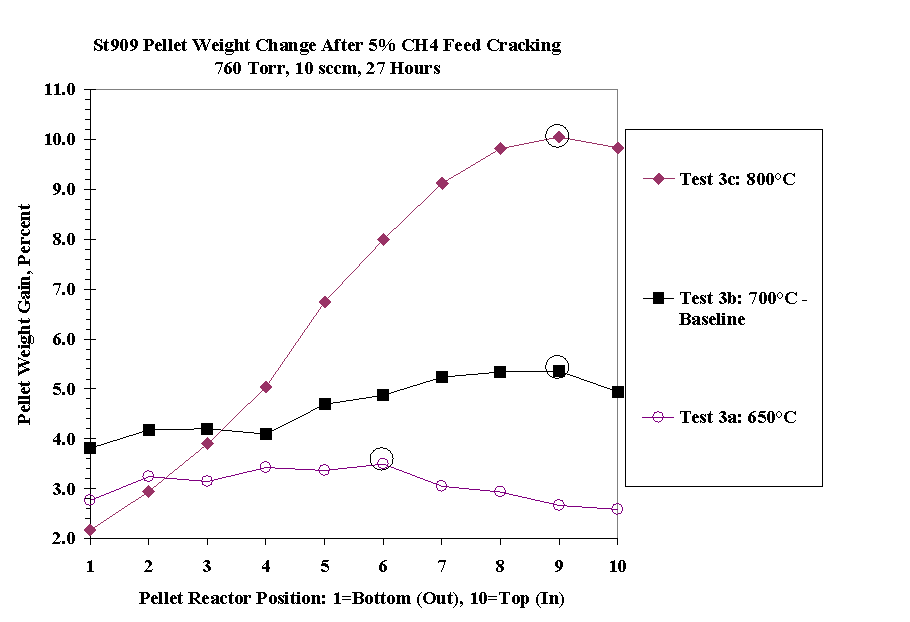
Figure 11. Test Set 4 Pellet Weight Change Reactor Profiles

Figure 12. Test Set 5 Pellet Weight Change Reactor Profiles

Figure 13. Test Set 6 Pellet Weight Change Reactor Profiles

Bed and Pellet Diameter Changes
Post-test bed diameter measurements found no significant change, outside of measurement error, in test bed outside diameter.
To determine if incorporating carbon into the St909 would cause the pellets to swell, four tests without methane were done to create pellets for comparison to the other pellets. Three pellets were used for each test and gas flows were 10 sccm and the pressure controlled at 760 torr.
For one test, helium was passed over the heated pellets for two hours at 600°C (Sample #13A), as was done during pellet activation, while the other test was conducted similarly at 800°C (Sample #14A). The two other tests had helium flow past the pellets for 2 hours and then had hydrogen pass over the pellets for an additional 2 hours. These tests were done at 600°C (Sample #13B) and 800°C (Sample #14C) and instead of evacuating the hydrogen after the test, the bed was isolated and cooled down in the hydrogen atmosphere in an attempt to make a metal hydride and swell the pellets.
Figure 14 shows the change in individual pellet diameter as a function of pellet weight change for beds with pre and post weight change data and for the four non-methane test pellets. It is not the author’s intention for the reader to identify specific test data in the figure, but to point out the three general areas of results.
One area of interest in Figure 14 is the region of zero weight change for the four tests which did not use methane. This region shows that diameter changes can be produced without the use of methane and that changes may result from just simply heating the pellets. The second region is the cluster of data in the center of the figure which has some pellet diameter changes lower, some the same, and some higher than the non-methane tested pellets. The third region is the anomalous results of Test 3c which shows much higher diameter changes compared to data with similar weight changes. For some individual tests, there can be found a general trend of increased pellet diameter change with increasing mass change, but this trend is not a general trend for all data.
Figure 14. Pellet Swelling Versus Weight Change

X-Ray Diffraction Analysis
XRD analyses were performed on the St909 material to determine the phase compositions. The analyses are complicated due to the large number of phases that could be formed. In the test temperature range, aluminum has a melting temperature of 660°C and manganese has an aMn to bMn phase transition at 727°C. Slightly higher temperatures would include an aZr to bZr phase transition at 863°C, and an aFe to gFe phase transition at 912°C. The lowest temperature eutectics for any two elements were 928°C for Fe-Zr and 1090°C for Mn-Zr [Ref. 2].
Possible binary alloys for Al, C, Fe, Mn, and Zr are: Al4C3, Fe3Al in the range of 400-550°C, FeAl, FeAl2, Fe2Al5, FeAl3, Al6Mn, Al11Mn4, Zr3Al, Zr2Al, Zr3Al2, Zr4Al3, ZrAl, Zr2Al3, ZrAl2, ZrAl3, Zr5Al3 and Zr5Al4 above 988°C, Fe3C, Mn3C between 917 to 1052°C, Mn23C6, Mn5C2, Mn7C3, ZrC, Zr3Fe, Zr2Fe between 775 and 974°C, ZrFe2, ZrFe3, and Mn2Zr [Ref. 2]. Fe-Mn does not exist as binary alloys, but as solutions of the different phases of the two materials.
The XRD pattern for "new" (as received) St909 material compares well to the reference spectrum for ZrMn2. The crystal structure differences between manganese and iron are small and it was assumed the XRD pattern represented the St909 ZrMnFe alloy. The diffraction pattern for Cr0.5Fe1.5Zr was also used for some analyses to represent the XRD for the ZrMnFe alloy. Diffraction patterns for aluminum, the pellet binder material, were also present. Other minor peaks present matched the pattern for zirconium carbide, ZrC. It was conjectured that impurity contamination occurred during the manufacturing of the material -- possibly from the use of a graphite crucible to form the alloy.
The XRD pattern for Sample #13A, pellets heated for two hours in helium at 600°C, showed the addition of small peaks matching those of Al3Zr in addition to the peaks for the "new" material sample. The pattern for Sample #14A, the sample heated for two hours in helium at 800°C, showed increased Al3Zr peak heights over those seen in Sample #13A, the addition of AlZr3 peaks, and the disappearance of the aluminum peaks – a small peak for Al9.83Zr0.17 may also be present. Some additional, unmatched minor peaks are present in the samples which most likely represent the spectra for the residual components of the initial ZrMnFe material.
The XRD pattern for Sample #13B, pellets heated two hours in helium and then two hours in hydrogen showed the same ZrMn2, ZrC, and Al3Zr alloys as for Sample #13A, but a three to four fold increase in Al3Zr peak intensities and the almost disappearance of the Al peaks. The XRD patterns for Sample #14C, two hours in helium and then two hours in hydrogen showed little difference compared to the pattern for Sample #14A in hydrogen except the addition of small peaks matching Mn3AlC. It was assumed the carbon was from the initial ZrC present in the material.
XRD patterns for all pellets that had been used for cracking methane had decreased signal to noise ratios. The crystalline content of the samples had been decreased by a factor of two to three, indication the presence of an amorphous phase in the material. It can not be stated if the amorphous phase is from carbon from methane cracking or from alloys formed from the residual Zr, Mn, Fe, and Al .
The XRD pattern for Test 1a (600°C) showed peak matches for ZrC, Al3Zr, and Cr0.5Fe1.5Zr representing the ZrMnFe alloy. The XRD pattern for Test 1b (650°C) shows peaks similar to those found for Test 1a, but larger peak intensities for ZrC which might be expected for the larger weight gain for Test 1b pellets.
The XRD pattern for the next higher Set 1 test temperature, Test 1c at 700°C, shows ZrC and ZrMn2 peaks as seen in the Test 1b sample, but the disappearance of the Al3Zr peaks and the appearance of an aluminum transition metal carbide peaks for Al12Mn15.6C, and small peaks for Mn3AlC. The XRD pattern for Test 1d at 750°C shows the same alloys found for Test 1c with larger ZrC peaks associated with the larger weight gain of the Test 1d sample and two to three times larger Mn3AlC peaks. The XRD peaks for the Test 1e (800°C) sample were similar to those of the Test 1d sample with the peaks of the starting alloy (ZrMn2) greatly decreased, slightly larger Mn3AlC peaks, and the appearance of small Al4C3 peaks.
The XRD pattern for the Test 2a (600°C) sample, which had hydrogen passed over it after methane cracking, showed the same alloys present as for the Test 1a sample, the test without hydrogen after methane cracking. Test 2a had higher ZrC peaks than Test 1a which was attributed to the higher weight gain for the Test 2a sample.
The XRD pattern for the Test 2b (700°C) sample showed a decrease in the peaks for the starting alloy (ZrMn2) pattern compared to the Test 1c sample XRD pattern. A slight increase was observed in the Mn3AlC peak heights. The XRD pattern for the Test 2c (800°C) sample showed another decrease in the peaks for the starting alloy (ZrMn2) pattern compared to the Test 1e XRD pattern and is almost gone from the pattern. Slight increases were observed in the Mn3AlC and the Al12Mn15.6C peaks.
The XRD pattern for the Test 3a (650°C) sample, 5 vol% methane for 27 hours, showed the presence of Al3Zr and AlZr3 as were seen in Test Set 1 and 2 samples at 600°C, but also Mn3AlC peaks that were seen in previous samples only at 700°C and above. The XRD pattern for the Test 3b (700°C) sample shows ZrC, ZrMn2, and Mn3AlC peaks, but no Al-Zr alloy peaks as seen in the 650°C test. The XRD pattern for the Test 3c (800°C) sample showed ZrC peaks and large Mn3AlC peaks with the almost disappearance of the ZrMn2 peaks.
Discussion
XRD results for pellets not exposed to methane showed that not only temperature, but time at temperature may influence the alloys present. For example, XRD results for Samples #13B and #14C were thought to increase the Al3Zr peaks seen not due to the hydrogen, but due to increased time at the test temperature while flowing hydrogen over the sample. It was interesting to note that no hydride was detected by XRD analyses, but PVT absorptions would be a better method to determine if a hydride was formed.
It appears that heating the St909 pellets for 2 to 4 hours caused Al to pull Zr out of the ZrMnFe alloy to form the Al3Zr and at 800°C, AlZr3. At 800°C, the Al also alloyed with Mn/Fe to pull carbon from the ZrC present in the "new" material and formed alloys represented by Mn3AlC. Even without the addition of carbon to the pellets from methane cracking, the pellets underwent changes in diameter after heating and cooling back to room temperature.
XRD results from Test Set 1 tests showed that the carbon from cracked methane not only goes to ZrC, but also to a compound represented by Mn3AlC XRD patterns. The decrease in signal-to-noise ratio for XRD analyses of pellets after methane cracking showed the presence of an amorphous phase which could be graphitic carbon on the pellets, but this could not be confirmed and may be a result of other amorphous compounds.
XRD results for Test Set 1 tests at 600°C and 650°C showed Al3Zr peaks that were not present for XRD results at 700°C, 750°C, and 800°C: the Al was present in peaks represented by Al12Mn15.6C and Mn3AlC. As temperature increased above 700°C and weight change increased, the XRD sample results showed larger ZrC and Mn3AlC peaks with a decrease in size of the reference ZrMn2 peaks to the point where almost no pattern was present. At 800°C, some small Al4C3 peaks were present.
Test Set 2 tests showed repeatability of St909 methane performance when compared to Test Set 1 tests performed under the same conditions. Test Set 2 also showed some methane could be formed by passing hydrogen over the pellets after methane cracking. A collection header volume of 37 cc and 20°C and a Pd/k Bed volume of 126 cc at 4°C with a Test 2b (700°C) system pressure of 123 torr at 120 minutes, yields 25.7 scc gas in these volumes. The average methane concentration from Table 2 is 29.6 vol% which gives a total of 7.6 scc of methane formed. For the nominal 1200 scc of hydrogen that passed through the bed at 120 minutes, a maximum of 600 scc of methane could be formed. The 7.6 scc of methane formed represents 1.27% of the hydrogen which could reform into methane.
The bench scale reactor tests, due to the use of whole pellets and reactor geometry, can not be used predict performance of full scale reactors with St909, but were useful in systematically measuring the effect of different experimental parameters on methane cracking efficiency. These bench scale tests could be used to represent the lower bound in cracking efficiencies of a full-scale reactor.
Methane cracking efficiencies measured were lower than those found in Ref. 1 and are due to several factors. At room temperature, a fresh pellet leaves 38.6% of the reactor tube’s cross-sectional area available for flow channeling past the pellets. Figure 3 showed powdered St909 material in these test reactors had higher methane cracking efficiencies than whole pellets tested under the same conditions demonstrating either improved reactor flow geometry or surface area effects.
It is not known why minima-maxima traces are seen in the methane cracking efficiency plots in Figures 2 and 3 for 100 vol% methane feed at 600°C and in Figures 5 through 8 for 5 vol% methane feed under various experimental conditions. For 5 vol% methane feed, the minima-maxima trace is absent for only two relatively lower efficiency tests, Test 3a and Test 5c, and one high efficiency test, Test 3c. After the initial maximum, Figures 2 and 3 show peak efficiency maxima occur after circa 250 to 400 scc of methane have been passed through the bed while Figure 6 shows it around circa 200 to 300 scc of methane – almost independent of residence time. The explanation for the minima-maxima traces will require additional research.
The cracking efficiency at any given time is an indicator of the rate of methane cracking. Figure 15 is a natural log plot of cracking efficiencies at 30 and 120 minutes versus reciprocal absolute temperature of the data in Table 4. The cracking efficiencies between 650 and 800°C after 30 minutes of testing are fit well with an Arrhenius rate expression with the regression lines and equations shown if Figure 15. The 30 minute data between 650 and 800°C give an activation energy for methane decomposition of 12.9 kcal/mole. The 120 minute data between 650 and 800°C show curvature in the Figure 15 plot and indicates other or a combination of different mechanisms determine the methane decomposition rate.
Table 4 shows that the (16/40)feed ratio was constant for most tests, and had an acceptable amount of drift, and worked well for calculating RGA Efficiencies. The Test 3c initial (16/40)feed value was high due to the first test using the RGA having an incomplete line flush when switched from the pure methane to the methane with the 1 vol% argon, but the RGA Efficiency varied by less than 4 percent when using these different values. Higher (16/40)feed values were obtained for tests with different gas compositions, Test 5b and 5c, and tests at different pressures, Test 6a and 6b, but showed the advantage of using a relative rather than an absolute method to calculate efficiencies. Variations in Start and End (16/40)feed ratios could be reduced by taking longer times to obtain Start values at the beginning of the test. If only one value was used to calculate RGA Efficiencies, End (16/40)feed ratios would have been chosen since the RGA and the pump train have had the entire test time to establish a quasi steady-steady profile and stable ratio data.
Figure 5 data shows higher methane cracking efficiencies can be obtained at 800°C and that efficiency decreases greatly as temperature decreases. Figure 6 shows increased flow rate reduces efficiency, but Table 4 weight gain data show St909 can still crack methane at these lower efficiencies and getter the carbon.
Figure 7 shows that methane cracking with St909 is heavily influenced by the amount of hydrogen in the carrier gas and the presence of ammonia in the feed stream. Figure 16 shows the RGA ratio data for Test 5a. In this test, the ammonia concentration, represented by the (17/4) ratio, decreases rapidly as the test begins and rises very slightly as the test proceeds. Figure 16 also shows the mass (28/40) ratio rise as the test progresses, but does not reach a steady-state value.
Figure 15. Test Set 1 Decomposition Test Arrhenius Plot

Figure 16. Test 5a RGA Mass Ratio Data

Figure 9 of Ref. 1 shows the hydrogen, nitrogen, and ammonia concentrations for a 1 vol% ammonia in helium carrier test at 800°C. Figure 9 in Ref. 1 shows a sharp drop in the ammonia concentration leaving the St909 bed, similar to that seen in Figure 16, and a gradual increase in the nitrogen concentration until a steady outlet nitrogen concentration was obtained. Ref. 1 interpreted the transient as a nitrogen capacity of the St909 material. The results for Test 5a are similar to that of Ref. 1 except the cracking of methane appears to gradually reduce the ammonia cracking efficiency and the nitrogen concentration did not reach a steady-state value.
The significant decreases seen in Figure 7 methane cracking efficiencies for increased hydrogen concentrations in the carrier gas, Test 5b and 5c, were unexpected. Table 5 shows methane decomposition heat of reaction on equilibrium constants for the reaction to carbon and ZrC. With such large equilibrium constants for the formation of ZrC, it was assumed that lower methane concentration (higher cracking efficiencies) would need to be seen before the impact of hydrogen on reaction rate would be seen in Figure 7.
In Figure 8, the methane cracking efficiencies at different pressures show methane cracking is not a simple function of methane partial pressure. The feed pressure for Test 6a is twice the baseline test case while Test 6b is one-half the baseline pressure. The effect of hydrogen and methane concentration/partial pressure on decomposition reaction rates will need to be studied in more detail.
Table 5. Methane Decomposition Heats of Reactiona and Equilibrium Constants
|
Reaction |
600°C |
700°C |
800°C |
|||
|
DHf |
Ka |
DHf |
Ka |
DHf |
Ka |
|
|
CH4 => C + 2H2 |
22.06 |
2.21 |
22.38 |
7.80 |
22.62 |
22.00 |
|
CH4 + Zr => ZrC + 2H2 |
-8.23 |
2.04x10¹¹ |
-7.91 |
1.23x10¹¹ |
-7.66 |
8.20x10¹⁰ |
akcal per mole methane.
Pellet weight change distributions shown in Figure 9 are interpreted as variations in the reactor’s temperature profile. With a single zone heater, the center of the furnace would be expected to be the hottest spot in the system. The strong dependence of methane cracking on temperature supports the reactor’s center pellets being hotter and thus more active for methane decomposition and having the highest weight gains. For Test 1c, the downward sloping profile from outlet to inlet in Figure 9 was interpreted as the bed top not as well insulated during this test as it had been during other tests giving the bed top a lower temperature and thus a smaller decomposition rate and smaller pellet weight gain.
The pellet weight change profile in Figure 10 for Test 3c pellets shows what weight gain profile was expected before testing was conducted: higher at the inlet and lower at the outlet of the bed. Pellet weight profiles in Figure 11 and 12 are somewhat scattered under the different test conditions while the profiles in Figure 13 appear to trend higher at the inlet, lower at the outlet.
Pellet dimensional changes can occur from heating and does not require the addition of carbon. Changes in pellets phases or the softening of the pellets may account for pellet diameter changes. The anomalous results for Test 3c, i.e. the characteristic larger diameter change for all of these pellets, is yet to be understood.
Conclusions
St909 can crack methane under a variety of operation conditions, but the efficiency can be affected by many factors. ZrC, some found in the "as received" material, is also found in increasing concentrations, up to a point, as St909 carbon capacity increases. The St909 aluminum, thought to be just a binder for pellet formation, forms many phases with the St909 ZrMnFe alloy and also forms alloys with the carbon from methane cracking at temperatures above 650°C.
Methane can be reformed over the temperature range of 600 to 800°C when hydrogen is passed over St909 that had been used to crack methane. Although the amount reformed is relatively small, it is easily measurable. Methane formation under these conditions may indicate amorphous carbon on the surface of the St909 pellets, but the amount was below the estimated three to four wt% detection limit of XRD analysis.
The methane cracking efficiency was not as high as expected, due partially to the use of whole pellets for the tests. Tests with powders showed increased methane cracking efficiencies. Tests results could not be compared directly to those obtained in Ref. 1, due to the bench scale test reactor flow geometry and inability to directly scale results.
Temperature has the greatest impact on methane cracking efficiency as St909 carbon content increases. Anomalous decrease, then increase followed by decrease in methane cracking efficiencies were found for many tests and the reason for this behavior is uncertain. Changing the carrier gas composition helium and hydrogen composition showed a decrease in methane cracking efficiency with an increasing hydrogen concentration.
Two vol% ammonia in the feed mixture had the effect of reducing methane cracking efficiency by 10 to 15% below the baseline test (Test 3b) up to the point were 250 scc of methane had been passed through the bed. The ammonia had even a greater effect as more methane was fed to the bed and nitrogen from cracked ammonia saturated the St909 and reduced cracking efficiencies further. Methane cracking efficiencies are 10 to 15 percent higher at a pressure of 1520 torr compared to 760 torr tests. Conversely, methane cracking efficiencies are only 2 to 10 percent lower at a pressure of 380 torr compared to 760 torr tests.
Bench scale tests can be continued to determine the impact of other parameters, e.g. nitrogen feed concentration, on methane cracking efficiencies. Whole pellet testing using larger scale St909 test beds will be needed to better assess performance in full scale St909 beds.
References