
WSRC-TR-2000-00050
Bed Expansion Crucible Tests
M. E. Stone and J. W. DuVall
Westinghouse Savannah River Company
Aiken, SC 29808
This report was prepared as an account of work sponsored by an agency of the United States Government. Neither the United States Government nor any agency thereof, nor any of their employees, makes any warranty, express or implied, or assumes any legal liability or responsibility for the accuracy, completeness, or usefulness of any information, apparatus, product or process disclosed, or represents that its use would not infringe privately owned rights. Reference herein to any specific commercial product, process or service by trade name, trademark, manufacturer, or otherwise does not necessarily constitute or imply its endorsement, recommendation, or favoring by the United States Government or any agency thereof. The views and opinions of authors expressed herein do not necessarily state or reflect those of the United States Government or any agency thereof.
This report has been reproduced directly from the best available copy.
Available for sale to the public, in paper, from: U.S. Department of Commerce, National Technical Information Service, 5285 Port Royal Road, Springfield, VA 22161, phone: (800) 553-6847, fax: (703) 605-6900, email: orders@ntis.fedworld.gov online ordering: http://www.ntis.gov/support/ordering.htm
Available electronically at http://www.osti.gov/bridge/
Available for a processing fee to U.S. Department of Energy and its contractors, in paper, from: U.S. Department of Energy, Office of Scientific and Technical Information, P.O. Box 62, Oak Ridge, TN 37831-0062, phone: (865 ) 576-8401, fax: (865) 576-5728, email: reports@adonis.osti.gov
Keywords: Americium, Curium Vitrification, Bed Expansion Crucible
Introduction
The Am/Cm program will vitrify the americium and curium currently stored in F-canyon. A batch flowsheet has been developed (with non-radioactive surrogate feed in place of the F-canyon solution) and tested full-scale in the 5" Cylindrical Induction Melter (CIM) facility at TNX. During a normal process run, a small bed expansion occurs when oxygen released from reduction of cerium (IV) oxide to cerium (III) oxide is trapped in highly viscous glass. The bed expansion is characterized by a foamy layer of glass that slowly expands as the oxygen is trapped and then dissipates when the viscosity of the foam becomes low enough to allow the oxygen to escape.
Severe bed expansions were noted in the 5" CIM when re-heating after an interlock during the calcination phase of the heat cycle (1), escaping the confines of the melter vessel. In order to better understand the cause of the larger than normal bed expansion and to develop mitigating techniques, a series of three crucible tests were conducted.
Summary
The crucible tests led to a better understanding of the mechanism of glass formation and bed expansions in the current baseline process. The major findings were:
Evaluation of the 25SrABS fused glass former in the 5" CIM is recommended as a potential means of eliminating the volume expansion noted during normal processing and the severe volume expansions noted during upset condition tests.
Discussion
Three series of tests were performed, as shown in Tables 1, 2 and 3. All tests were conducted in 100ml platinum crucibles and produced 50 grams of 49 wt% Ln loaded SrABS glass. Thirty four grams of 25SrABS cullet were used for all runs and was combined with 26.6 grams of dried oxalate from run CP-711, except for runs 5 and 6 in Series Three, which used 16 grams of lanthanum oxide. Unless otherwise noted, the cullet was added to the crucible, then the oxalate poured on top.
Series One
The first series of tests were conducted to determine if the crucible tests were adequate to determine whether or not a bed expansion would occur and to attempt to find the lowest temperature that the melter interlock would cause a severe bed expansion upon restart. The crucibles were calcined at the temperature shown in Table 1 for three hours, then allowed to cool overnight to simulate an interlock during the calcination phase of the melter heat cycle. Crucible 7 was not calcined to simulate a base process run. Crucibles 1 through 7 were then ramped at 8 ° C/min to a temperature of 1170 ° C, held for ten minutes, then pulled from the furnace. All crucibles contained surrogate oxides resting on top of a highly porous glass pool, as shown in Figure 1. The highly porous nature of the bed expansion could easily be seen when the material was removed from the crucible, as shown in Figure 2. Volume expansions were noted in all crucibles, although crucibles 5, 6, and 7 had smaller expansions than the others.

Crucible 8 was not vitrified so that any reactions between the cullet and surrogate could be determined. Visual and scanning electron microscope observations indicated that no interaction had occurred between the cullet and surrogate, as shown in Figure 3.

The first series of tests showed that crucible testing could duplicate the volume expansions noted during pilot facility processing, although the relative sizes of the volume expansions are not scalable.
Table 1. Calcination and Vitrification Temperatures, 1st Series
|
Crucible |
Calcination Temperature, ° C |
Vitrification Temperature, ° C |
|
1 |
300 |
1170 |
|
2 |
400 |
1170 |
|
3 |
500 |
1170 |
|
4 |
600 |
1170 |
|
5 |
700 |
1170 |
|
6 |
800 |
1170 |
|
7 |
NA |
1170 |
|
8 |
800 |
NA |
Series Two
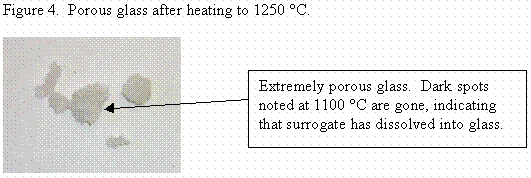
The second series of tests were conducted to determine the temperature that cullet and surrogate oxide begin to react and to extend the range of the interlock tests to 1100 ° C. The crucibles were calcined at the temperature shown in Table 2 for three hours, then allowed to cool overnight to simulate an interlock during the calcination phase of the melter heat cycle. Crucible 1 was not calcined to simulate a base process run. Crucibles 1 through 5 were then ramped at 8 ° C/minute to a temperature of 1250 ° C. Bed expansions were noted in all crucibles. A very large amount of porosity was noted in the glass when removed from the crucibles, as shown in Figure 4. The surrogate oxides had begun to react with the cullet, but the majority of the surrogate was still unreacted.
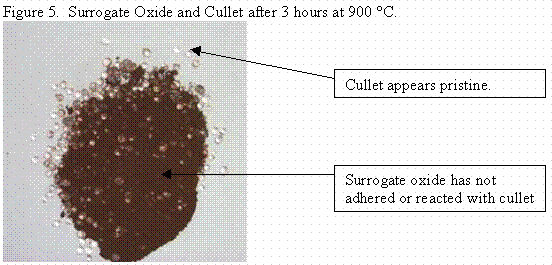
Crucibles 6-8 were examined after calcination to determine the temperature at which surrogate and cullet react. Crucible 6 indicated that no reaction between the cullet and surrogate occurred at 900 ° C, as shown in Figure 5. In contrast, Crucible 7 contained a clear monolith of fused cullet with very little porosity at the bottom of the crucible, as shown in Figure 6. The fused cullet contained embedded particles of surrogate oxide, but the majority of the surrogate oxide was still above the fused cullet. No reaction between the cullet and surrogate oxide was observed. Crucible 8 looked very similar to the crucibles vitrified at 1170 and 1250 ° C, with the fused monolith becoming opaque and highly porous, as shown in Figure 7. A dark spot ( assumed to be surrogate oxide ) could be seen next to many of the bubbles. The majority of the surrogate remained on top of the glass.


Based on the observations of crucibles 7 and 8, the following hypotheses were made:
Table 2. Calcination and Vitrification Temperatures, 2nd Series
|
Crucible |
Calcine Temperature, ° C |
Vitrification Temperature, ° C |
|
1 |
NA |
1250 |
|
2 |
800 |
1250 |
|
3 |
900 |
1250 |
|
4 |
1000 |
1250 |
|
5 |
1100 |
1250 |
|
6 |
900 |
NA |
|
7 |
1000 |
NA |
|
8 |
1100 |
NA |
Series Three
The third series of tests were conducted to test the hypotheses formulated after the second series of tests and to determine the point at which the majority of the surrogate oxides were dissolved into the glass.
Crucible 1 was heated to 1300° C at 8 ° C/min and held for 10 minutes. All the surrogate oxides had dissolved into the glass pool forming a light brown glass pool with a foamy layer around the edges.
Crucibles 2 and 3 contained 25SrABS cullet and dried surrogate oxalate mixed together. Heating the mixed material to 1000° C (Crucible 3) did not result in any visible reaction between the cullet and surrogate. The presence of the surrogate material prevented fusing of the 25SrABS cullet as noted during previous crucible tests. Crucible 2 was heated to 1100° C and resulted in a bed expansion that was ~2X the expansions seen in other runs.
An "inverted batch" was tested in crucible 4, with the dried oxalate added to the crucible prior to the cullet addition. This run resulted in a bed expansion similar to those seen in other crucibles.
Lanthanum oxide was used in place of the dried surrogate oxalate in Crucibles 5 and 6 to eliminate cerium from the system. The crucibles were heated to 1100 and 1200 ° C, respectively and no volume expansions were noted, indicating that cerium reduction was the driving force behind the expansions.
A potential method for minimizing the bed expansion was tested in crucibles 7 and 8. Most of the oxygen gas generation from cerium reduction occurs in the 1100 to 1200 ° C temperature range while the surrogate does not react significantly with the 25SrABS glass former until 1250 ° C. Therefore, very little oxygen should be evolved from the surrogate after incorporation into the glass former. If no surrogate oxides are trapped underneath the fused cullet during the monolith formation at 1000 ° C, nearly all the oxygen should be free to escape without causing a bed expansion.
A fused monolith of 25SrABS was formed in crucibles 7 and 8 by heating 25SrABS cullet at 1000° C for three hours. After allowing the crucible to cool overnight, dried surrogate oxalate was added to the crucible. A good seal had formed between the fused 25SrABS cullet and the crucible, and no surrogate is believed to have penetrated underneath the fused cullet. Crucible 7 was heated to 1100 ° C for three hours while Crucible 8 was ramped at 8 ° C /min to 1250 ° C and held for ten minutes. No bed expansions were noted in either crucible.
Table 3. Initial Heatup and Vitrification Temperatures, 3rd Series
|
Crucible |
Initial Heatup Temperature, ° C |
Vitrification Temperature, ° C |
|
1 |
NA |
1300 |
|
2 |
1100 |
NA |
|
3 |
1000 |
NA |
|
4 |
1100 |
NA |
|
5 |
1100 |
NA |
|
6 |
1200 |
NA |
|
7 |
1000 |
1100 |
|
8 |
1000 |
1250 |
Conclusions
Recommendations
Evaluation of 25SrABS fused glass former in the 5" CIM as a potential means to eliminate volume expansions during normal processing and upset conditions should be pursued. The potential advantages include significantly reducing the processing risks by eliminating the potential for a bed expansion.
References