WSRC-RP-2000-00524
Subsidence Sensitivity Study for Low-Level Waste in Slit Trenches
L. B. Collard
Westinghouse Savannah River Company
Aiken, SC 29808
Keywords: Subsidence, Sensitivity Study, Slit Trench
1.0 Executive Summary
This study evaluated two global and two local subsidence scenarios for slit trenches to determine the effect on well concentrations for three long-lived radionuclides as compared to Performance Assessment (PA, McDowell-Boyer, et. al, 2000) results. Global subsidence, where all trenches and the land between the trenches were assumed to subside equally, increased well concentrations by about 25% in the worst case analyzed. Local subsidence, where only part of a trench was assumed to subside, decreased peak well concentrations, indicating that some local subsidence could be beneficial.
Subsidence was assumed to increase the amount of water that traveled through the waste. Some precipitation normally would run off to adjacent areas (see Figure 1), evaporate or return to the atmosphere via transpiration from plants. The portion of precipitation that escaped these processes would percolate deeply into the vadose zone. The deep percolation would become recharge when it encountered the water table.
The processes of precipitation, runoff, evaporation, and transpiration were not individually modeled; instead, the recharge was applied as a boundary condition at the top surface of the model. Average precipitation was about 120 cm/yr, average runoff was about 40 cm/yr and average evapotranspiration was about 40 cm/yr, resulting in an average recharge of 40 cm/yr.
The PA used this nominal average recharge of 40 cm/yr as its top surface boundary condition.
For the local-subsidence scenarios in this study, the runoff from adjacent areas was assumed to become runon for the subsided area. The subsided area also was assumed to prevent its own runoff. Runon and preventing runoff increased the recharge that was applied as a top surface boundary condition. The globally subsided area was assumed to increase the recharge by preventing its own runoff and by decreasing evapotranspiration.
A cap was assumed to cover a set of five trenches (see Figure 2). The cap was shaped like a house roof with a peak down the center of its length. Local subsidence was assumed to affect ten percent of the capped area.
Two global-subsidence scenarios were selected to span the likely recharge conditions for large-scale subsidence. In the first scenario, an enhanced recharge rate of 120 cm/yr represented all precipitation. In the second scenario, an enhanced recharge rate of 80 cm/yr was selected that was half of the average of the precipitation rate and the typical recharge rate of 40 cm/yr from the PA.
One local-subsidence scenario placed the subsided area at the bottom of the cap (see Figure 3). That subsided area collected all the runoff from one side of the roof, resulting in an enhanced recharge rate of 240 cm/yr through the subsided area. The second local-subsidence scenario placed the subsided area halfway up one side of the roof. Collecting only the runoff from one-half of one side of the roof generated an enhanced recharge rate of 140 cm/yr through the subsided area.
Subsidence was assumed to occur immediately after loss of institutional control, during the Failed Phase. The Failed Phase was the last of three major phases that the PA model used. The three major phases from the PA model and recharge changes for the current study were as follows:
|
1. Initial Uncapped Phase |
0-25 years |
no recharge changes |
|
2. Institutional Control Phase |
25-125 years |
no recharge changes |
|
3. Failed Phase |
125+ years |
enhanced recharge |
Three long-lived radionuclides considered were I-129, C-14, and Np-237. They ranged from high to moderate mobility and thus were expected to represent the family of radionuclides that had the greatest potential for posing problems in satisfying PA performance objectives.
Results
As shown in Table ES-1, subsidence had no impact on I-129 peak well concentrations because I-129 peaked before subsidence occurred. Because I-129 results are unique, they are excluded from further discussion.
The global-subsidence cases (see Table ES-1) always increased the peak concentrations at the well. For C-14, global subsidence increased the peak concentration to 254 pCi/L (+17%) for the 80 cm/yr scenario and 266 pCi/L (+23%) for the 120 cm/yr scenario. For Np-237, the global subsidence increased the peak concentration to 106 pCi/L (+15%) for the 80 cm/yr scenario and 110 pCi/L (+19%) for the 120 cm/yr scenario. As the Kd increased (Np-237 had a higher Kd than C-14), the effect of the recharge decreased (e.g., the C-14 peak increased 23% at a recharge rate of 120 cm/yr, while the Np-237 peak increased only 19%).
Table ES-1. Peak Well Concentrations
|
I-129 |
C-14 |
Np-237 |
|||||
|
Subsidence |
Recharge |
Conc. |
Time |
Conc. |
Time |
Conc. |
Time |
|
None |
40 |
477 |
29 |
217 |
180 |
92.3 |
280 |
|
Global |
80 |
484 |
29 |
254 |
164 |
106 |
228 |
|
Global |
120 |
484 |
29 |
266 |
158 |
110 |
212 |
|
Local |
140 |
484 |
29 |
218 |
177 |
91.8 |
270 |
|
Local |
240 |
484 |
29 |
214 |
177 |
89.9 |
271 |
As opposed to global subsidence, the local subsidence normally decreased the peak concentrations at the well. This decrease was caused by the reduced peak contaminant fluxes at the water table that were input to and drove the aquifer model.
For local subsidence, contaminant fluxes at the water table from two vadose zone models were combined and input to an aquifer model. The first vadose zone model consisted of the subsided area. The second vadose zone model consisted of the area that did not subside. As shown in Figure 12, the C-14 contaminant flux at the water table for the local-subsidence scenario "Local 240" had an early peak and a late peak. Quicker water movement through the subsided area in the first vadose zone model caused the early peak. Slower water movement through the area without subsidence in the second vadose zone model caused the late peak, which was higher than the early peak. The contaminant flux at the water table from the subsided area was almost exhausted by the time the late peak from the area without subsidence reached the water table. Hence, the late peak from the local-subsidence scenario was less than the late (and only) peak for the scenario without subsidence "PA 40."
Figure ES-1 graphically displays the information from Table ES-1. The figure shows the C-14 and Np-237 well concentrations for the PA model (the initial point for each curve), the local-subsidence models (the dashed lines), and the global-subsidence models (the solid lines). The slopes of the solid lines show that a global increase in recharge rate from 40 to 80 cm/yr had a greater effect on the well concentration than an equal increase in recharge rate from 80 to 120 cm/yr. Hence, as the recharge rate increased, its effect on the well concentration was not linear, but rather its incremental effect decreased. The local-subsidence lines show that as the recharge was increased, the well concentrations decreased.
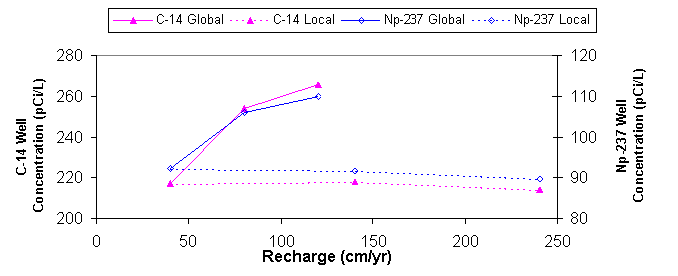
Figure ES-1. C-14 and Np-237 Well Concentrations
In summary, radionuclides that produced peak well concentrations before the Failed Phase (i.e., I-129) did not show any significant changes in results due to subsidence. For other radionuclides, increases in recharge rates (attributed to increases in global subsidence) did increase the peak well concentrations. Radionuclides with higher Kd’s exhibited a lower percentage increase in peak well concentration than did radionuclides with lower Kd’s. As the global-subsidence recharge rate increased, the rate of increase of the peak well concentration decreased (the slope of the curve flattened). For radionuclides other than those that peaked early, increases in local subsidence tended to decrease the peak well concentration. However, this effect could be reversed for larger local subsidence areas.
Information generated by this subsidence study can help in the selection of one or more subsidence scenarios for consideration in establishing waste acceptance criteria.
2.0 IntroductionThis study analyzed the effect of subsidence on the movement of contaminants from Low-Level Waste in slit trenches to a hypothetical 100-m well. Two types of subsidence modeled were as follows:
- global subsidence where all slit trenches were assumed to subside
- local subsidence where a portion of a slit trench was assumed to subside.
Subsidence was assumed to increase the amount of water that traveled through the waste. Some precipitation normally would run off to adjacent areas (see Figure 1), evaporate or return to the atmosphere via transpiration from plants. The portion of precipitation that escaped these processes would percolate deeply into the vadose zone. The deep percolation would become recharge when it encountered the water table.
The processes of precipitation, runoff, evaporation, and transpiration were not individually modeled; instead, the recharge was applied as a boundary condition at the top surface of the model. Average precipitation was about 120 cm/yr, average runoff was about 40 cm/yr and average evapotranspiration was about 40 cm/yr, resulting in an average recharge of 40 cm/yr.
The PA used this nominal average recharge of 40 cm/yr as its top surface boundary condition.
For the local-subsidence scenarios in this study, the runoff from adjacent areas was assumed to become runon for the subsided area. The subsided area also was assumed to prevent its own runoff. Runon and preventing runoff increased the recharge that was applied as a top surface boundary condition. The globally subsided area were assumed to increase the recharge by preventing its own runoff and by decreasing evapotranspiration.
Subsidence was assumed to occur immediately after loss of institutional control, during the Failed Phase. The Failed Phase was the last of three major phases that the PA model used. The three major phases from the PA model and recharge changes for the current study were as follows:
|
4. Initial Uncapped Phase |
0-25 years |
no recharge changes |
|
5. Institutional Control Phase |
25-125 years |
no recharge changes |
|
6. Failed Phase |
125+ years |
enhanced recharge |
Three long-lived radionuclides considered were I-129, C-14, and Np-237. They ranged from high to moderate mobility and thus were expected to represent the family of radionuclides that had the greatest potential for posing problems in satisfying PA performance objectives.
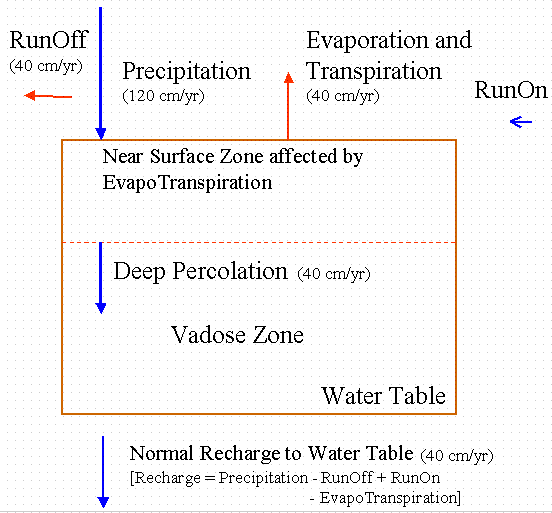
Figure 1. Water Balance
3.0 DiscussionA single clay cap was assumed to cover five slit trenches (see Figure 2). The cap was shaped like a house roof with a peak down the center of its length. In the vadose zone model, all five trenches occupied an area 200-m long by 48-m wide (9,600 m2). Each trench was 6 m wide and 6 m deep with a waste thickness of 4.8 m.
3.1 Local Subsidence Scenarios
The first local-subsidence scenario consisted of local subsidence below the entire bottom edge of the roof (see Figure 3). One-tenth of the covered land surface was assumed to subside, hence the width of the local subsidence was 4.8 m (0.1 * 48 m), or 80 percent of the trench width of 6 m.
The subsided area generated enhanced recharge by capturing all the runoff from one side of the roof (one-half of the capped area) and combining that with the normal recharge. The assumed rate of runoff was 40 cm/yr. One-half the roof area was 9,600 ÷ 2 m2, or 4,800 m2. The annual volume of water diverted from runoff to recharge through the subsided area was 0.4 m/yr * 4,800 m2 or 1,920 m3. The recharge rate for diverted runoff was the diverted runoff divided by the subsided area (one-tenth of the roof, or 960 m2). Thus, the recharge rate for diverted runoff was 1,920 m3/yr ÷ 960 m2 * 100 cm/m or 200 cm/yr. The sum of the diverted runoff and the normal recharge of 40 cm/yr generated an enhanced recharge rate of 240 cm/yr through the subsided area.
The second local-subsidence scenario consisted of local subsidence below the middle of the roof over one-tenth of the covered land surface (see Figure 4). The local subsidence captured only one-half the runoff from one side of the roof (1,920 ÷ 2 or 960 m3/yr ). The recharge rate for diverted recharge for this scenario was 960 m3/yr ÷ 960 m2 * 100 cm/m or 100 cm/yr. The sum of the diverted recharge and the normal recharge of 40 cm/yr generated an enhanced recharge rate of 140 cm/yr through the subsided area.
3.2 Global Subsidence Scenarios
Global subsidence was assumed to occur over the entire capped area (see Figure 5). The first global-subsidence scenario assumed that the recharge matched the annual precipitation of 120 cm. The second global-subsidence scenario assumed that the recharge was the average of the maximum global-subsidence recharge and the normal recharge of 40 cm/yr, or 80 cm/yr.
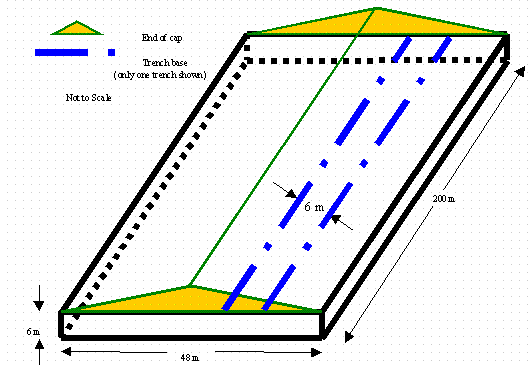
Figure 2. Set of Five Slit Trenches Covered by One Clay Cap
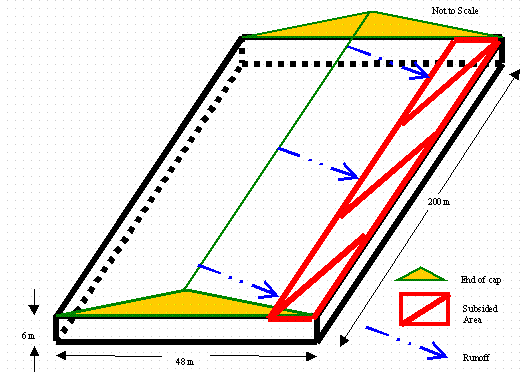
Figure 3. Local Subsidence at Bottom of Roof
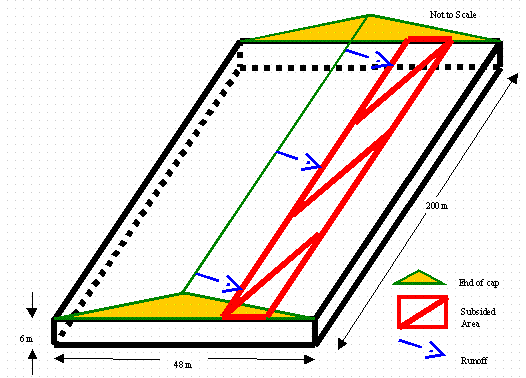
Figure 4. Local Subsidence at Middle of Roof
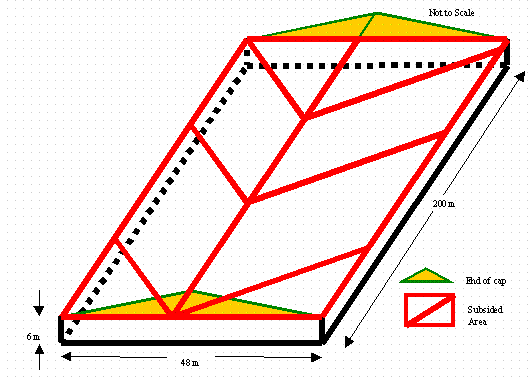
Figure 5. Global Subsidence
3.3 Applying Recharge from Subsidence to the PA Model
For the vadose zone, this study analyzed one trench at a time (see Figure 6), as was done in the PA. The primary change to the PA vadose-zone model for this study was increasing the upper boundary condition, i.e., the recharge rate, during the Failed Phase only.
The vadose zone model generated contaminant fluxes to the water table that were input to an aquifer model to analyze the movement of contaminants to a 100-m well and to determine the contaminant concentrations at that well. The PA used 10 trenches (2 sets of 5 trenches, each set with its own cap) for its aquifer model. Because all trenches were identical in the PA, the contaminant flux to the water table from 10 trenches was simply 10 times the flux from a single trench model. The global subsidence model applied in this study used the same method.
However, for the local subsidence model in this study, only part of one trench (one-tenth of the total capped area) subsided. The composite input to the aquifer model (see Figure 7) was calculated as the sum of the following:
- the contaminant flux to the water table from two trenches with subsidence
- the contaminant flux to the water table from eight trenches without subsidence.
3.4 Selection of Radionuclides to Model
Radionuclides were selected that would generate high well concentrations. Three of the radionuclides that produced high well concentrations in the PA are shown in Table 3.4.1. Those radionuclides had relatively low retardation and slow decay rates. The peak concentration decreased and the peak time increased as the Kd of the contaminants increased. The long half-lives had little impact on results.
Table 3.4.1. PA Results for Key Radionuclides
|
Radionuclide |
Kd in Waste |
Half-Life |
Peak Well Conc.1 |
Peak Time1 |
|
I-129 |
0.6 |
1.57E7 |
477 |
29 |
|
C-14 |
2.0 |
5.73E3 |
217 |
180 |
|
Np-237 |
5.0 |
2.14E6 |
92.3 |
280 |
1 From Table 5.1-4 in PA
I-129 was investigated to see if the subsidence would have any effect, because the enhanced recharge only occurred during the Failed Phase, while the I-129 peaked early. The I-129 peak well concentration at 29 years combined with the peak contaminant flux to the water table at 22.4 years (Table 4.3-5 in PA) indicated that the Initial Uncapped Phase was the most important period for I-129 in the PA. C-14 and Np-237 were investigated because they peaked during the Failed Phase and had low, but significantly different Kd’s.
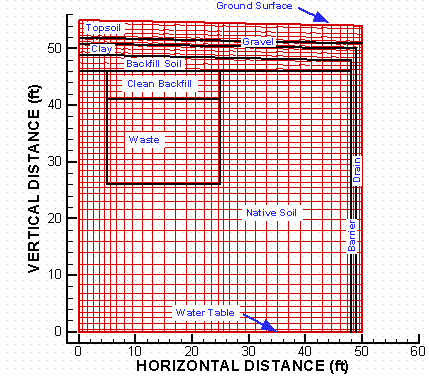
Figure 6. Geometric Mesh for Vadose Zone Model
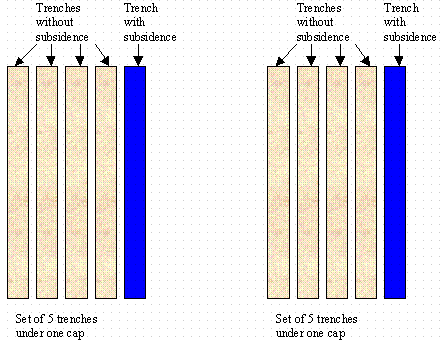
Figure 7. Trench Combination for Aquifer Model
3.5 Results
Pairs of plots show contaminant flux to the water table and well concentrations for each radionuclide. The plots include two local scenarios, two global scenarios, and the PA results.
I-129 results are shown in Figure 8 and Figure 9. The legend name for each curve contains a number that refers to the recharge rate. Explanations for each curve in these and similar figures are as follows:
|
Global 80: |
The global scenario with recharge at 80 cm/yr. |
|
Global 120: |
The global scenario with recharge at 120 cm/yr. |
|
PA 40: |
The PA results with output recorded about every 5 years after the Institutional Control Phase. Recharge was 40 cm/yr. |
|
Local 140: |
The local scenario with subsidence occurring in the middle of one side of the cap. The recharge was 140 cm/yr for 2 subsided trenches and 40 cm/yr for eight trenches without subsidence. |
|
Local 240: |
The local scenario with subsidence occurring at the bottom of one side of the cap. The recharge was 240 cm/yr for 2 subsided trenches and 40 cm/yr for eight trenches without subsidence. |
3.5.1 I-129 Results
The I-129 contaminant flux at the water table attained its highest peak during the Initial Uncapped Phase at 22.4 years (see Figure 8). Because subsidence did not occur until the Failed Phase, contaminant flux results theoretically were the same for all scenarios before that phase. However, the PA results differed, because the output was recorded much less frequently than for the other scenarios. The narrow spike during the Failed Period for the "Global 120" scenario almost matched the peak during the Initial Uncapped Period.
In Figure 9, I-129 well concentrations followed the same pattern as the contaminant fluxes, but peaked slightly later at 29 years. All results before the Failed Phase were the same except for the PA. Well concentrations had a second peak at about 135 years, slightly after the contaminant flux peak. The second well-concentration peak was lower than the first, because less I-129 remained in the modeling domain when the second peak occurred. The lower amount of available I-129 during the Failed Phase caused the flux spike near 127 years (see Figure 8) to be narrow and provided less of a driving force to the second well-concentration peak.
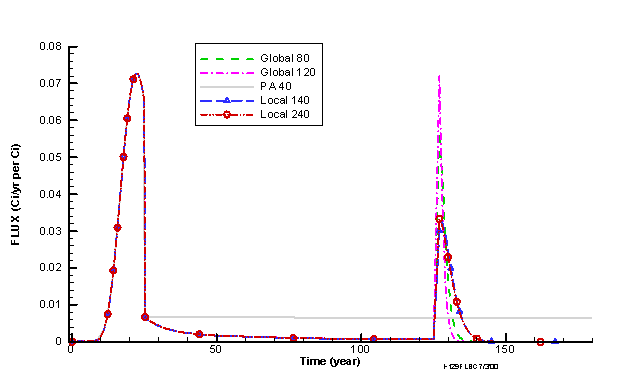
Figure 8. I-129 Fractional Fluxes to the Water Table
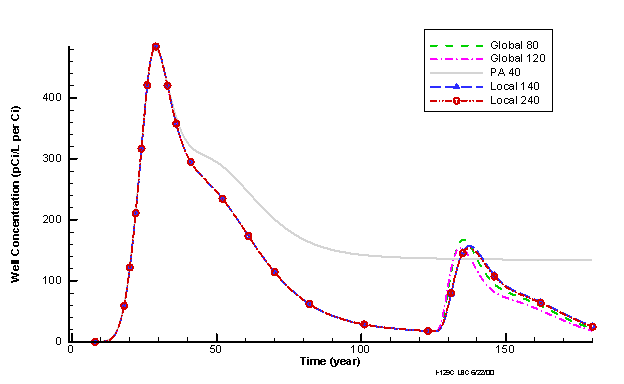
Figure 9. I-129 Well Concentrations
The I-129 contaminant fluxes at about 127 years were expanded in Figure 10. The "Global 120" and the "Global 80" contaminant fluxes peaked earlier and at higher peaks than did the other scenarios. The "Local 240" scenario had a slightly higher and earlier second peak than the "Local 140" scenario, which in turn had a slightly higher and earlier second peak than the "PA 40" scenario.
The I-129 well concentrations at about 135 years were expanded in Figure 11. All peaks had about the same magnitude, but the global scenarios have earlier peaks. The peaks were marginally greater than the PA results.
3.5.2 C-14 Results
C-14 fluxes to the water table were plotted in Figure 12. The flux peaks occurred much later (after 135 years) than for I-129, but the C-14 flux peaks were moderately higher than the I-129 flux peaks. The likely cause was that a relatively high recharge rate only had 25 years to force the I-129 to release. However, little C-14 released during the first 125 years, so most of it was available for release when the higher recharge rates prevailed during the Failed Phase.
The global scenarios peaked earlier and at higher values than the other scenarios. The "PA 40" scenario had a higher peak than the local-subsidence scenarios. The "Local 140" scenario had a slightly lower and earlier peak than did the "PA 40" scenario. The "Local 240" scenario had the lowest peak that occurred almost at the same time as the "PA 40" peak.
Differences in peak times between the area without subsidence and the area with subsidence reduced the maximum peak for the local-subsidence scenarios, such that they were lower than the peak for the PA scenario without subsidence. For example, the "Local 240" curve had an early peak from the subsided area and a late peak primarily from the area without subsidence. The late peak was higher than the early peak, but was less than the one and only peak for the PA, which only had trenches without subsidence.
C-14 well concentrations were plotted in Figure 13. The C-14 well concentration peaks were lower than the I-129 well-concentration peaks and they occurred much later (after 158 years). The C-14 well concentrations mimicked the C-14 contaminant fluxes, although on a slightly delayed basis.
The "PA 40" scenario had a slightly higher well concentration peak than the "Local 140" peak, which was slightly higher than the "Local 240" peak. The "Local 140" peak occurred slightly before the "Local 240" peak, which occurred slightly before the "PA 40" peak. Thus, as the recharge through the subsided area increased, the late peak decreased and its timing approached the timing of the "PA 40" peak. In the extreme, if the recharge through the subsided area was high enough, then no contamination from the subsided area would remain near the time of the late peak, and the late peak would occur exactly at the same time as the "PA 40" peak. The well concentration peaks were much smoother versus the contaminant flux peaks because of injection into the aquifer model and travel time to the well.
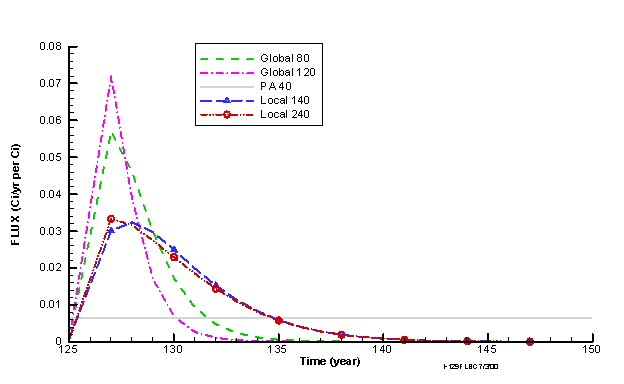
Figure 10. I-129 Fractional Fluxes to the Water Table at
125 Years
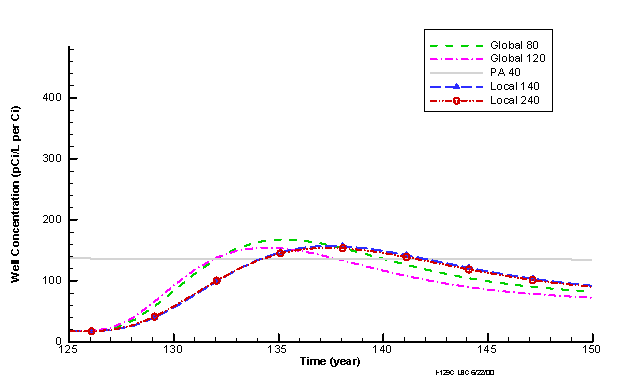
Figure 11. I-129 Well Concentrations at 125 Years
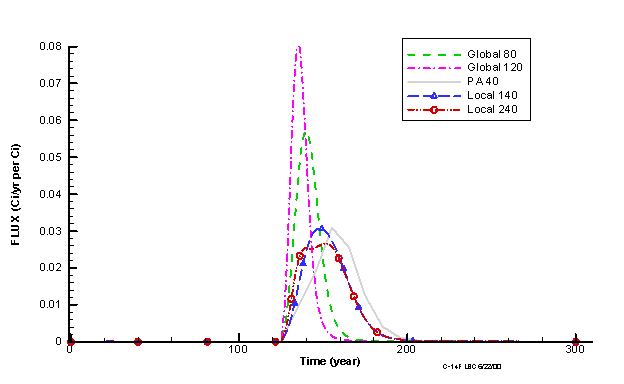
Figure 12. C-14 Fractional Fluxes to the Water Table
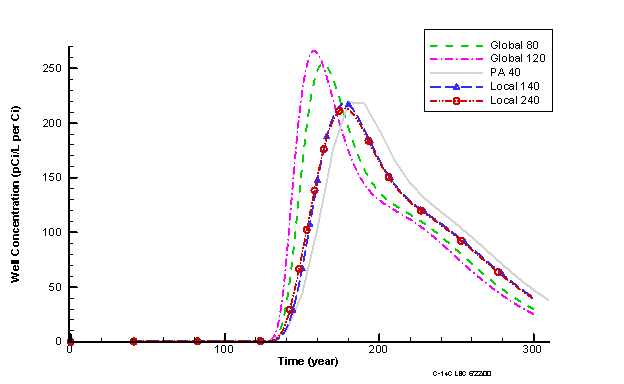
Figure 13. C-14 Well Concentrations
3.5.3 Np-237 Results
Np-237 fluxes to the water table were plotted in Figure 14. These peaks occurred much later (after 156 years) than for the other radionuclides and at much lower magnitudes. The higher Kd for Np-237 retarded its movement and decreased its peak flux. The relationships between the curves were similar to those for C-14, although there was more of a time separation between scenarios due to the higher Np-237 Kd. The "Local 240" scenario clearly demonstrated its bimodal behavior, while the "Local 140" scenario merely hinted at it. The local and PA peaks occurred at about 200 years.
Np-237 well concentrations were plotted in Figure 15. These curves followed the pattern for C-14 well concentration and Np-237 flux plots. The peak times occurred later, after 212 years. There was more time separation between the scenarios than for C-14 well concentrations or for Np-237 fluxes due to the higher Np-237 Kd that caused the travel times to increase in both the vadose zone and the aquifer.
3.5.4 Peak Results for All Selected Radionuclides
All I-129 peaks in Table 3.5.1 were the same except for the PA peak well concentration. It differed slightly because the contaminant flux in the PA was recorded less frequently, thus dampening the peaks. For C-14 and Np-237, increases in the global recharge rates always increased the peak and shortened the time elapsed to the occurrence of the peak. For the latter two radionuclides, increases in the local recharge rates had the opposite effect of decreasing the composite peak. For local recharge increases, the peak occurred before the peak for the PA, but as the recharge increased the time of the peak approached the time of the PA peak.
Table 3.5.1. Peak Contaminant Fluxes to
the Water Table and Well Concentrations
|
I-129 |
C-14 |
Np-237 |
|||||
|
Subsidence |
Recharge |
Flux |
Conc. |
Flux |
Conc. |
Flux |
Conc. |
|
PA1 – No |
40 |
0.0727 [22.4] |
477 [29] |
0.0309 [155] |
217 [180] |
0.0150 [215] |
92.3 [280] |
|
Global |
80 |
0.0727 [22.4] |
484 [29] |
0.0571 [140] |
254 [164] |
0.0269 [171] |
106 [229] |
|
Global |
120 |
0.0727 [22.4] |
484 [29] |
0.0811 [135] |
266 [158] |
0.0376 [156] |
110 [212] |
|
Local (Middle) |
140 / 40 |
0.0727 [22.4] |
484 [29] |
0.0307 [148] |
218 [177] |
0.0131 [207] |
91.8 [270] |
|
Local (Bottom) |
240 / 40 |
0.0727 [22.4] |
484 [29] |
0.0267 [151] |
214 [177] |
0.0125 [210] |
89.9 [271] |
1 From PA: fluxes in Table 4.3-5, concentrations in Table 5.1-4
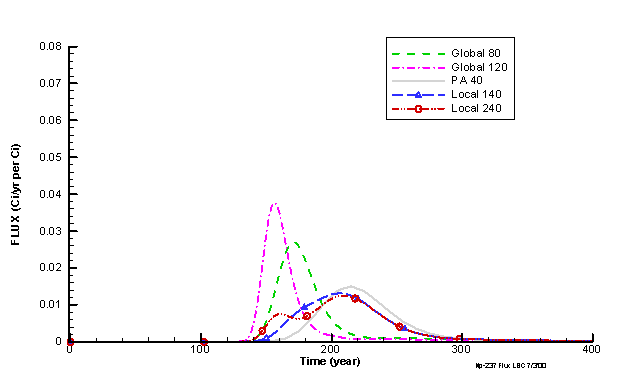
Figure 14. Np-237 Fractional Fluxes to
the Water Table

Figure 15. Np-237 Well Concentrations
4.0 Conclusions
4.1 Global Subsidence
The effects of global subsidence varied depending on the retardation of the contaminant. For long-lived, highly mobile contaminants, such as I-129, subsidence did not affect peak well concentrations, because the highest peak was caused by water flows during the 25-year Initial Uncapped Phase. If the mobility decreased slightly, subsidence could cause the secondary peak during the Failed Phase to exceed the initial peak, but no such contaminants were evaluated in this study.
For contaminants with higher Kd’s whose peak concentration occurred during the Failed Phase in the PA, subsidence had an impact. The highest increase in peak well concentration in this study was 23% for C-14 with a recharge rate of 120 cm/yr. For contaminants whose peak concentrations occurred during the Failed Phase, the effects of subsidence decreased as the Kd increased.
An independent analysis of the impact of radionuclide decay rate was not completed. The half-lives of all the radionuclides considered were more than an order of magnitude greater than the time of the peak well concentration. Subsidence-increased recharge rates could have a greater impact on short-lived radionuclides that peak during the Failed Phase. Thus, short-lived radionuclides that were not important in the PA could become important when subsidence is considered.
4.2 Local Subsidence
For the scenarios with ten percent of the covered area subsided, local subsidence had a much different impact on peak well concentrations than did global subsidence. Local subsidence created an early peak for a small amount of waste, and a late peak for the remainder of the waste. There was little overlap in the contaminant fluxes to the water table from the two areas. Thus the composite effect typically was to lower the later peak. As the recharge rate increased, the early peak increased, but the time of the peak decreased and the later peak decreased further.
Highly mobile contaminants, such as I-129, were an exception, because they peaked before subsidence had any impact. For short-lived radionuclides that peak during the Failed Phase, an increased recharge rate could cause the early peak from the subsided area to exceed the late peak from the area without subsidence.
This study assumed a local subsidence area equal to ten percent of the entire capped area. If the subsidence area increased, (e.g., if two trenches under one cap subsided simultaneously), then the local subsidence peak would increase as it approached the peak for a global subsidence scenario.
5.0 Summary
This study analyzed the effects of global and local subsidence on slit trenches. It provides valuable information on how sensitive results are to the effects of subsidence for four assumed scenarios.
Global subsidence always increased the peak concentrations for radionuclides that peaked during the Failed Phase in the PA, while local subsidence always decreased the peak concentrations for such radionuclides. The local subsidence decreased the peaks because it created an early, low peak for the subsided area but it contributed little to the late peak. The late peak was larger than the early peak, but smaller than the one and only peak from the PA. For highly mobile contaminants, such as I-129 that peaked during the Initial Uncapped Phase, neither type of subsidence changed the peak.
The global subsidence results should hold true for all radionuclides. However, the local subsidence results may vary depending on the radionuclide properties and on assumptions about the size and timing of subsidence.
Short-lived nuclides may be more dependent on the increase in recharge rate caused by subsidence. Quick delivery of a small portion of waste (from the subsided area) to the well before much decay occurs could be significant. However, slow delivery of the bulk of the waste could be insignificant due to decay.
Although I-129 showed no absolute peak change relative to subsidence, it did show a high secondary peak during the Failed Phase. If the Initial Uncapped Phase was shortened, then more I-129 would remain at the time of the Failed Phase and the secondary peak would increase, possibly exceeding the absolute peak caused by the Initial Uncapped Phase water flow. If the Initial Uncapped Phase was lengthened, then more I-129 would be released early that could increase the early well concentration peak.
If the size of the subsided area is increased, then the local subsidence peak would increase. The local subsidence peak could exceed the peak for the scenario without subsidence.
If the local subsidence occurred later, then the peaks for the subsided area and the areas without subsidence could occur simultaneously. In this case, there would be no time offset and the peaks could exceed the highest global subsidence scenario considered.
6.0 Future Work
This study provides preliminary information about the effects of subsidence on slit trenches. The size and location for initial local subsidence were hypothetical cases. Information on past subsidence events would provide the basis for developing a more defendable local subsidence model.
The study did not include short-lived radionuclides. Models without decay could generate undecayed well-concentration curves. Post-multiplying those curves sans decay by a specified decay rate would generate the appropriate decayed well-concentration curves.
Screening the radionuclides would select only those important for management of solid waste. Only important radionuclides should be included in short-lived radionuclide analyses. Similarly, only important radionuclides would be checked to see if they could be exceptions to the general local subsidence results.
7.0 References
- McDowell-Boyer, L., A.D. Yu, J.R. Cook, D.C. Kocher, E.L. Wilhite, H. Holmes-Burnes, and K.E. Young. 2000. Radiological Performance Assessment for the E-Area Low-Level Waste Facility, WSRC-RP-94-218, Rev. 1, Westinghouse Savannah River Company, Aiken, South Carolina.