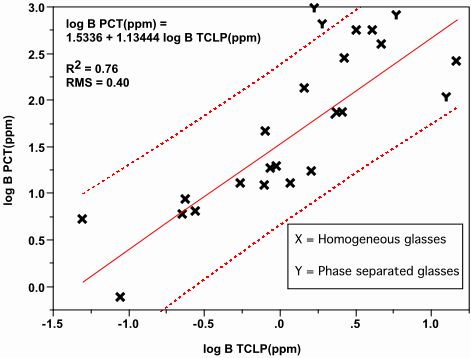
Figure 1. Correlation of boron released from the TCLP and PCT leach tests.
WSRC-MS-2001-00925
TCLP Leaching Prediction from the
"THERMOTM" Model for Borosilicate
Glasses
J. B. Pickett, and C. M. Jantzen
Westinghouse Savannah River Company
Aiken, SC 29808
This report was prepared as an account of work sponsored by an agency of the United States Government. Neither the United States Government nor any agency thereof, nor any of their employees, makes any warranty, express or implied, or assumes any legal liability or responsibility for the accuracy, completeness, or usefulness of any information, apparatus, product or process disclosed, or represents that its use would not infringe privately owned rights. Reference herein to any specific commercial product, process or service by trade name, trademark, manufacturer, or otherwise does not necessarily constitute or imply its endorsement, recommendation, or favoring by the United States Government or any agency thereof. The views and opinions of authors expressed herein do not necessarily state or reflect those of the United States Government or any agency thereof.
This report has been reproduced directly from the best available copy.
Available for sale to the public, in paper, from: U.S. Department of Commerce, National Technical Information Service, 5285 Port Royal Road, Springfield, VA 22161, phone: (800) 553-6847, fax: (703) 605-6900, email: orders@ntis.fedworld.gov online ordering: http://www.ntis.gov/support/index.html
Available electronically at http://www.osti.gov/bridge
Available for a processing fee to U.S. Department of Energy and its contractors, in paper, from: U.S. Department of Energy, Office of Scientific and Technical Information, P.O. Box 62, Oak Ridge, TN 37831-0062, phone: (865 ) 576-8401, fax: (865) 576-5728, email: reports@adonis.osti.gov
Abstract
The Savannah River Technology Center (SRTC) of the Westinghouse Savannah River Co. (WSRC) has been conducting glass property modeling for many years to support the High Level Waste (HLW) vitrification process in the Defense Waste Processing Facility (DWPF). SRTC also demonstrated the first mixed waste glass for the site’s M-Area plating line sludge, which met the EPA’s Land Disposal Restriction (LDR) storage and disposal criteria. A mechanistic glass durability model, the Thermodynamic Hydration Energy Reaction MOdel (THERMOTM) was developed to predict glass durability from composition and to control the DWPF production process, using the ASTM C1285-97 Product Consistency Test (PCT) as the leaching test. During the treatment of the M-Area sludge, the model (THERMOTM) was successfully used to predict the leaching properties of the M-Area glass, using the EPA Toxicity Characteristic Leaching Procedure (TCLP). This was the first successful prediction of glass leaching results using the TCLP procedure. The THERMOTM model can be used to correlate the PCT and TCLP leaching test results for radioactive and mixed waste glasses.
Background
The Savannah River Site (SRS) is a 300 square mile complex, which has been dedicated to the production of national defense materials since 1952. The SRS is operated by the Westinghouse Savannah River Co. (WSRC) for the U.S. Department of Energy (DOE). One of the legacies of the production activities was a mixed waste plating line sludge, generated in the Reactor Materials Area (M-Area). This plating line sludge was generated during the wastewater treatment of effluents from the nickel plating of depleted uranium cores, which were subsequently irradiated in the site’s reactors to form plutonium-239.
The M-Area plating line sludge was an EPA hazardous waste (F-006 listed waste). Since it contained a significant amount of depleted uranium, it was a "mixed" waste as defined by the Federal Facilities Compliance Act (FFCA) of 1992. In order to comply with the RCRA (Resource Conservation and Recovery Act) laws, the waste had to be treated to meet the Land Disposal Restriction (LDR) regulations [1].
The Savannah River Technology Center (SRTC) conducted numerous treatability studies to determine how the M-Area wastes could be stabilized to meet the regulatory requirements. The initial scouting studies demonstrated that both vitrification or cementitious techniques [2, 3, 4] resulted in stabilized wasteforms which met the hazardous waste disposal requirements.
Vitrification Studies
SRTC Crucible Studies
The initial vitrification studies with the mixed M-Area waste were conducted by the Savannah River Technology Center (SRTC) in 1992. The studies indicated that either borosilicate or soda-lime-silica glass (SLS) formulations could be used, with at least a 75% waste (sludge) loading on a calcine oxide basis. The resulting glasses melted at <1150°C and demonstrated an 81% volume reduction from original waste to final glasses. The borosilicate glasses were shown to meet the hazardous waste leaching requirements in place at that time [4]. Additional treatability studies were conducted in 1993 on a wide range of borosilicate and SLS glasses to optimize the glass formulation to be used for the stabilization of the M-Area sludge [5].
In 1993, the M-Area wastewater treatment facility was continuing to treat a supernate stored in the M-Area waste tanks. The resulting wastewater filtercake, a silica rich perlite, was then returned to the waste storage tanks. At the completion of the supernate treatment, it was planned to combine the contents of all of the storage tanks into one homogenous sludge mixture. Since the final volume of the high silica filtercake could not be accurately established, test glasses were prepared which spanned the range of "high" silica, a "nominal" silica, and "low" silica concentrations in the eventual sludge. Forty-four different glass formulations were tested, to determine the optimum formulation for melting temperature (1150°C maximum), waste loading, and durability (leachability) [5].
Office of Technology Development (OTD) Pilot Scale Melter Tests
In 1994, SRTC conducted a scale-up treatability test using the 10 kg/day test melter at the Catholic University of America (CUA) Vitreous State Laboratory (VSL). The test was conducted for the DOE’s Office of Technology Development (OTD). Actual M-Area sludge samples were used, from Tanks 7, 8, and 10. By 1994, the blending scheme for the M-Area tanks had changed from one "master" blend of all tanks, to two homogenous mixtures. One feed tank would be Tank #7, with ½ of the filtercake in Tank 10, the other would be Tank #8, with the remainder of the filtercake. Seven glass samples were produced during the test run at VSL, using glass formulations provided by SRTC.
Vendor Treatment Facility (VTF) Glass Results
Between 1996 and 1999, all of the M-Area plating line sludge was vitrified by GTS Duratek, in a melter called the Vendor Treatment Facility (VTF) at the SRS. There were 44 different feed batches prepared and treated throughout the run, and each of these was tested to ensure that the final glass met the contractual TCLP leaching requirements for Ni, Cr, Pb, and U. The TCLP leach results from the VTF glasses were used as "validation" data points for the TCLP vs. D Gf (THERMOTM) prediction.
Experimental
SRTC Crucible Tests
Samples of the M-Area sludges were collected from two storage tanks, #8 and #10. The sludge in Tank 8 was generated from the nickel plating operations in M-Area, and contained primarily aluminum hydroxide, depleted uranium (as a sodium uranate), sodium nitrate, silica, a zeolite (aluminosilicate), and aluminum phosphate [6]. The material in Tank 10 was the filtercake from the wastewater treatment of the supernate, and Zeolite-A which had formed in-situ in the tanks. The volume of all of the stored nickel plating sludges was estimated to be ~244,000 gallons in 1993. The volume of the perlite in Tank 10, after treatment of the supernate was completed, was assumed to range from 200,000 gallons at 17% solids, to 450,000 gallons at 30% solids. The crucible studies used glass formulations which spanned the range of the potential feed The range of glass formulations is summarized in Table I; the individual glass formulations were described previously [5].
Table I. Tank Ratios and Glasses Studied During SRTC Treatability
Studies
|
Formulation |
Assumed Volume |
% Solids |
No. of Glasses Studied |
||
|
Tanks 1-8 |
Tank 10 |
Tanks 1-8 |
Tank 10 |
||
|
Nominal |
244 |
412 |
30 |
17 |
26 |
|
Low Silica |
244 |
200 |
30 |
17 |
11 |
|
High Silica |
244 |
450 |
30 |
17 |
7 |
It is interesting to note that the final tank volumes, when measured in 1995, were most similar to the "low silica" formulation, i.e; 330,000 gallons of plating line sludge and 228,000 gallons of Tank 10 filteraid.
The glasses were size reduced to prepare them for the TCLP and PCT leaching tests. A solid sample for TCLP leaching test (the EPA’s SW-846 Method 1311) is size reduced to pass a 3/8 inch sieve. In the SRTC tests, the crucible samples were size reduced until all of the sample passed the 3/8" sieve. A representative sample was then collected, which obviously contained a distribution of sizes including some fraction of smaller glass particles. In the TCLP test no restraints are placed on the amount of material less than 3/8", and the samples were not rinsed of adhering fine particles or otherwise modified prior to TCLP leaching. The TCLP leaching tests were conducted by the General Engineering Laboratory (GEL) in Charleston, SC. Each remaining sample was then size reduced to <100 to >200 mesh, to conduct the SRTC PCT leaching tests and determine the total constituent concentrations.
Two glass samples (Nominal 5 and Low Silica 5) were separated into various size fractions to determine the affect of size on the TCLP test results. The sizes ranged from 3/8" to the fine size used for the PCT tests. TCLP testing was conducted by the General Engineering Laboratory.
OTD Tests
The M-Area sludge samples (Tanks 7, 8, and 10) were calcined and analyzed at VSL. SRTC provided glass formulations, using Li, B, Al, and Na as additives to the sludge samples. The SRTC glasses were intended to have ~80% dry weight loading, to demonstrate the large volume reduction achievable by vitrification. The glass feed was modified to the SRTC formulation at the end of a treatability study conducted for GTS Duratek by the VSL. The VSL treatability study was being conducted to provide Duratek with additional design data for the VTF melter and off-gas system. Approximately 10 kgs of glass were produced with the SRTC tank 8/10 formulation, while ~49 kgs were produced with the tank 7/10 blend. All of the SRTC formulation glasses were returned to SRTC, and size reduced for TCLP, PCT, and total constituent concentrations. All of the samples were sent to GEL for TCLP analyses. Two of the glass samples sent to GEL were tested for the entire EPA hazardous waste Appendix 8 constituents. These two samples were also tested by the EPA’s Multiple Extraction Procedure (MEP). The Appendix 8 analyses and the MEP results were used to prepare an "Upfront Delisting Petition" for the Vitrified M-Area sludges [7].
VTF Glass Analyses
Each feed batch of sludge for the VTF melter was analyzed by the SRTC mobile laboratory, for GTS Duratek. The batch was adjusted, if necessary, with feed additives and then vitrified. Five samples of glass were obtained from the last 10 drums (71 gallon drums) of glass produced from each batch. The glass from the VTF melter was produced as flattened "gems" (ovoids, ~3/4" long and ¼" thick). GTS Duratek then size reduced the gems to pass the 3/8" limit for the TCLP test, and had the glass tested by GEL. Each and every batch passed the contractural limits for the metals of concern, and all of these TCLP results were included in a revised Delisting Petition, which was updated in 2000 [8].
Results and Discussion
Congruent Dissolution
The PCT and TCLP results for the crucible study glasses (boron, silicon, and uranium) are provided in Table II. The boron PCT results had 3.5 order of magnitude range, while the boron TCLP had a 2.5 magnitude range. The results for the other RCRA hazardous metals are not provided, as both the PCT and TCLP results were usually less than the analytical detection limit. A correlation between the PCT and TCLP boron data in ppm demonstrated a strong correlation between the durability response of these two tests (Figure 1). The strong correlation indicates that the TCLP test exhibits "congruent dissolution" of the glass matrix, and thus the THERMOTM model should be able to predict the TCLP
leaching potential of these borosilicate glasses. Previous researchers have attempted to develop a model for predicting the TCLP leaching results, but have not been successful [9]. Part of this is due to fact that unless a constituent is present in the glass at a substantial concentration (³ 0.5 wt.%), the TCLP leachant concentrations will be too low to develop an applicable model. The data in Table II indicate that the much more aggressive PCT leaching procedure always resulted in a higher leachant concentration than the TCLP test. The only metals that could be correlated in these studies were Ni and U, due to their relatively high concentrations in the M-Area glasses.
Table II. Comparison of TCLP vs. PCT Durability Test Response
|
Sample ID |
Boron (ppm) |
Silicon (ppm) |
Uranium (ppm) |
|||
|
PCT * |
TCLP‡ |
PCT* |
TCLP‡ |
PCT* |
TCLP‡‡ |
|
|
MN-1 |
6.42 |
0.28 |
37.6 |
0.71 |
1.15 |
0.57 |
|
MN-2 |
957 |
1.72 |
35.9 |
1.30 |
3.98 |
0.93 |
|
MN-3 |
5270 |
12.6 |
54.3 |
4.2 |
0.69 |
2.15 |
|
MN-4 |
8.67 |
0.24 |
52.4 |
0.56 |
4.10 |
0.61 |
|
MN-5 |
12.7 |
1.20 |
38.1 |
2.70 |
1.82 |
0.79 |
|
MN-6 |
804 |
6.03 |
23.6 |
4.56 |
2.82 |
1.70 |
|
MN-7 |
5.29 |
0.050 |
58.5 |
0.50 |
4.21 |
0.63 |
|
MN-8 |
642 |
1.93 |
33.6 |
0.72 |
4.54 |
0.95 |
|
MN-9 |
279 |
2.70 |
34.3 |
5.60 |
5.21 |
1.90 |
|
MN-10 |
0.77 |
0.088 |
75.1 |
0.30 |
2.21 |
0.60 |
|
MN-11 |
46.5 |
0.82 |
118 |
2.28 |
6.82 |
0.97 |
|
MN-12 |
261 |
14.9 |
229 |
25.5 |
25.0 |
5.30 |
|
MN-13 |
19.4 |
0.97 |
150 |
3.79 |
7.82 |
1.20 |
|
MN-14 |
108 |
12.9 |
349 |
49.4 |
31.1 |
8.10 |
|
MN-15 |
5.90 |
0.23 |
68.6 |
1.75 |
3.54 |
0.72 |
|
MN-16 |
18.5 |
0.88 |
60.3 |
2.62 |
3.21 |
0.60 |
|
MHSI-5A |
17.2 |
1.65 |
49.2 |
3.49 |
3.60 |
1.35 |
|
MLSI-4 |
12.1 |
0.81 |
49.0 |
2.68 |
6.87 |
1.00 |
|
MLSI-5A/5L |
134 |
1.48 |
41.2 |
3.27 |
6.65 |
1.10 |
|
MLSI-7 |
12.9 |
0.56 |
59.6 |
3.61 |
8.04 |
1.30 |
|
MLSI-8 |
557 |
4.13 |
24.5 |
6.38 |
1.00 |
2.15 |
|
MLSI-9 |
397 |
4.76 |
22.0 |
10.80 |
1.00 |
3.60 |
|
MLSI-11A |
74.3 |
2.42 |
114 |
8.01 |
5.08 |
3.10 |
* Average of 3 replicate PCT analyses
‡ Total constituent analysis by SRTC on TCLP solution returned from GEL
‡‡ TCLP leach by GEL, uranium by SRTC Chem-check
Figure 1. Correlation of boron released from the TCLP and PCT leach tests.
THERMOTM Model for Predicting TCLP for Borosilicate Glasses
The regression analyses for the predicted durability using the THERMOTM model (D Gf, kcal/mole) are plotted vs. the normalized elemental concentrations of Ni and U and the TCLP leaching results; in Figures 2 and 3. The TCLP data is given in Table III. Although the R2 for the regressions is somewhat low at 0.65, this scatter can be attributed to lack of size control for the TCLP test procedure, e.g. the TCLP has a noisy durability test response. The SRTC crucible were used to develop the correlation; the VTF production scale melter data and the OTD pilot scale melter data were used to validate the model. This model can be used to predict the durability of a glass that will need to meet a TCLP leaching limit. For example, the RCRA limit for delisting a mixed waste is 10 ppm TCLP, for nickel (100 x the EPA primary drinking water standard of 0.1 mg/L). The 10 ppm TCLP limit is overlain on Figure 2, and indicates that any glass with a durability better than –25 kcal/mole will pass, at up to 3 wt. % nickel oxide. If the proposed EPA drinking water limit of 0.020 mg/L for uranium were required to be met for a delisting petition, then the TCLP limit would be 2 ppm TCLP. The overlay in Figure 3 indicates that the durability would have to be improved to ~-10 kcal/mole, if the glass contained 5 wt. % U3O8.
Glass Size vs. TCLP Leaching Results
The data for the TCLP leaching results for various size fractions is shown in Figure 4. As expected, the smaller the particle size, and the greater the surface area, the greater the TCLP leachant concentration. The difference for a 3/8" size material vs. a <100 to >200 mesh material can be a great as 3X to 4X (Figure 4). The data also indicate that the TCLP results are fairly similar until the particle size is reduced to between 16 to 30 mesh size. This means that some small amount of material less than the nominal 3/8" size should not affect the TCLP result significantly. But the lack of size control and presence of adhering fines will always affect the reproducibility and accuracy of the TCLP test vs. the PCT test.
Conclusions
The TCLP test response for boron correlates well with the PCT test response from the same borosilicate glasses. This indicates that the durability of the glass, as expressed by each test response, is controlled by similar mechanisms, e.g. congruent dissolution. The TCLP test response can be adequately modeled using the THERMO model currently employed for PCT durability test response in the SRS DWPF facility. In addition, the TCLP test was performed on glasses sized from 3/8" to 200 mesh and shown to be a strong function of particle size once the size was reduced below ~16 mesh.
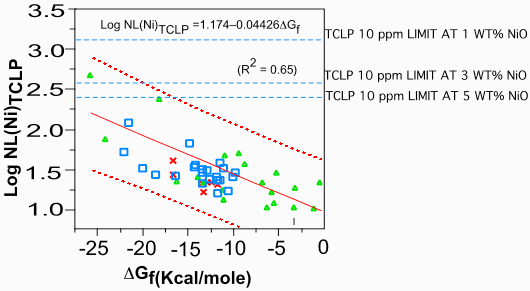
Figure 2. TCLP Ni leaching as a function of the hydration free energy (DGf) and Ni concentration in the glass.
The Ni leaching response has been normalized to the mass fraction of Ni in the glass.
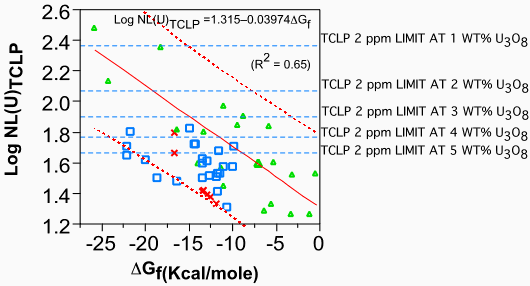
Figure 3. TCLP U leaching as a function of the hydration free energy (DGf) and U concentration in the glass.
The U leaching response has been normalized to the mass fraction of U in the glass.
Table III. Uranium and Nickel TCLP Data and Calculated DGf
Values
|
Sample Id |
U3O8 (wt%) |
GEL U TCLP |
SRTC |
NiO |
GEL |
DGf |
Observations |
|
OTD TEST |
|||||||
|
MIC4-144 |
2.85 |
1.12 |
0.64 |
0.20 |
-16.51 |
||
|
MIC4-149C |
3.53 |
1.87 |
0.75 |
0.34 |
-16.48 |
XLS |
|
|
MIC5-9A |
2.53 |
0.53 |
0.67 |
0.17 |
-12.80 |
XLS |
|
|
MIC5-13A |
1.75 |
0.35 |
0.63 |
0.16 |
-12.29 |
XLS |
|
|
MIC5-21A |
1.50 |
0.27 |
0.58 |
0.14 |
-11.62 |
XLS |
|
|
MIC5-42A |
1.42 |
0.31 |
0.61 |
0.15 |
-13.31 |
XLS |
|
|
MIC5-42C |
1.35 |
0.30 |
0.62 |
0.12 |
-13.11 |
XLS |
|
|
SRTC CRUCIBLE STUDY |
|||||||
|
MN-1 |
4.98 |
0.77 |
0.57 |
0.63 |
0.08 |
-0.98 |
|
|
MN-2 |
4.60 |
1.23 |
0.93 |
0.55 |
0.13 |
-3.43 |
f Sep |
|
MN-8 |
4.59 |
1.35 |
0.95 |
0.56 |
0.14 |
-2.64 |
f Sep |
|
MN-3 |
4.20 |
3.00 |
2.15 |
0.5 |
0.43 |
-4.61 |
f Sep |
|
MN-4 |
4.99 |
0.78 |
0.61 |
0.62 |
0.08 |
-3.12 |
|
|
MLSi-4 |
5.24 |
1.48 |
1.00 |
0.69 |
0.15 |
-2.99 |
|
|
MHSi-5A/5B |
3.39 |
1.98 |
1.35 |
0.62 |
0.12 |
-5.62 |
|
|
NM-5 (or 5A) |
3.88 |
1.11 |
0.79 |
0.48 |
0.12 |
-0.30 |
|
|
MLSi-5A/5B |
4.55 |
1.55/1.99 |
1.10/ - |
0.68 |
0.22 |
-5.17 |
|
|
MN-6 |
3.81 |
2.26 |
1.70 |
0.49 |
0.27 |
-9.31 |
f Sep |
|
MN-7 |
5.00 |
0.91 |
0.63 |
0.62 |
0.09 |
-5.41 |
|
|
MLSi-7 |
5.45 |
1.81 |
1.30 |
0.68 |
0.17 |
-6.72 |
|
|
MLSi-8A/8B |
3.57 |
1.99/2.69 |
1.40/2.15 |
0.78 |
0.20 |
-16.19 |
|
|
MN-9A |
3.52 |
2.42 |
1.90 |
0.49 |
0.20 |
-8.57 |
|
|
MLSi-9 |
3.88 |
4.55 |
3.60 |
0.51 |
0.41 |
-24.06 |
|
|
MN-15 |
4.69 |
1.11 |
0.72 |
0.63 |
0.10 |
-10.93 |
|
|
NM-16 |
2.95 |
0.93 |
0.60 |
0.59 |
0.12 |
-11.12 |
|
|
MN-10 |
4.94 |
0.81 |
0.60 |
0.62 |
0.08 |
-6.14 |
|
|
MN-11 |
4.20 |
2.28 |
0.97 |
0.52 |
0.13 |
-13.11 |
|
|
MLSi-11A/B |
5.25 |
4.45/4.20 |
2.95/3.10 |
0.75 |
0.39 |
-10.81 |
|
|
MN-12 |
3.72 |
7.19 |
5.30 |
0.47 |
1.08 |
-18.12 |
|
|
MN-13 |
4.42 |
1.48 |
1.20 |
0.59 |
0.17 |
-13.80 |
|
|
MN-14 |
4.07 |
10.50 |
8.10 |
0.52 |
2.26 |
-25.71 |
f Sep |
|
VTF DRUMS |
|||||||
|
44 |
1.61 |
0.89 |
0.33 |
0.42 |
-21.64 |
||
|
68 |
1.92 |
0.74 |
0.29 |
0.17 |
-22.05 |
||
|
128 |
1.94 |
0.86 |
0.51 |
0.30 |
-22.14 |
||
|
158 |
1.86 |
0.67 |
0.53 |
0.20 |
-20.01 |
||
|
168 |
1.90 |
0.52 |
0.51 |
0.16 |
-18.58 |
||
|
226 |
4.05 |
1.10 |
0.72 |
0.18 |
-13.38 |
||
|
290 |
6.88 |
1.77 |
0.90 |
0.28 |
-16.38 |
||
|
325 |
5.71 |
1.28 |
0.93 |
0.18 |
-11.68 |
||
|
640 |
3.44 |
0.97 |
0.5 |
0.14 |
-12.67 |
||
|
715 |
3.17 |
0.92 |
0.65 |
0.18 |
-11.45 |
||
|
965 |
2.98 |
0.83 |
0.76 |
0.23 |
-11.83 |
||
|
1650 |
2.42 |
1.40 |
0.91 |
0.66 |
-14.83 |
||
|
1780 |
2.97 |
1.35 |
0.94 |
0.39 |
-14.23 |
||
|
1820 |
3.72 |
1.27 |
1.12 |
0.38 |
-13.42 |
||
|
1923 |
4.39 |
1.43 |
1.27 |
0.48 |
-11.06 |
||
|
2014 |
4.33 |
1.58 |
1.49 |
0.54 |
-13.45 |
||
|
2128 |
4.87 |
1.99 |
1.1 |
0.48 |
-11.53 |
||
|
2225 |
4.38 |
2.01 |
0.69 |
0.27 |
-14.35 |
||
|
2256 |
5.84 |
1.89 |
0.87 |
0.26 |
-9.99 |
||
|
2475 |
4.77 |
1.69 |
0.78 |
0.28 |
-12.94 |
||
|
2558 |
4.51 |
1.98 |
0.91 |
0.31 |
-9.76 |
||
|
VTF1636 |
4.19 |
1.23 |
1.24 |
0.34 |
-11.70 |
||
|
VTF1735 |
0.63 |
0.11 |
0.24 |
0.05 |
-10.59 |
||
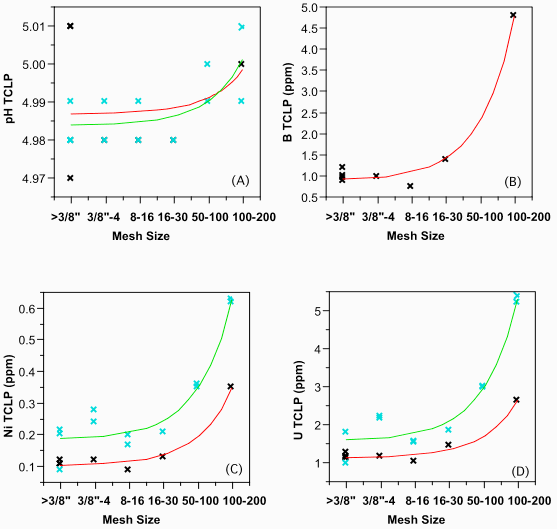
Figure 4. TCLP leaching response as a function of
mesh size for glasses MN-5 and MLSI-5 from Table IV.
Table IV. Leaching of B, Ni, and U in TCLP as a Function
of Mesh Size
|
Mesh Size (in. or sieve#) |
Mesh Size |
Final pH |
Ni, ppm by GEL |
U(ppm) by GEL |
U(ppm) by SRTC |
B, ppm |
Si, ppm |
|
|
MN-5 (or 5A) |
<3/8 inch |
<9.5 |
4.98 |
0.12 |
1.11 |
0.79 |
1.20 |
2.70 |
|
MN-5B |
<3/8 inch |
<9.5 |
4.97 |
0.11 |
1.14 |
0.73 |
0.89 |
1.60 |
|
MN-5- AL-B* |
<3/8 inch |
<9.5 |
5.01 |
0.11 |
1.16 |
0.79 |
0.97 |
1.02 |
|
MN-5-AL-A* |
<3/8 inch |
<9.5 |
5.01 |
0.11 |
1.27 |
0.88 |
1.02 |
1.29 |
|
MN-5C |
<3/8" - >4 |
<9.5->4.74 |
4.98 |
0.12 |
1.17 |
0.80 |
0.98 |
1.51 |
|
MN-5E |
<8 - >16 |
<2.36->1.18 |
4.98 |
0.09 |
1.04 |
0.66 |
0.75 |
1.35 |
|
MN-5G |
<16 - >30 |
<1.18->0.60 |
4.98 |
0.13 |
1.46 |
0.93 |
1.38 |
2.00 |
|
MN-5K |
<100 - >200 |
<0.15->0.075 |
5.00 |
0.35 |
2.65 |
2.05 |
4.79 |
4.28 |
|
MLSi-5A |
<3/8 inch |
<9.5 |
4.99 |
0.17 |
1.55 |
1.10 |
1.48 |
3.27 |
|
MLSi-5B |
<3/8 inch |
<9.5 |
4.98 |
0.22 |
1.99 |
|||
|
MLSi-5-AL-B* |
<3/8 inch |
<9.5 |
4.98 |
0.20 |
1.93 |
|||
|
MLSi-5-AL-A* |
<3/8 inch |
<9.5 |
4.98 |
0.089 |
2.10 |
1.50 |
1.83 |
3.33 |
|
MLSi-5C |
<3/8 - >4 |
<9.5->4.74 |
4.99 |
0.28 |
2.23 |
|||
|
MLSi-5D |
<3/8 - >4 |
<9.5->4.74 |
4.99 |
0.24 |
2.16 |
|||
|
MLSi-5E |
<8 - >16 |
<2.36->1.18 |
4.98 |
0.20 |
1.53 |
|||
|
MLSi-5F |
<8 - >16 |
<2.36->1.18 |
4.98 |
0.17 |
1.57 |
|||
|
MLSi-5G |
<16 - >30 |
<1.18->0.60 |
4.99 |
0.21 |
1.85 |
|||
|
MLSi-5I |
<50 - >100 |
<0.30 - >0.15 |
5.00 |
0.36 |
3.02 |
|||
|
MLSi-5J |
<50 - >100 |
<0.30 - >0.15 |
4.99 |
0.35 |
2.99 |
|||
|
MLSi-5K |
<100 - >200 |
<0.15->0.075 |
5.01 |
0.62 |
5.23 |
|||
|
MLSi-5L |
<100 - >200 |
<0.15->0.075 |
5.01 |
0.63 |
5.41 |
3.95 |
* small chunks of Al(OH)3
References